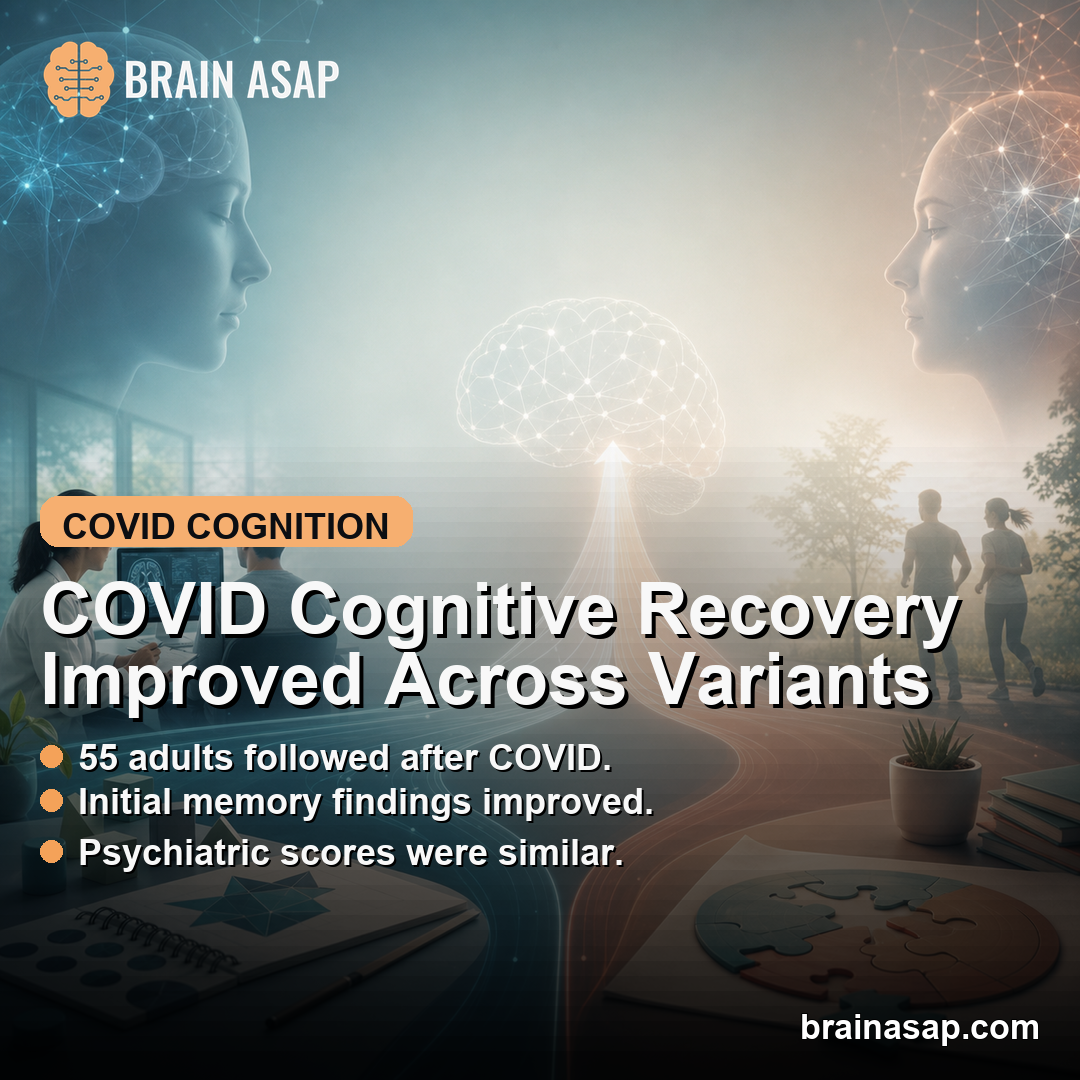
TL;DR: A 2026 study in Neuropsychiatric Disease and Treatment followed 55 adults after mild-to-moderate COVID-19 and found that neurocognitive test performance improved over time after both Alpha/Delta-era and Omicron-era infections.
Key Findings
- 55-person longitudinal sample: Researchers compared 28 Alpha/Delta-era participants with 27 Omicron-era participants after mild-to-moderate COVID-19.
- Initial cognitive findings: About half of each group had at least mild neuropsychological impairment at the first visit.
- Memory and speed signals: Both groups scored below norms on immediate memory, while the Omicron group also scored lower on Trail Making Test Part A, a processing-speed and attention task.
- Follow-up recovery: At the second visit, no neuropsychological test score in either group remained significantly below population norms.
- Psychiatric symptoms: Depression, anxiety, PTSD, and fatigue measures did not significantly differ between the Alpha/Delta and Omicron groups.
Source: Neuropsychiatric Disease and Treatment (2026) | Lynch et al.
Post-acute sequelae of COVID-19 (PASC), often called Long COVID, can include cognitive complaints, fatigue, depression, anxiety, and post-traumatic stress symptoms after the acute infection has passed.
The Omicron era raised a practical question for clinicians and patients: did later, generally less severe variants leave the same neuropsychiatric pattern as earlier Alpha and Delta infections?
Researchers studied that question with in-person neuropsychological testing rather than brief screening alone. Their sample was small, but the longitudinal design gives a clearer view of change over time than a single questionnaire snapshot.
Researchers Compared Alpha/Delta and Omicron Recovery
The study included 55 adults who had recovered from mild-to-moderate COVID-19. None were hospitalized, and clinical PASC referrals were excluded to reduce referral bias.
Participants were split by infection period:
- Alpha/Delta group: 28 adults infected between December 2020 and November 2021.
- Omicron group: 27 adults infected between February and May 2022.
- Follow-up sample: 27 Alpha/Delta participants and 21 Omicron participants returned for a second assessment.
Researchers measured neuropsychological performance across memory, attention, processing speed, executive function, and language. The battery included the Repeatable Battery for the Assessment of Neuropsychological Status (RBANS), Trail Making Test Parts A and B, verbal fluency, and the Stroop Color-Word Test.
Psychiatric and fatigue measures included the Patient Health Questionnaire-9 (PHQ-9) for depression symptoms, Generalized Anxiety Disorder-7 (GAD-7) for anxiety symptoms, the PTSD Checklist for DSM-5 (PCL-5), and the Chalder Fatigue Scale.
The two groups were not identical. The Alpha/Delta group had more medical comorbidities and reported more severe acute COVID-19 symptoms, with a mean acute severity score of 13.7 versus 10.6 in the Omicron group.
Initial Testing Found Mild Cognitive Impairment in Both Groups
At the first assessment, cognitive impairment was common but usually mild. In the Alpha/Delta group, 46.4% had some neuropsychological test impairment. In the Omicron group, the comparable figure was 55.5%.
Both groups showed one shared test-level finding. Average RBANS Immediate Memory scores were significantly below population-based norms in the Alpha/Delta group and the Omicron group.
Immediate memory on RBANS reflects short-term learning of new verbal or visual material. In this study, lower immediate-memory performance did not mean broad dementia-like impairment; other cognitive domains were mostly near expected ranges.
The Omicron group also scored lower than norms on Trail Making Test Part A (TMT-A), a timed measure of visual scanning, processing speed, and simple attention.
- Alpha/Delta first visit: RBANS Immediate Memory was below norms; visuospatial/constructional scores were above norms.
- Omicron first visit: RBANS Immediate Memory and TMT-A were below norms.
- Other domains: delayed memory, complex attention, language, and executive measures did not show the same broad deficit pattern.
The pattern supports a narrow interpretation. Mild post-COVID cognitive inefficiency appeared in both variant periods, but the study did not show a large, variant-specific collapse across the whole testing battery.
Follow-Up Testing Showed Better Cognitive Scores
Follow-up happened months later. The Alpha/Delta group returned at an average of 380.7 days after acute infection, while the Omicron group returned at an average of 275.0 days.
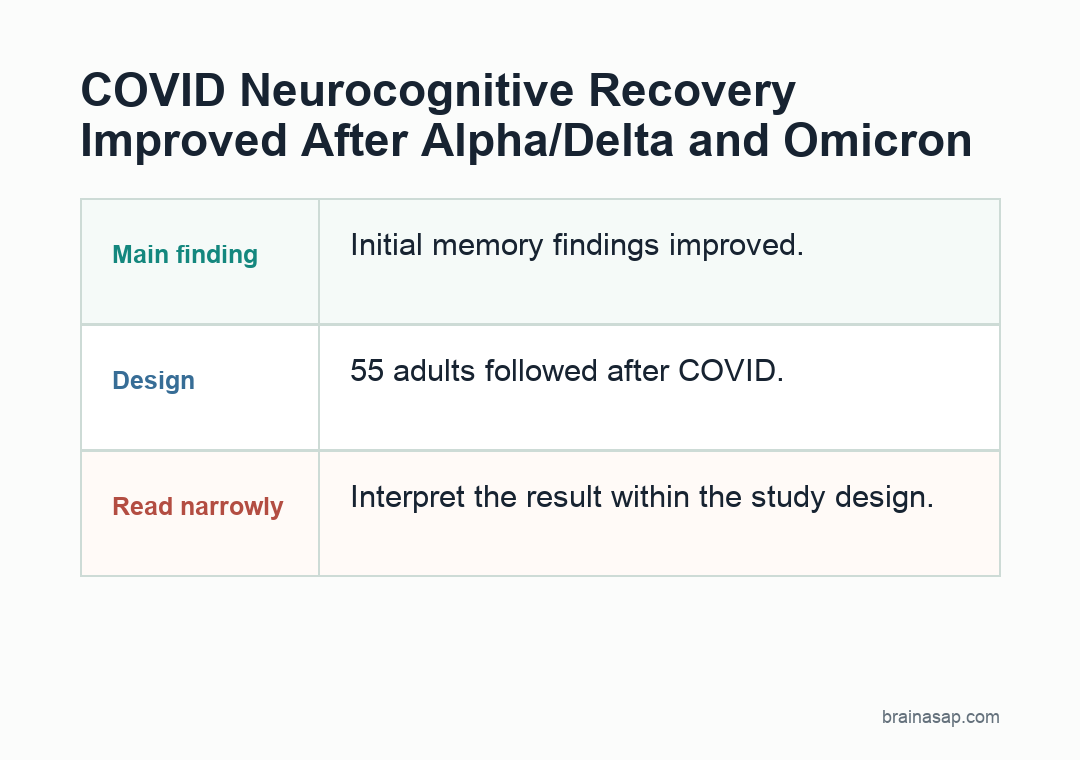
By that second visit, the main result was improvement. No neuropsychological test score in either group remained significantly below normative values.
Classification-based impairment also declined. The share with no impairment increased from 53.6% to 59.3% in the Alpha/Delta group and from 44.4% to 66.7% in the Omicron group.
- Alpha/Delta follow-up: 10 participants remained in the low range, and 1 remained in the extremely low range.
- Omicron follow-up: 7 participants remained in the low range, and none remained in the extremely low range.
- No decline signal: researchers reported that no participant showed cognitive decline over time.
A model found one time-related interaction for RBANS Delayed Memory, with greater improvement in the Alpha/Delta group. Researchers treated that result cautiously because the sample was limited and the broader testing pattern did not show many variant-by-time effects.
The practical takeaway is reassuring but bounded. In this community-recruited sample, cognitive recovery was the dominant trajectory after mild-to-moderate infection.
Depression, Anxiety, PTSD, and Fatigue Were Similar Across Variants
Psychiatric measures did not separate the Alpha/Delta and Omicron groups in a statistically significant way. Mean scores for depression, anxiety, PTSD, and fatigue were generally in the non-clinical range at the first visit and follow-up.
At the first visit, clinically significant depressive symptoms appeared in 21.4% of the Alpha/Delta group and 14.8% of the Omicron group. Clinically significant anxiety showed the same percentages.
Fatigue showed a numerical difference at the first visit, but it did not reach statistical significance. Clinically significant fatigue was reported by 28.6% of the Alpha/Delta group and 11.1% of the Omicron group.
- Depression screen: PHQ-9 scores did not significantly differ between variant groups.
- Anxiety screen: GAD-7 scores were similar between groups.
- PTSD and fatigue: PCL-5 and Chalder Fatigue Scale results also did not show significant variant-group differences.
The psychiatric similarity is notable because the Alpha/Delta era involved more severe acute illness, fewer treatment options, less vaccination availability, and heavier pandemic stress. The absence of large psychiatric differences may reflect the study’s relatively mild illness profile and exclusion of people seeking specialized PASC care.
The Recovery Finding Applies to a Narrow COVID Sample
The study should not be read as proof that Long COVID cognitive symptoms are never persistent. The sample was modest, mostly White and female, and limited to adults with mild-to-moderate infections who were not hospitalized.
COVID-19 variant was inferred from timing rather than confirmed by viral sequencing. Vaccination status also differed by era because vaccines and treatments were not equally available during the Alpha/Delta and Omicron recruitment windows.
Psychiatric diagnoses were not established through structured clinical interviews, and multiple statistical comparisons increase the chance of isolated false-positive findings.
Still, the design has strengths that matter for interpretation:
- In-person testing: researchers used a broader neuropsychological battery instead of relying only on screening tools or online surveys.
- Same framework: both variant-era groups were assessed with a consistent study approach.
- Longitudinal follow-up: the second visit showed whether test performance worsened, persisted, or improved.
Within those boundaries, the finding stays specific. After mild-to-moderate COVID-19, both Alpha/Delta-era and Omicron-era participants showed mild initial cognitive findings, similar psychiatric symptom levels, and improved neuropsychological performance over time.
Citation: DOI: 10.2147/NDT.S594322. Lynch et al. Neurocognitive and psychiatric outcomes following mild to moderate COVID-19: a longitudinal comparison of Alpha/Delta and Omicron variants. Neuropsychiatric Disease and Treatment. 2026;22:594322.
Study Design: Longitudinal comparison of adults assessed after mild-to-moderate COVID-19 during Alpha/Delta-era and Omicron-era infection periods.
Sample Size: 55 adults at the first visit; 48 returned for follow-up, including 27 Alpha/Delta participants and 21 Omicron participants.
Key Statistic: At follow-up, no neuropsychological test score in either variant-era group remained significantly below population norms, and no participant showed cognitive decline over time.
Caveat: The sample was small and demographically limited, and variant status was inferred from calendar timing rather than viral sequencing.