TL;DR: A 2026 modeling study in Journal of Mathematical Biology found that delayed unfolded protein response (UPR), a cellular stress program that slows protein production, could make toxic prion protein either die out, persist, or oscillate as it spreads through a brain-connectome model.
Key Findings
- The model tracked PrPC and PrPSc: Researchers modeled normal cellular prion protein and its toxic misfolded form, scrapie prion protein.
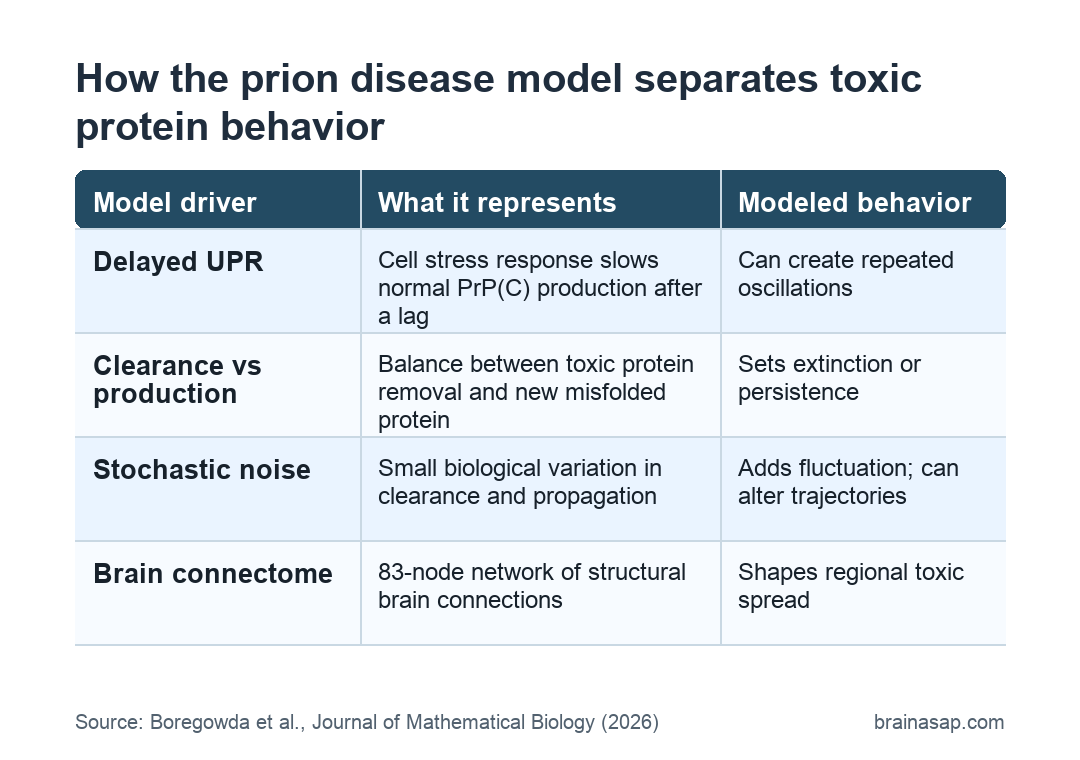
- Delayed UPR changed the dynamics: When the cellular stress response acted after a time lag, the deterministic model could shift into sustained oscillations.
- Clearance versus production set the threshold: Toxic protein persisted when modeled production outweighed clearance, but extinction became possible when clearance dominated or noise disrupted growth.
- The connectome model used 83 brain nodes: A reduced structural brain network represented toxic protein movement through anatomical connections.
- Sensitivity analysis centered on day 33: Mean toxic burden at 33 days post-inoculation was most affected by protein clearance, conversion, and production parameters.
Source: Journal of Mathematical Biology (2026) | Boregowda et al.
Prion diseases are rare neurodegenerative disorders in which normal cellular prion protein, written as PrPC, can be converted into a misfolded toxic form called PrPSc. Once enough misfolded protein accumulates, it can stress neurons and help convert more normal protein into the toxic form.
The study was not a patient trial or a biomarker study. It was a mathematical modeling paper asking which conditions could make toxic prion protein fade out, remain present, or fluctuate over time as it moves through brain connections.
Delayed UPR Was Added to a Prion Protein Model
Researchers built on a heterodimer model, which treats toxic PrPSc as interacting with normal PrPC and recruiting it into the misfolded state. The key biological addition was the unfolded protein response, or UPR.
UPR is a cellular stress response triggered when misfolded proteins build up in the endoplasmic reticulum. In this model, UPR reduced production of normal PrPC after a time delay, because cells need time to detect stress, activate signaling, and change protein synthesis.
The simplified single-region model had several moving parts:
- Normal protein production: PrPC was produced by neurons, then reduced by delayed UPR feedback.
- Toxic conversion: PrPSc recruited PrPC into the misfolded state.
- Protein clearance: Both protein forms were cleared, with PrPSc cleared more slowly.
- Random fluctuation: Stochastic noise represented small biological variability in protein clearance.
That structure let the researchers test a direct question: under what parameter regimes does toxic protein remain mathematically stable, disappear, or generate repeated waves?
Clearance Dominated Extinction and Persistence Thresholds
The central threshold came from zeta, a dimensionless parameter tied to the reciprocal of the average number of toxic PrPSc particles generated from one PrPSc particle in a susceptible protein population. In plain terms, zeta summarizes how strongly clearance counters toxic protein production.
When modeled clearance was high enough relative to production, toxic protein moved toward extinction. When production and recruitment outweighed clearance, toxic protein could persist at a positive level.
The stochastic version added an important caveat. Random biological fluctuation could still push the system toward extinction even when deterministic production looked strong enough to maintain toxic protein.
Delayed UPR Created Oscillations in the Deterministic Model
The most readable result was the delay finding. When the UPR response acted after a sufficient lag, the deterministic delayed model crossed a Hopf bifurcation, which means a stable level can shift into sustained oscillation.
One numerical example used zeta = 0.21 and eta = 10. Under those settings, the model calculated a critical delay of about 5.5064 dimensionless time units.
Above that delay, toxic protein oscillations persisted. Below it, the oscillations faded.
The biological interpretation is straightforward:
- Toxic protein rises: PrPSc accumulates around neurons and triggers stress signaling.
- UPR slows production: The delayed response reduces PrPC synthesis, limiting new toxic conversion.
- Toxic load falls: Clearance and reduced substrate lower PrPSc.
- Production resumes: As stress declines, normal protein production returns and the cycle can restart.
Small stochastic perturbations, such as sigma = 0.01 or sigma = 0.05 in the simulations, preserved behavior similar to the deterministic model. Larger noise made the oscillations less regular.
An 83-Node Brain Connectome Simulated Spatial Spread
The researchers also extended the model across a structural brain network. The connectome began from 1,015 nodes and 37,477 weighted edges, then was mapped into a reduced network with 83 nodes and 1,130 edges.
Each node represented a brain region, and each edge represented a structural connection. Toxic PrPSc was allowed to move along those connections, while normal PrPC was treated as membrane-bound and not transported between regions.
For visualization, the researchers grouped the 83 nodes into seven major anatomical regions:
- Temporal region
- Parietal region
- Frontal region
- Basal ganglia
- Occipital region
- Limbic region
- Brain stem
The connectome simulations suggested that network structure shaped the overall spread pattern, while stochastic fluctuation changed the exact timing and regional trajectories. That is a plausible modeling explanation for why similar biological mechanisms can still produce variable progression patterns.
Sensitivity Analysis Pointed to Clearance and Conversion
The paper measured mean toxic protein burden across the 83-node model at 33 days post-inoculation, a time point chosen because prior animal work reported observable clinical symptoms around that point.
In the baseline simulation, mean toxic burden was 9.20 x 10⁻⁷ g/cm3. Changing several parameters by 10% shifted that value in expected directions.
- Higher PrPC clearance: Increasing alpha by 10% lowered mean toxic burden by 5.6%.
- Higher PrPSc clearance: Increasing beta by 10% lowered burden by 5.3%.
- Lower conversion rate: Reducing gamma by 10% lowered burden by 6.7%.
- Higher production rate: Increasing normal-protein production A by 10% raised burden by 4.3%.
Delay time, noise intensity, UPR threshold, and transport velocity had smaller effects in that sensitivity table. Those parameters may still matter in other model outputs.
The specific output metric at day 33 was most sensitive to protein production, clearance, and conversion.
The Main Limit Is That This Is a Model, Not Disease Measurement
The evidence supports a narrow interpretation. The study gives mathematical conditions for toxic protein behavior in a prion-disease model.
It does not show that the same thresholds can diagnose, predict, or treat human prion disease.
Several assumptions matter. The model did not include oligomers, fibrils, or higher-order protein structures. Some biological parameters were loose estimates.
The full stability and Hopf bifurcation analysis for the connectome-based delayed stochastic system was left for future work.
Still, the modeling framework makes a useful point for neurodegeneration: protein production, clearance, delayed stress responses, random biological fluctuation, and brain connectivity can be represented together instead of treated as separate explanations.
Citation: DOI: 10.1007/s00285-026-02390-6. Boregowda et al. Theory and simulations of delayed stochastic and deterministic models of prion diseases. Journal of Mathematical Biology. 2026;92:75.
Study Design: Mathematical modeling study using delayed deterministic, stochastic, and connectome-based models of prion protein spread.
Sample/Model: Single-region toxic-protein equations plus an 83-node reduced structural brain-connectome simulation.
Key Statistic: In one delayed deterministic example, zeta = 0.21 and eta = 10 produced a Hopf bifurcation at a critical delay of about 5.5064 dimensionless time units.
Caveat: The work is a theoretical simulation study with estimated parameters, not a clinical validation study in patients.