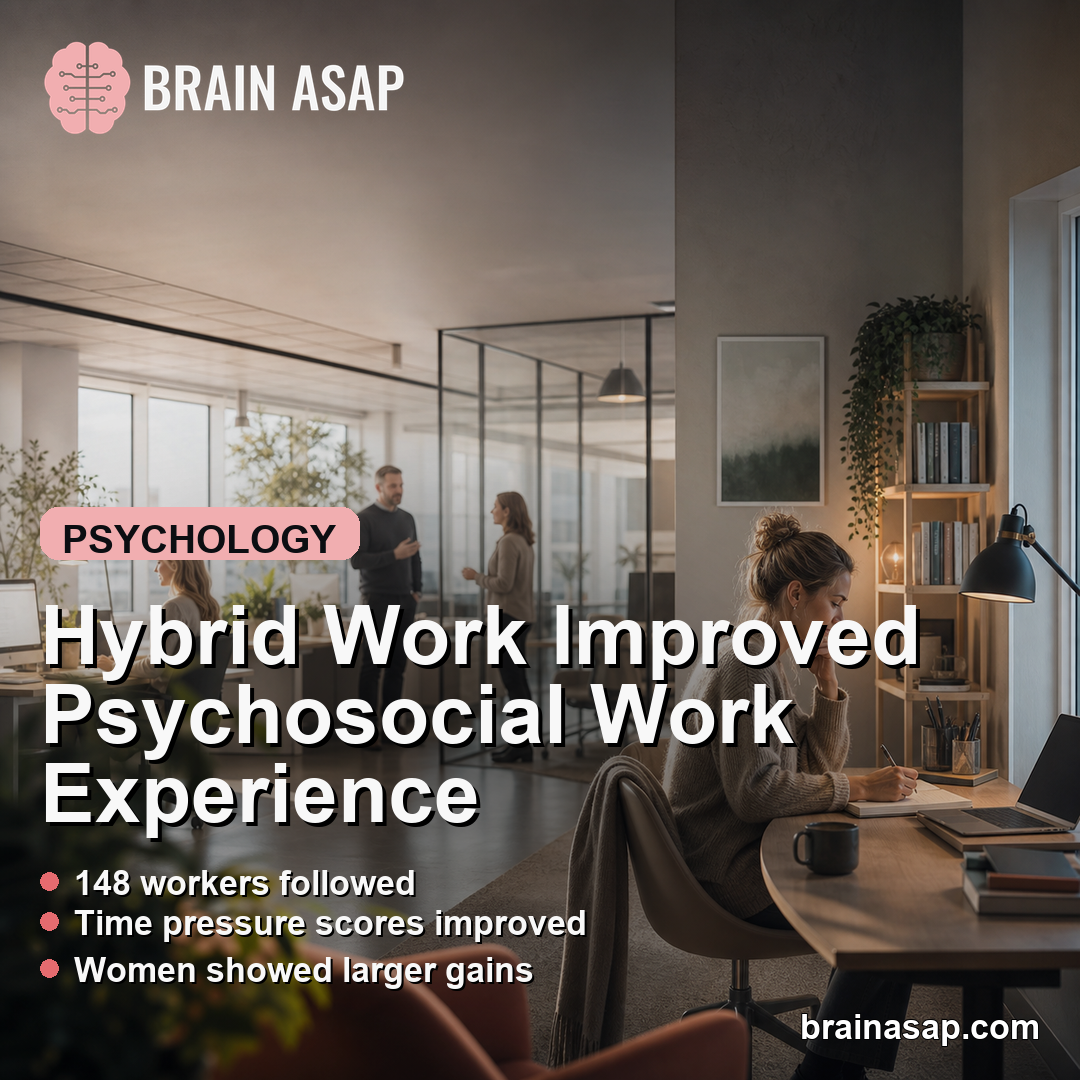
TL;DR: A longitudinal study in BMC Public Health followed Swedish municipal office workers before and after hybrid work became routine and found improved psychosocial work-experience scores, especially for time pressure, autonomy, leadership access, and women workers.
Key Findings
- Work experience improved: Total Work Experience Measurement Scale scores increased after the transition to hybrid work.
- Time pressure shifted: Every time-experience item improved, including enough time to finish work and less work beyond scheduled hours.
- Autonomy gained ground: Workers reported more control over work pace and broader improvements in the autonomy dimension.
- Leadership access improved: The strongest leadership item was manager availability when workers needed support.
- Sex differences mattered: Women showed significant improvement over time, while men’s work-experience scores did not change significantly.
Source line: Researchers compared 2017 and 2023 survey data from 148 white-collar municipal workers using the Work Experience Measurement Scale, or WEMS.
WEMS captures psychosocial work conditions such as support, time, autonomy, management, and internal work experience.
Hybrid work means splitting work between office and remote settings. For brain and mental-health readers, the relevant question is not whether remote work is fashionable.
The practical question is whether the arrangement changes daily stress exposure, control over tasks, manager contact, and the boundaries between work and home.
Researchers studied a Swedish municipality that had survey data from 2017, before the COVID-19 shift, and follow-up data from 2023, about 1.5 years after national work-from-home restrictions were lifted.
That timing allowed the analysis to compare the same organization before and after hybrid work became embedded rather than treating one cross-sectional snapshot as the whole answer.
Hybrid Work Was Linked to Better WEMS Scores
The main result was direct: work-experience scores improved after the transition to hybrid work. The gains were statistically significant on the total WEMS scale and in four dimensions:
- Supportive working conditions: Workers rated job happiness, feedback, and work routines more favorably.
- Time experience: Workers reported better ability to finish tasks without time pressure and stay within scheduled hours.
- Autonomy: Workers reported more control over when and how work tasks were handled.
- Leadership: Manager availability improved, suggesting remote or hybrid routines did not necessarily weaken supervisor access.
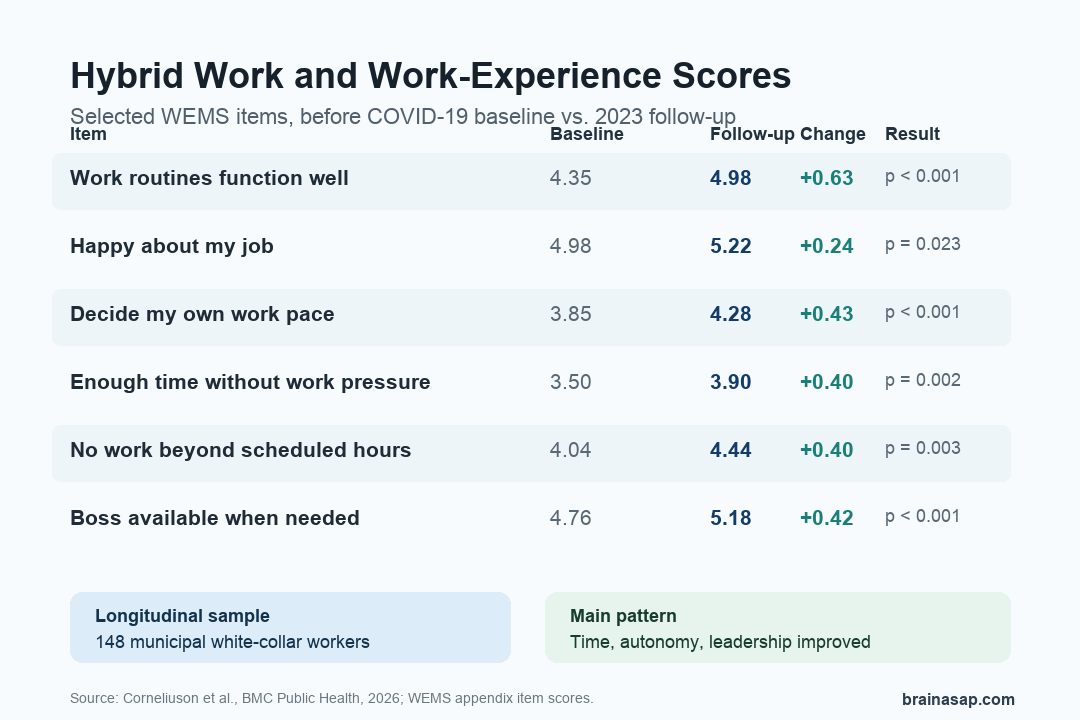
The time-experience dimension is the clearest mental-load signal. One item asked whether workers had enough time during normal hours to do the job without stress; its average score increased from 3.50 to 3.90.
Another item asked whether workers avoided working beyond scheduled hours; that score increased from 4.04 to 4.44. These are not clinical outcomes, but they speak to the daily work conditions that can shape fatigue, strain, and recovery.
Time Pressure Improved More Consistently Than Every Other Area
Not every questionnaire item changed, and the study should not be read as proof that hybrid work improves every part of work life. The strongest pattern was narrower: all three time-experience items improved.
Workers were more likely to say they had enough time, could finish tasks properly, and did not need to work more than scheduled hours.
Hybrid work is often criticized for making work sprawl across the day. In this cohort, the measured pattern went the other way.
Researchers interpreted the findings as evidence that hybrid work can improve job satisfaction, time experience, and employee well-being without requiring a simple return-to-office explanation.
- Work routines: The item “I think the work routines function well” increased from 4.35 to 4.98.
- Work pace: The item “I decide my own work pace” increased from 3.85 to 4.28.
- Manager access: The item “My boss is available when I need him/her” increased from 4.76 to 5.18.
The leadership result is useful because hybrid work can create a management tradeoff: fewer spontaneous office encounters but more intentional check-ins. In this organization, workers rated manager availability higher at follow-up, which suggests the hybrid model did not automatically mean isolation from supervisors.
Women Showed Larger Work-Experience Gains
The strongest factor associated with change was sex. Women’s work-experience scores improved significantly over time, while men’s scores did not.
The study does not identify the mechanism behind that difference, but it gives a reason to treat hybrid work as a psychosocial intervention that may affect groups differently.
The researchers also examined age, managerial position, children at home, work tasks, autonomy to choose work location, and time spent at the office. Those factors did not explain the change as strongly as sex did in the reported univariate models.
- Do not overgeneralize: The sample came from one Swedish municipal organization, not from every job type or country.
- Do not assume causality: The design was longitudinal, but it was not a randomized hybrid-work trial.
- Do study mechanisms: Future research needs to clarify whether flexibility, reduced commuting, task control, household responsibilities, or manager practices drove the sex difference.
Time Pressure and Autonomy Are the Mental-Load Link
Psychosocial work conditions are not abstract HR vocabulary. They include concrete daily exposures: time pressure, control over work pace, support from colleagues, manager access, and whether work can be completed inside normal hours.
These conditions can influence stress, burnout risk, sleep timing, family conflict, and the ability to recover after work.
For employers, the result supports a practical interpretation. Hybrid work should be designed around work routines, manager availability, and boundary protection, not treated as a binary office-versus-home debate.
For workers, the study suggests that flexibility can align with better psychosocial experience when the organization maintains support and clear routines.
- Best-supported takeaway: Hybrid work was associated with improved self-rated work experience in this organization.
- Most concrete signal: Time-experience items improved consistently from baseline to follow-up.
- Main boundary: The study measured one workplace context and did not test mental-health diagnoses or biological stress markers.
Citation: DOI: 10.1186/s12889-026-27487-x. Corneliuson et al. Psychosocial work experience after implementing hybrid work: a longitudinal study. BMC Public Health. 2026;26:1359.
Study Design: Longitudinal questionnaire study comparing pre-pandemic baseline data with follow-up data after hybrid work implementation.
Sample Size: 148 white-collar workers in a medium-sized Swedish municipality.
Key Statistic: WEMS scores improved on the total scale and in supportive working conditions, time experience, autonomy, and leadership.
Caveat: Single-organization observational design, with no random assignment and no clinical mental-health outcome measure.