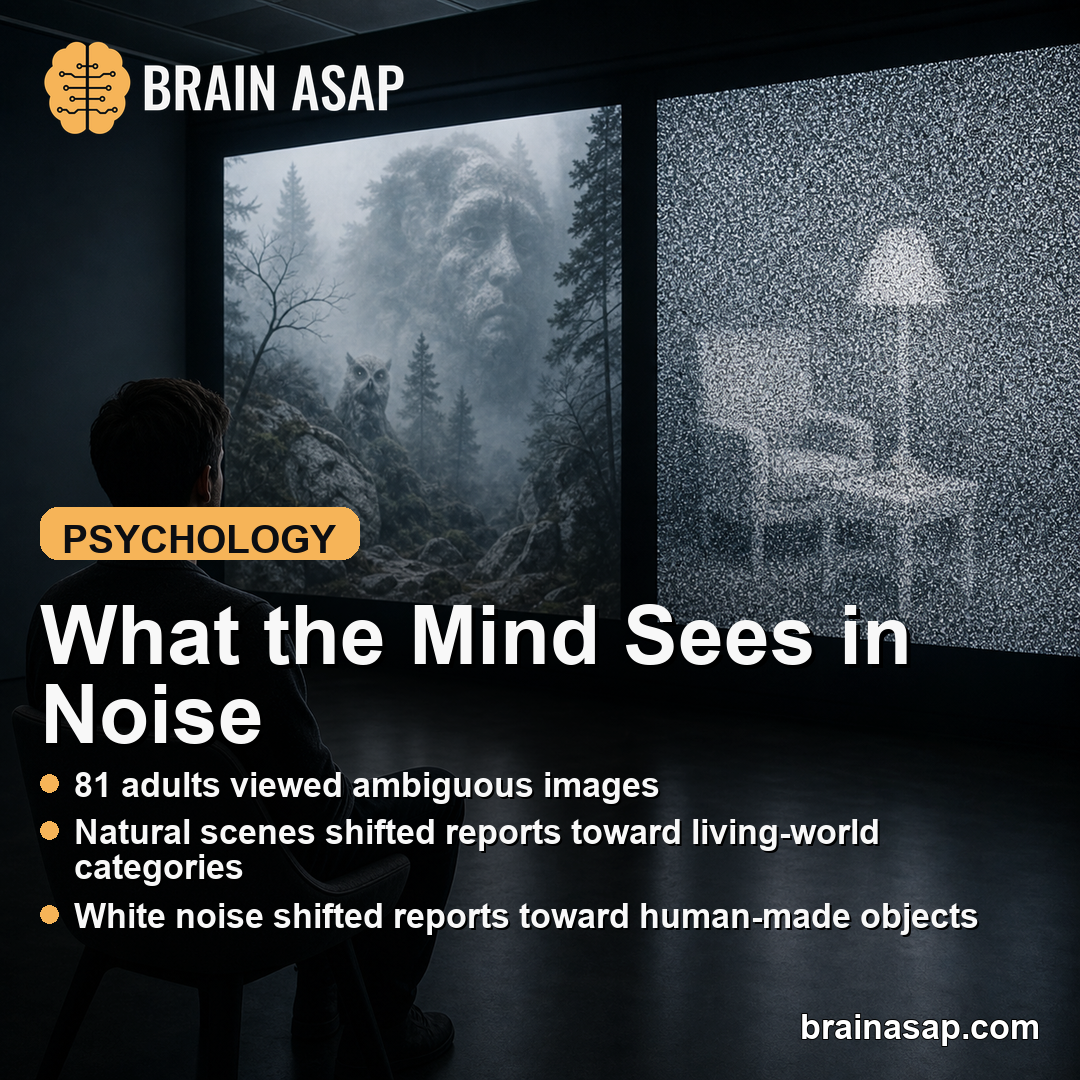
TL;DR: A 2026 Scientific Reports study found that natural images and white noise images produced similar amounts of pareidolia, but they shifted what people thought they saw.
Key Findings
- Healthy adult sample: The study included 81 participants who viewed ambiguous images and drew every illusory object, face, figure, or pattern they perceived.
- Equal quantity: The median output was 9 pareidolia per image, with no significant difference across the 16 image stimuli.
- Different content: Natural images produced more Natural World interpretations, while white noise produced more Human-Created interpretations.
- Animals dominated: Animal responses accounted for nearly 40% of all pareidolia, making them the most common category.
- Timing mattered: Human figures appeared earlier in the task, while tool-like interpretations became more common later.
Source: Scientific Reports, 2026.
Pareidolia is the perception of a meaningful pattern where none was intentionally placed, such as seeing a face in a cloud or an animal shape in a rock. The new study asked a narrower question: does the type of ambiguity change what the mind supplies?
Researchers compared two image environments. Natural images had real-world structure, while white noise images had far less organized visual content.
Participants were not told to look specifically for faces. They were asked to let their imagination run and draw what they saw.
Natural Images and White Noise Produced Similar Pareidolia Counts
The study included 81 healthy participants, with an average age of about 50 years. Each person viewed a randomized series containing three natural images and one white noise image, with each image shown for 5 minutes.
During each trial, participants used a digital pen to mark the perceived shapes and verbally identify them. Those responses were later translated, transcribed, and grouped into semantic categories.
- Task duration: Each image stayed on screen for 5 minutes, giving people time for both immediate and later interpretations.
- Open instruction: Participants could report any perceived pattern, not only faces.
- Response coding: Researchers classified responses into 19 semantic categories, then grouped them into broader clusters.
The number of reports did not depend strongly on image type. Participants produced a median of 9 pareidolia per image, and the full range was wide, from 2 to 42.
A Kruskal-Wallis test across the 16 images was not significant (p = 0.149).
The main result was not that one image type made people see more things. The image type changed the kind of thing people reported.
Image Type Shifted the Meaning People Gave to Ambiguous Shapes
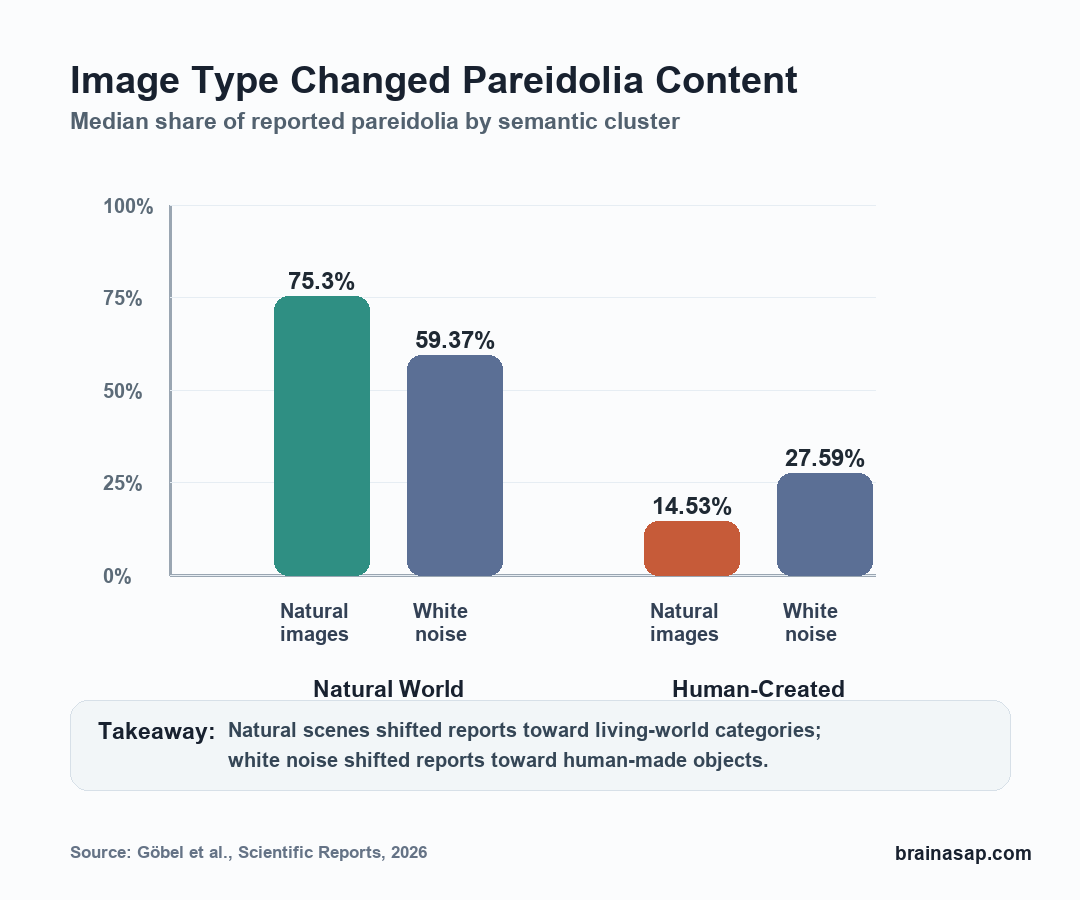
Researchers grouped the original categories into three broad clusters: Natural World, Human-Created Categories, and Abstract Concepts.
Natural World included responses such as geography, nature, animals, weather, body parts, faces, and humans. Human-Created Categories included objects such as tools, vehicles, accessories, food, architecture, and art.
The split was clear. Natural images produced a higher share of Natural World pareidolia, with a median of 75.3%, compared with 59.37% for white noise images. The difference was statistically significant (p = 0.0109).
White noise showed the opposite pattern for Human-Created Categories. Natural images had a median of 14.53% in this cluster, while white noise images reached 27.59% (p = 0.0076).
Abstract Concepts did not differ meaningfully between image types. In practical terms, the visual environment mainly pushed people toward nature-like or human-made interpretations, not toward more abstract symbols.
Animal Responses Were the Most Common Pareidolia Category
The most frequent category was animals, which accounted for nearly 40% of all reported pareidolia. The next most common categories were fantasy figures, humans, tools, human faces, and body parts.
Researchers interpreted the animal result through visual attention and evolutionary pressure. A visual system that quickly detects living things can be useful even when it sometimes over-detects them.
Seeing an animal where there is only bark or cloud texture is a low-cost error compared with missing a real animal in the environment.
- Biological salience: Animal-like shapes may receive priority because they can carry survival or social meaning.
- Perceptual grouping: Natural scenes already contain contours, textures, and partial object-like structure.
- Conceptual filling-in: White noise offers fewer real-world cues, so interpretation may depend more on memory and mental imagery.
Pareidolia is not simply irrational noise. The study presents it as a normal perception strategy: the brain resolves ambiguity by combining what is on the screen with what it has learned to expect from the world.
Human Figures Appeared Earlier While Tools Appeared Later
The researchers also looked at when different categories appeared during the 5-minute task. Human pareidolia occurred more often early in the sequence (r = -0.760, p = 0.002). Tool pareidolia increased later (r = 0.610, p = 0.021).
That timing result supports the idea that some interpretations are more immediate than others. Human-like forms may be detected quickly because they are socially relevant.
Tool-like interpretations may take more searching, comparison, and imagination.
- Early phase: Fast social or biological categories may come forward first.
- Later phase: Less obvious object categories may emerge after prolonged inspection.
- Stable categories: Animal, fantasy, face, and body-part responses did not show significant timing trends.
The study has a useful boundary. It was conducted in healthy adults, and it tested a short, structured visual task.
It does not show how pareidolia behaves in neurological disease, hallucination-prone states, or daily life.
Still, the finding clearly shows how perception and meaning interact. The same basic tendency to find patterns can produce different content depending on whether the eye starts with a structured natural scene or a nearly structureless field of noise.
Citation: DOI: 10.1038/s41598-026-47242-x. Göbel et al. Image type reveals evolutionarily shaped perceptual and conceptual mechanisms of pareidolia. Scientific Reports. 2026.
Study Design: Experimental visual-perception task comparing natural image and white noise image conditions.
Sample Size: 81 healthy adults.
Key Statistic: Natural images produced more Natural World pareidolia than white noise images (75.3% vs 59.37% median), while white noise produced more Human-Created pareidolia (27.59% vs 14.53% median).
Caveat: The task measured short-session reports in healthy participants, so it should not be treated as a clinical pareidolia test.