TL;DR: A 2026 study in BMC Psychology found high rates of depression, anxiety, and recent self-harm thoughts among international students in Germany, with acculturative stress linked to worse mental health and mindfulness, optimism, self-efficacy, acceptance, and social support linked to lower symptom burden.
Key Findings
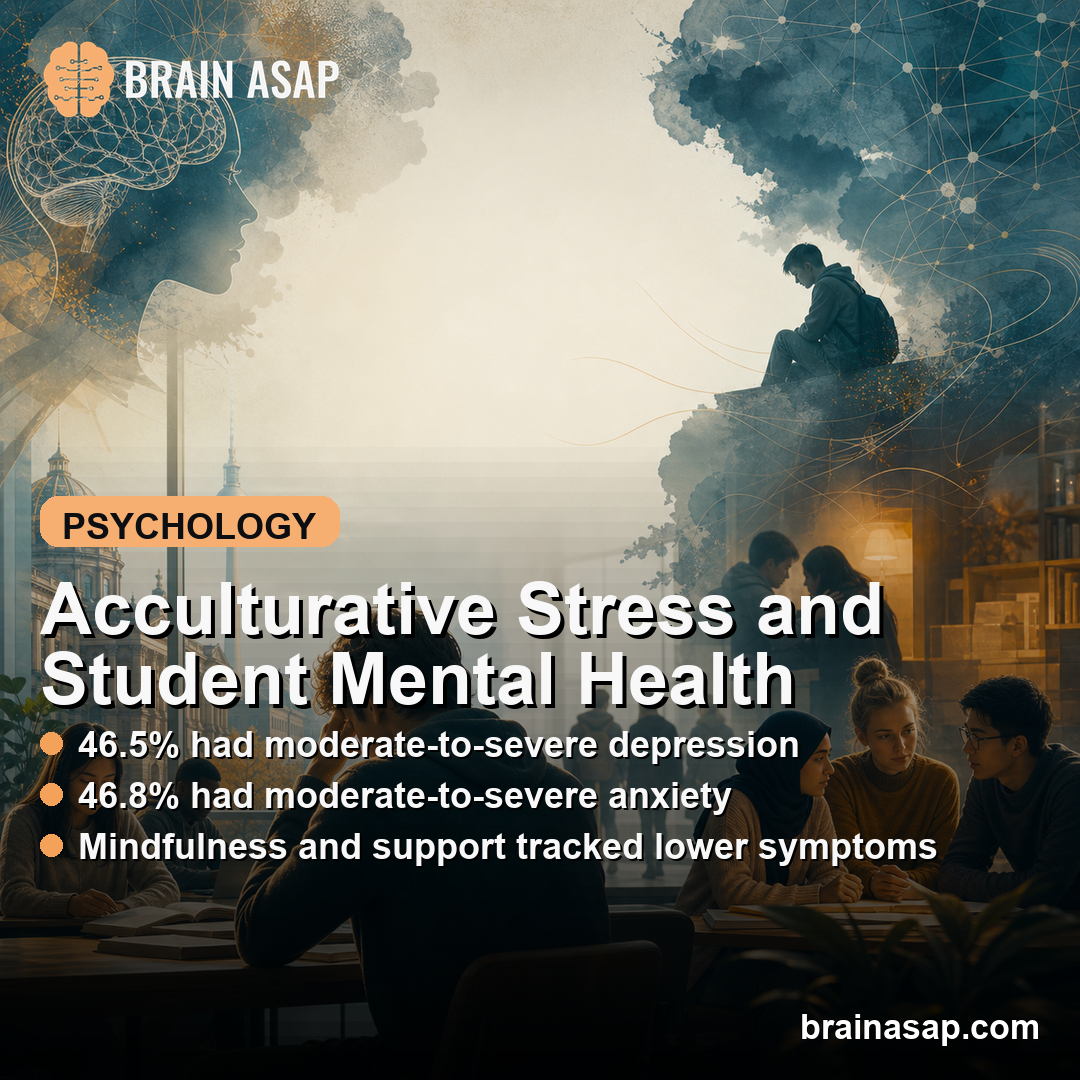
- Depression and anxiety were common: 46.5% of the 327 international students reported moderate-to-severe depressive symptoms, and 46.8% reported moderate-to-severe anxiety symptoms.
- Recent self-harm thoughts were frequent: 31.2% reported suicidal ideation or thoughts of self-harm on the PHQ-9 depression questionnaire in the prior 2 weeks.
- Acculturative stress mattered: Higher acculturative stress independently predicted higher depression and anxiety after demographics, psychological resources, and coping variables were considered.
- Protective factors differed by outcome: Mindfulness was linked to lower depression, anxiety, and acculturative stress, while support from fellow students, friends, family, and institutions showed outcome-specific associations.
- Formal care was uncommon: Only 10.9% of students with moderate-to-severe depression and/or anxiety reported receiving professional help.
Source: Karing and Idemudia studied international students in Germany using standardized mental-health and coping questionnaires.
International Students Reported High Depression and Anxiety Burden
Researchers surveyed 327 international students enrolled at German universities. The sample was young, with a mean age of 26.21 years, and most participants were graduate students.
The mental-health numbers were high for a university sample. On the Patient Health Questionnaire-9 (PHQ-9), a depression-symptom questionnaire, the mean score was 10.27, which falls in the moderate range.
On the Generalized Anxiety Disorder-7 (GAD-7), an anxiety-symptom questionnaire, the mean score was 9.39.
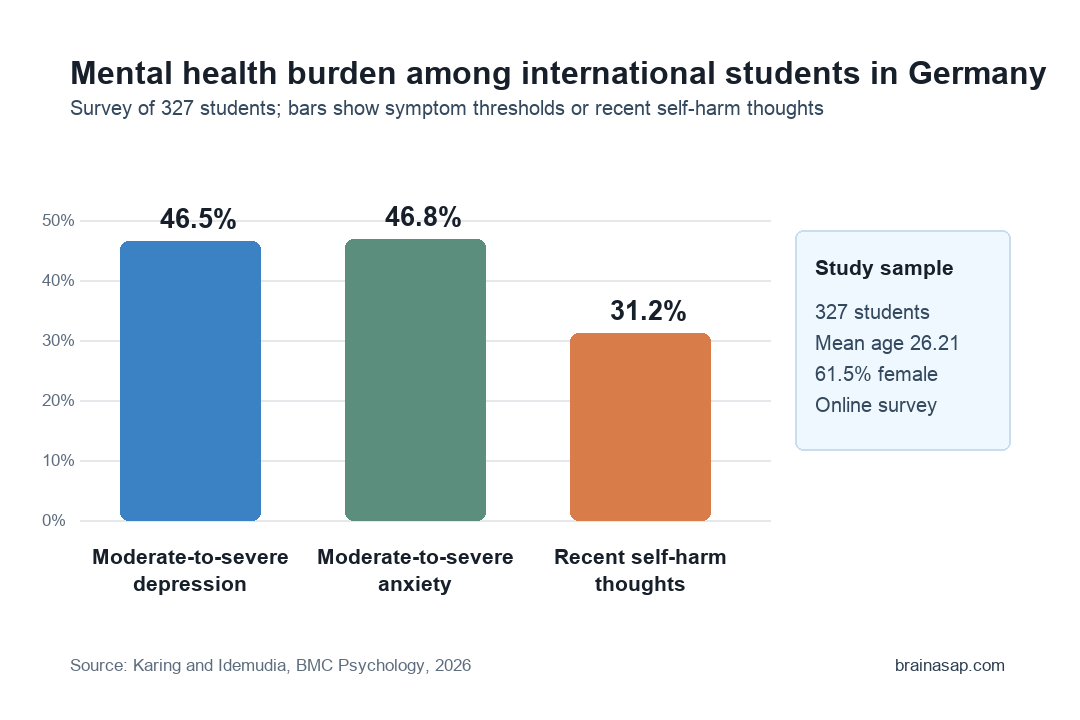
The clearest result was the share of students crossing clinically meaningful symptom thresholds:
- Moderate-to-severe depression: 46.5% of participants met that PHQ-9 range.
- Moderate-to-severe anxiety: 46.8% met that GAD-7 range.
- Recent self-harm thoughts: 31.2% endorsed suicidal ideation or thoughts of self-harm in the prior 2 weeks.
- Professional help: Only 10.9% of students with moderate-to-severe depression and/or anxiety reported receiving care such as psychotherapy.
Those figures cannot show that studying abroad caused the symptoms. The study was cross-sectional, so it measured students at one point in time.
Still, the pattern points to a service gap: many students reported substantial symptoms, while few reported professional support.
Acculturative Stress Predicted Depression and Anxiety
Acculturative stress means psychological strain tied to adapting to a different cultural, academic, social, and language environment. In this study, international students reported moderate acculturative stress on average.
Researchers used hierarchical regression models, adding predictors in blocks. The models first accounted for demographics, then psychological resources, then coping and social support.
Acculturative stress was entered last for the depression and anxiety models.
Even after those earlier variables were included, acculturative stress remained a significant predictor of both depression and anxiety.
The standardized association was β = 0.252 for depression and β = 0.208 for anxiety, with both p values below 0.001.
This separates acculturative stress from a broad “student stress” label. The analysis suggests that culture-adjustment burden predicted mental-health symptoms beyond age, gender, degree level, origin region, personal resources, coping style, and support.
Mindfulness Was Linked to Lower Symptoms Across Outcomes
The strongest broad protective pattern involved mindfulness, measured as dispositional mindful attention and awareness. Higher mindfulness was associated with lower scores across all three main outcomes:
- Depression: higher mindfulness predicted lower depressive symptoms (β = -0.251, p < 0.001).
- Anxiety: higher mindfulness predicted lower anxiety symptoms (β = -0.219, p < 0.001).
- Acculturative stress: higher mindfulness predicted lower culture-adjustment stress (β = -0.192, p < 0.001).
Optimism and self-efficacy also appeared protective, but the associations were more specific. Optimism was linked to lower depression and anxiety, while self-efficacy, confidence in handling unexpected events, was linked to lower anxiety.
The finding fits a practical reading: internal resources may help students handle uncertainty, but they are not interchangeable.
Mindful awareness, positive expectations, and confidence in coping each tracked different parts of the mental-health picture.
Acceptance and Social Support Showed Outcome-Specific Patterns
Coping style and support source mattered, but not in one simple direction. Acceptance was associated with lower anxiety, while problem-solving was not significantly associated with the main mental-health outcomes in the final models.
Problem-solving still has an obvious role. A student can solve a paperwork problem, schedule a housing appointment, or ask for class help.
For stressors with limited personal control, such as cultural adjustment and distance from home, acceptance-based coping may be more relevant to anxiety symptoms.
Different forms of support also lined up with different outcomes:
- Fellow-student support: associated with lower depression.
- Friend support: associated with lower anxiety.
- Family support: associated with lower acculturative stress.
- Institutional support: associated with lower acculturative stress.
Institutional support is especially actionable for universities. Less than half of the students agreed that they were well supported by their faculty, department, institution, or international office.
A formal support system may still miss the students who need it.
Cross-Sectional Data Limit the Causal Claim
The study should not be read as proof that mindfulness training, acceptance coaching, or institutional support would automatically lower symptoms. The data were cross-sectional, collected through an online survey, and based on self-report questionnaires.
Several design features matter for interpretation:
- No causal timing: symptom burden, coping, support, and acculturative stress were measured at the same point.
- Convenience sampling: students were recruited through university mailing lists and social media, which may not represent all international students in Germany.
- Self-report measures: PHQ-9 and GAD-7 scores are useful screening tools, but they are not clinical diagnoses.
- Service-use detail: the survey captured whether students reported professional help, not the quality, timing, or accessibility of care.
The practical takeaway is still direct. In this sample, mental-health symptoms were common, acculturative stress independently predicted symptom burden, and protective factors were not limited to individual resilience.
Student peers, friends, family, and institutions each appeared in the model in different ways.
For universities, the result supports more targeted support for international students: visible counseling access, culturally responsive services, peer connection, and clear institutional help before symptoms become severe.
Citation: DOI: 10.1186/s40359-026-04576-5. Karing and Idemudia. Acculturative stress and mental health among international students in Germany: the protective roles of mindfulness, optimism, self-efficacy and coping strategies. BMC Psychology. 2026;14:605.
Study Design: Cross-sectional online survey of international students enrolled at German universities.
Sample Size: 327 international students; mean age 26.21 years; 61.5% female.
Key Statistic: 46.5% reported moderate-to-severe depressive symptoms, 46.8% reported moderate-to-severe anxiety symptoms, and 31.2% reported recent suicidal ideation or self-harm thoughts.
Caveat: The study measured associations at one point in time, so it cannot show whether acculturative stress or protective factors caused later symptom changes.