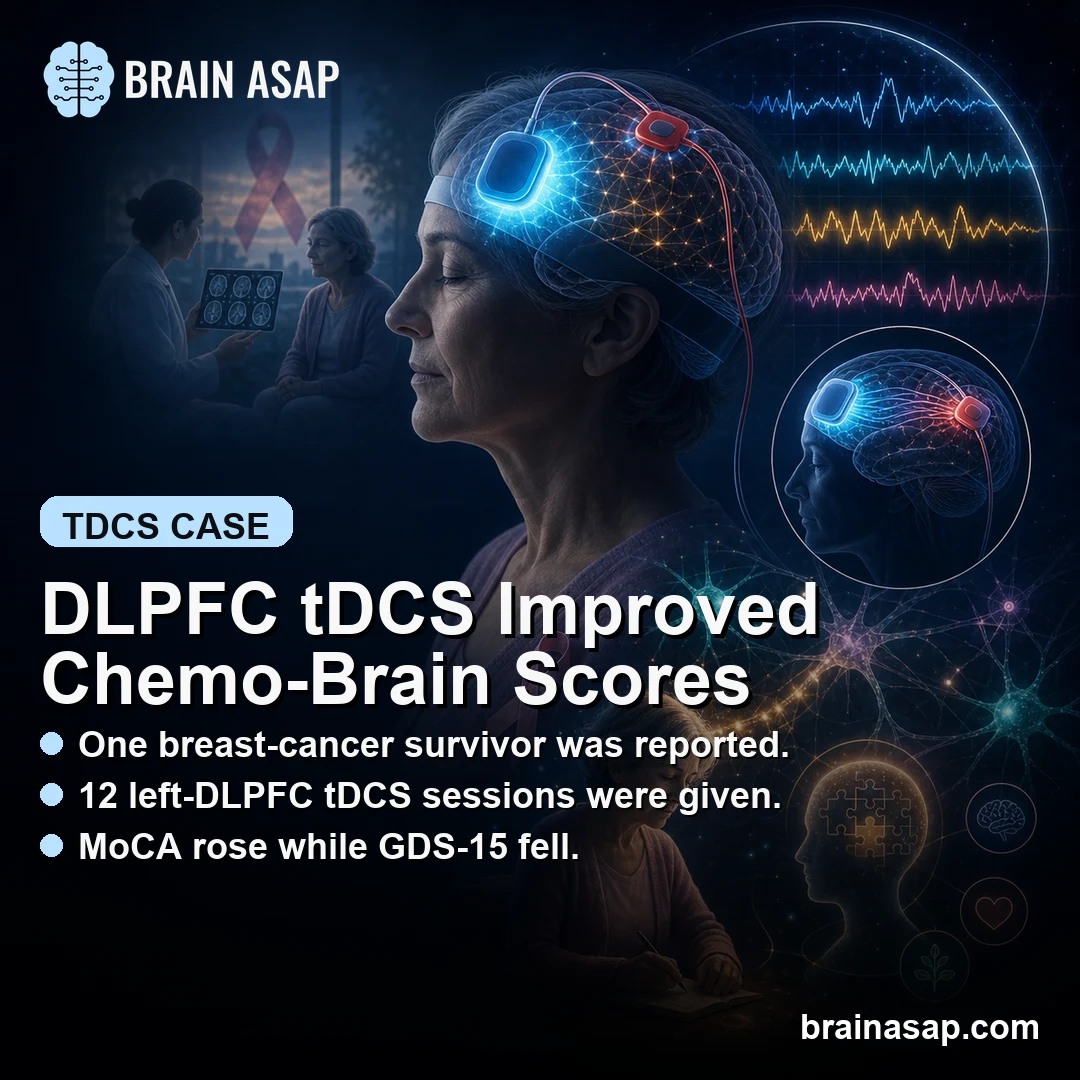
TL;DR: A 2026 study in Journal of Medical Case Reports described a 71-year-old breast-cancer survivor whose Montreal Cognitive Assessment (MoCA), a cognitive screening test, increased from 16 to 20 and whose 15-item Geriatric Depression Scale (GDS-15), a depression-symptom questionnaire, decreased from 8 to 2 after 12 sessions of left DLPFC, a prefrontal executive-control region, transcranial direct current stimulation.
Key Findings
- One breast-cancer survivor: The case involved a 71-year-old Brazilian woman with cognitive complaints after chemotherapy and hormone therapy for luminal A breast cancer.
- 12 tDCS sessions: Researchers applied 2 mA anodal transcranial direct current stimulation over the left dorsolateral prefrontal cortex three times weekly for 4 weeks.
- MoCA cognitive screening improved: Montreal Cognitive Assessment score increased from 16 before stimulation to 20 after the protocol.
- GDS-15 depression screening decreased: The 15-item Geriatric Depression Scale score decreased from 8 to 2, while the patient reported no psychiatric treatment or antidepressant change during the protocol.
- Verbal fluency worsened: Animal naming score decreased from 7 to 5, so cognitive improvement was not uniform across tests.
Source: Journal of Medical Case Reports (2026) | Alexandrino et al.
tDCS Was Tested for Chemo-Brain in One Breast-Cancer Survivor
Transcranial direct current stimulation, or tDCS, is a noninvasive brain-stimulation method that applies a weak electrical current through scalp electrodes.
In this case report, researchers used it to target the left dorsolateral prefrontal cortex, a frontal brain region involved in attention, working memory, executive control, and mood regulation.
The patient was a 71-year-old breast-cancer survivor who reported memory-related cognitive problems after adjuvant chemotherapy and hormone therapy.
Her cancer history included invasive ductal carcinoma, radical mastectomy, docetaxel plus cyclophosphamide chemotherapy, and daily letrozole hormone therapy.
Researchers ruled out brain metastases before the intervention.
They also discussed toxic leukoencephalopathy as a differential diagnosis but noted that the chemotherapy regimen was not one of the regimens most commonly linked to that complication.
Clinical context: Cancer-related cognitive impairment, often called chemo-brain or chemo-fog, can involve memory, attention, processing speed, fatigue, executive function, and daily work capacity.
In this case, the post-treatment symptom profile crossed several domains: memory complaints, low cognitive screening scores, depressive symptoms, low physical-activity level, and measurable prefrontal EEG activity before stimulation.
This neurocognitive and mood-symptom overlap is common in survivorship care.
Cancer treatment, aging, sleep disruption, mood symptoms, inactivity, endocrine therapy, and ordinary medical comorbidities can all push on cognition at the same time, which is why controlled trials need careful comparison groups.
Left DLPFC Stimulation Used 2 mA for 12 Sessions
The stimulation protocol was straightforward. Researchers placed the active electrode over the left dorsolateral prefrontal cortex at F3 and the passive electrode over the contralateral deltoid muscle.
The patient received 2 milliamps for 30 minutes per session. Sessions occurred three times per week on alternate days, for a total of 12 sessions across 4 weeks.
Before and after stimulation, researchers assessed global cognition, depression symptoms, verbal fluency, prefrontal EEG activity, physical activity, and total oxidative capacity.
The cognitive measures included the Mini-Mental State Examination, or MMSE, and the Montreal Cognitive Assessment, while depressive symptoms were measured with the 15-item Geriatric Depression Scale.
At baseline, the patient scored 21 on the MMSE and 16 on the MoCA. Clinicians considered the profile consistent with mild cognitive impairment. She also scored 8 on GDS-15, consistent with depressive symptoms.
The case tracked three main outcome layers:
- Cognition: MMSE, MoCA, and animal-naming verbal fluency.
- Mood: GDS-15 depression screening before and after stimulation.
- Physiology: prefrontal EEG spectral power and total oxidative capacity.
The MoCA is more sensitive than the MMSE to some executive and attention problems, which may explain why the MoCA shifted while the MMSE stayed flat.
That does not make the MoCA change definitive, but it makes the pattern plausible for a prefrontal stimulation protocol.
MoCA Improved While Verbal Fluency Declined
The clearest cognitive change was on the MoCA. After stimulation, the score increased from 16 to 20. The MMSE stayed at 21, which means the broader screening score did not show the same movement.
Verbal fluency moved in the opposite direction.
The animal-naming score decreased from 7 to 5.
A stronger treatment pattern would show improvement across related cognitive tasks, not one screening score improving while another language-executive task worsened.
Depression symptoms showed a larger directional change.
GDS-15 decreased from 8 to 2.
The report notes that the patient did not undergo psychiatric or psychological follow-up and did not use a pharmacological or non-pharmacological depression treatment during the protocol.
That observation is clinically relevant, but it still cannot isolate tDCS as the cause.
A single case has no sham condition, no blinded comparison, and no way to separate stimulation from expectancy, repeated testing, time, attention from the study team, or natural symptom fluctuation.
Prefrontal EEG Power Increased After Stimulation
The report adds a brain-activity measure, which is one reason the case is more informative than a symptom-only note.
Researchers recorded resting EEG from prefrontal channels and examined theta, alpha, low-beta, and upper-beta spectral power with eyes open and eyes closed.
After the tDCS protocol, spectral power increased across all listed frequency bands in both recording conditions.
For example, eyes-open theta increased from 2.12 to 5.77, and eyes-open alpha increased from 1.11 to 3.77 in the descriptive table.
Researchers interpreted the alpha and beta changes as consistent with cognitive improvement and discussed frontal theta in relation to depression.
The measured direction fits the clinical scores, but the EEG analysis remains descriptive.
It does not prove a specific neural mechanism for the symptom changes.
Total oxidative capacity also increased slightly, from 62.47 to 64.85 mmol ET/L.
Because the patient remained insufficiently active, researchers suggested the biological change deserves further study rather than treating it as a settled explanation.
The EEG and oxidative-capacity results are supporting observations rather than clinical endpoints. They show that researchers looked beyond a single questionnaire score, but they do not convert the case into controlled evidence.
The Case Supports Trials, Not Clinical Certainty
The case report is relevant because cancer-related cognitive impairment is common and difficult to treat.
The study cites estimates that cognitive symptoms may affect up to 75% of patients during treatment and may persist for months in a substantial minority.
Noninvasive stimulation is attractive because it is usually well tolerated and can be paired with cognitive rehabilitation. In this case, no physical complaints were reported after stimulation.
The limitations control how the result should be used:
- Single patient: The finding could reflect individual recovery, measurement variability, or expectation effects.
- No sham control: The report cannot separate active stimulation from placebo-like nonspecific effects.
- Mixed cognitive pattern: MoCA improved, but verbal fluency worsened.
- Case-report evidence: The result can generate hypotheses but should not guide routine clinical care by itself.
Left DLPFC tDCS was feasible and well tolerated in one breast-cancer survivor with chemo-brain complaints, and several measures moved in a favorable direction after 12 sessions.
The case report defines a testable protocol: electrode location, current strength, session count, outcome measures, and the clinical profile of the person treated.
For future studies, durability will be just as important as short-term score movement.
A helpful trial would need to show whether benefits last weeks or months, whether booster sessions are needed, and whether improvement appears in daily memory and attention rather than only in clinic-based screening tools.
The next step is not to declare tDCS a treatment for chemo-brain. The next step is a randomized, sham-controlled trial that tracks cognitive domains, mood, EEG changes, cancer-treatment variables, and durability of benefit.
Citation: DOI: 10.1186/s13256-026-06061-4. Alexandrino et al. Effects of transcranial direct current stimulation on cognition, depression, and brain activity in a breast-cancer survivor: a case report. Journal of Medical Case Reports. 2026.
Study Design: Single-patient case report with pre/post cognitive, depression, EEG, physical-activity, and oxidative-capacity measures.
Sample Size: One 71-year-old Brazilian breast-cancer survivor with post-treatment cognitive complaints.
Key Statistic: MoCA increased from 16 to 20 and GDS-15 decreased from 8 to 2 after 12 left-DLPFC tDCS sessions, while verbal fluency decreased from 7 to 5.
Caveat: Single case report with no sham condition, no blinding, and mixed cognitive results.