TL;DR: A study in Communications Biology found that environmental enrichment, richer housing with objects, running space, and novelty, reduced early-life-stress-linked visceral pain and depression-like behavior in rats while normalizing a CB1 receptor-sensitive prefrontal-limbic stress circuit.
Key Findings
- Early stress model: Researchers used neonatal colorectal distension (CRD), a controlled early-life gut stressor, in male and female Sprague-Dawley rats.
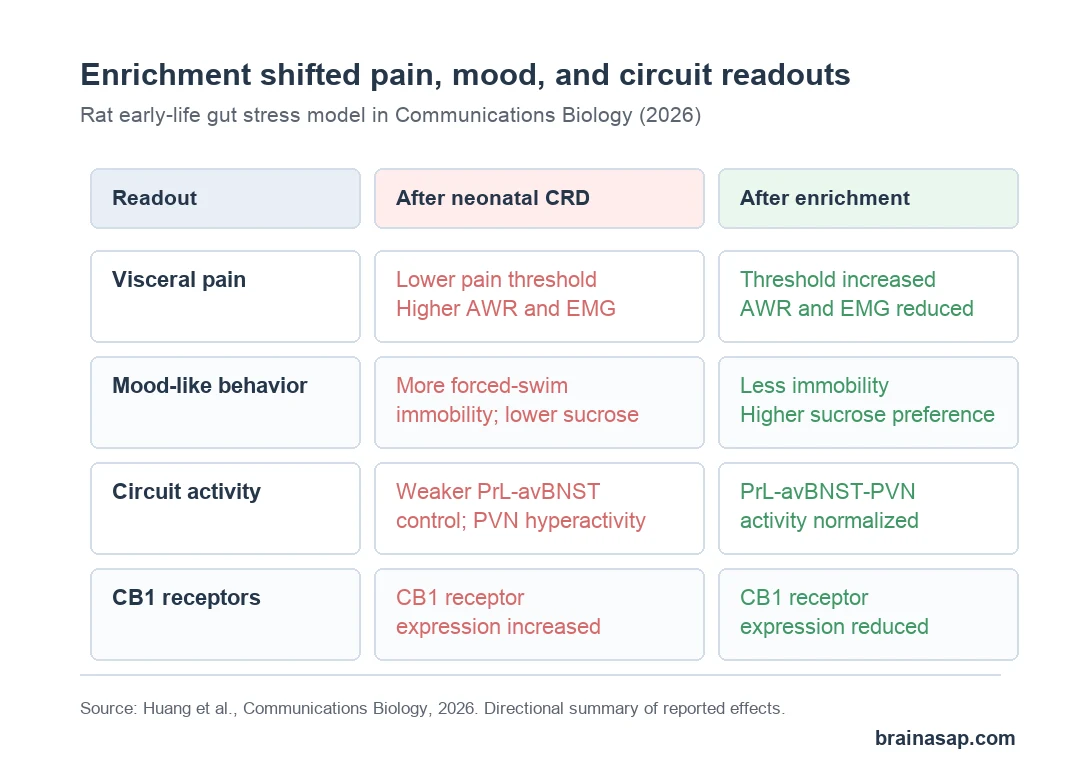
- Adult symptoms appeared: CRD-exposed rats later showed lower visceral pain thresholds, higher abdominal withdrawal reflex scores, stronger abdominal-muscle EMG responses, more forced-swim immobility, and lower sucrose preference.
- Enrichment helped: Rats housed after weaning in larger enriched cages had improved pain and mood-related readouts compared with CRD rats kept in standard cages.
- Circuit activity shifted: Enrichment normalized activity in a prelimbic cortex to avBNST to PVN pathway, a stress and pain-control circuit.
- CB1 receptors mattered: CB1 receptor expression was elevated following neonatal CRD and reduced following enrichment; blocking CB1 receptors in the avBNST also improved pain and forced-swim readouts in CRD rats.
Source: Communications Biology (2026) | Huang et al.
Visceral pain means pain coming from internal organs, including gut-related pain. In irritable bowel syndrome (IBS), abdominal pain can overlap with anxiety, depression, and stress-system changes, which makes the gut-brain circuit question clinically important.
This study used rats to ask a mechanistic question: can a richer early environment reshape the brain circuit linking early gut stress, chronic visceral pain, and depression-like behavior?
Neonatal CRD Modeled Early Gut Stress in Rats
Researchers used neonatal colorectal distension (CRD) on postnatal days 8, 10, and 12. CRD is a lab method that briefly distends the colon, and here it was used as an early-life stress model related to later visceral hypersensitivity.
Both male and female rats were included. After weaning at postnatal day 21, rats were housed either in standard cages or in enriched cages, then tested around postnatal day 60.
- Control group: Rats were not exposed to neonatal CRD.
- CRD group: Rats received neonatal CRD and then standard housing.
- CRD + enrichment group: Rats received neonatal CRD and then enriched housing after weaning.
The enriched cages were larger and included a running wheel, plastic tubing, houses, nestlets, and rotating objects to keep novelty in the environment.
Early Stress Raised Pain Sensitivity and Depression-Like Behavior
Adult CRD-exposed rats showed a combined pain and mood-related phenotype. Their visceral pain threshold was lower, meaning less pressure was needed before a pain-related response appeared.
Researchers also measured abdominal withdrawal reflex (AWR) scores and external oblique muscle EMG, an electrical readout from abdominal muscle activity during distension. Both pointed toward stronger pain-related responses after neonatal CRD.
The mood-related tests moved in the same unfavorable direction:
- Forced-swim test: CRD rats had more immobility, a common depression-like behavior readout in rodents.
- Sucrose preference: CRD rats had lower preference for sucrose, a rodent measure often used as an anhedonia-like readout.
- Combined interpretation: The model produced visceral hypersensitivity with depression-like behavior, not only one isolated pain score.
Enrichment Improved Pain and Mood-Related Readouts
The central behavioral finding was direct. Compared with CRD rats in standard cages, enriched rats had a higher visceral pain threshold, lower AWR scores, and lower abdominal-muscle EMG responses to graded distension at 30, 40, and 50 mmHg.
Enrichment also changed the mood-related tests. CRD + enrichment rats had less forced-swim immobility and higher sucrose preference than CRD rats.
The experiment does not show that novelty objects or exercise wheels are a proven IBS or depression treatment for people. In this rat model, post-weaning enrichment moved both pain and mood-related outcomes toward the control pattern.
The Circuit Ran From Prelimbic Cortex to avBNST to PVN
The prelimbic cortex is part of medial prefrontal cortex, a frontal brain area involved in stress, emotion, and top-down regulation.
The avBNST, or anteroventral bed nucleus of the stria terminalis, is a limbic stress-region hub. The PVN, or paraventricular nucleus of the hypothalamus, helps control stress-hormone output.
Researchers traced and manipulated a pathway from prelimbic glutamatergic neurons to avBNST GABAergic neurons and then to PVN CRH neurons.
Glutamatergic neurons usually provide excitatory drive. GABAergic neurons usually provide inhibitory control. CRH neurons are stress-hormone-system neurons.
- After CRD: avBNST GABAergic neurons fired less, and PVN CRH activity was elevated.
- After enrichment: prelimbic and avBNST activity moved back toward a healthier pattern, while PVN CRH hyperactivity decreased.
- Pathway meaning: The data point to a stress-circuit chain, not a single isolated brain region.
CB1 Receptors Were a Molecular Control Point
CB1 receptors are cannabinoid receptors that can regulate neurotransmitter release and synaptic signaling in the brain. In this study, neonatal CRD increased CB1 receptor expression in the circuit, including prelimbic neurons projecting to the avBNST.
Several manipulations supported the CB1 receptor link. Knocking down CB1 receptors in the prelimbic cortex improved pain threshold and reduced forced-swim immobility in CRD rats.
Microinjecting AM251, a CB1 receptor antagonist, into the avBNST also increased pain threshold, lowered AWR scores, and reduced forced-swim immobility in CRD rats.
The opposite manipulation pushed the circuit in the unfavorable direction. A CB1 receptor agonist lowered pain threshold and increased depression-like behavior in control rats, supporting the interpretation that excessive CB1 receptor signaling in this pathway can worsen the phenotype.
- Behavioral level: Enrichment improved pain and mood-like measures.
- Circuit level: Enrichment restored activity through the prelimbic-avBNST-PVN pathway.
- Molecular level: Enrichment reduced elevated CB1 receptor expression after early stress.
The Evidence Is Strongest as a Rat Circuit Finding
The practical interpretation should stay bounded. The experiments linked early-life gut stress, enriched housing, CB1 receptor signaling, and a prefrontal-limbic-hypothalamic pathway in rats.
The circuit context matters because IBS, chronic visceral pain, stress exposure, and depression can overlap in people. The experiment still did not test a human intervention.
The methods also used invasive viral tracing, chemogenetic manipulation, optogenetics, drug microinjection, electrophysiology, and rodent behavior tests that do not map one-to-one onto clinical care.
The clearest conclusion is mechanistic: in this rat model, enriched housing after weaning reduced later visceral pain and depression-like behavior while normalizing a CB1 receptor-sensitive stress circuit.
Citation: DOI: 10.1038/s42003-026-10105-2. Huang et al. Environmental enrichment reverses ELS-induced visceral pain and depression through a prefrontal-limbic circuit involving CB1Rs. Communications Biology. 2026.
Study Design: Rat early-life stress experiment combining neonatal CRD, enriched housing, behavior tests, viral tracing, chemogenetics, optogenetics, pharmacology, molecular assays, and electrophysiology.
Sample/Model: Male and female Sprague-Dawley rats; Fig. 6 behavioral enrichment comparisons used n = 10 rats per group.
Key Statistic: Enrichment improved pain threshold, AWR scores, EMG responses at 30, 40, and 50 mmHg, forced-swim immobility, and sucrose preference compared with CRD-only rats.
Caveat: The study is preclinical and does not prove that environmental enrichment or CB1 receptor drugs treat human IBS, chronic pain, or depression.