TL;DR: A 2026 mouse study in Cell found that olfactory receptor neurons, the smell-sensing cells in the nose, were arranged in spatial bands that lined up with matching sensory maps in the brain’s olfactory bulb.
Key Findings
- Organized receptor bands: Researchers found that odor receptor neurons were not randomly scattered across the mouse nose; receptor types followed horizontal spatial bands.
- More than 1,000 receptors: The study mapped the placement of a very large receptor family, giving olfaction a clearer anatomical layout than older random-distribution models implied.
- Nose-to-brain alignment: Receptor patterns in the nose matched corresponding maps in the olfactory bulb, the first brain relay for smell information.
- Mouse sensory model: The work used the mouse olfactory system, so it explains a basic mammalian smell circuit rather than diagnosing human smell loss.
- Mechanism still open: The result shows a spatial code, but it does not fully explain how development assigns each neuron its receptor identity.
Source: Cell (2026) | Brann et al.
Smell looks simple from the outside: an odor enters the nose, receptors detect it, and the brain decides what the odor means. The biology underneath is harder because mammals carry a huge family of odor receptors, and each sensory neuron must choose which receptor type it will use.
The new Cell study suggests that olfactory receptor choice follows a physical map. Instead of treating receptor neurons as a mostly random mixture, the researchers found a spatial code that organizes receptor types across the nasal tissue and preserves that organization in the brain.
Olfactory Receptors Were Arranged in Bands Across the Nose
Olfactory sensory neurons sit in the nasal epithelium, the smell-sensitive tissue inside the nose. Each neuron expresses one odor receptor type, and receptor identity helps determine which chemicals the neuron can detect.
Older explanations often emphasized broad zones or apparent randomness. This study adds a sharper structure: receptor neurons formed horizontal bands running from the upper to lower regions of the nose.
Receptor placement can shape the first step of odor coding. If receptor types occupy predictable regions, then inhaled molecules may meet a structured sensory sheet rather than an unorganized receptor field.
- Receptor identity: Each olfactory sensory neuron uses a specific odor receptor, which sets part of its odor-detection profile.
- Nasal location: The study found receptor types arranged by position, not simply scattered throughout the epithelium.
- Spatial code: The banding pattern gives the nose an anatomical code for odor sensing before neural messages reach the brain.
The Nose Map Lined Up With the Olfactory Bulb
The olfactory bulb is the brain’s first major relay for smell information. Axons from receptor neurons converge there, so alignment between the nose and bulb would make the peripheral map biologically meaningful.
Researchers reported that the nasal receptor map aligned with corresponding maps in the olfactory bulb. In practical terms, the spatial layout in the nose appeared to carry forward into the neural circuit that starts odor processing.
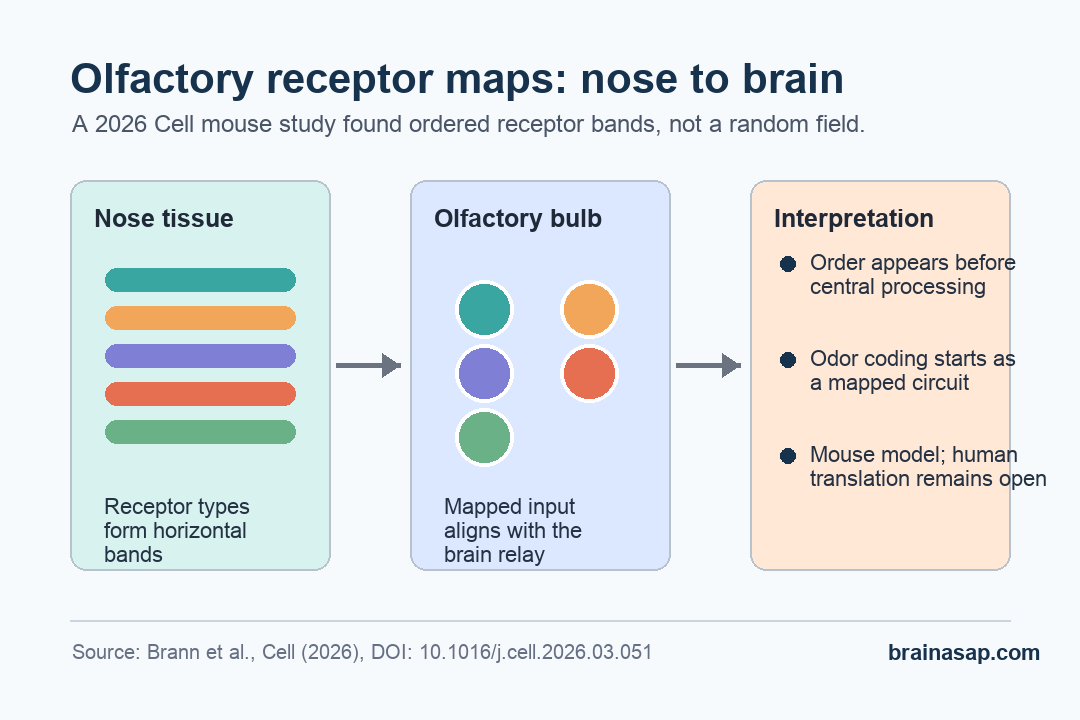
The nose is not a miniature brain; the first sensory sheet and the first brain relay share an ordered layout.
That shared layout could help explain how odor information stays organized as it moves from air exposure to neural processing. A chemical stimulus still activates many receptors, but those receptors may sit in a more predictable anatomy than earlier summaries suggested.
The Finding Changes a Basic Assumption About Smell
Vision and touch are easier to imagine as maps because the retina and skin preserve spatial information. Smell has been harder to map because odor identity depends on chemical features rather than simple physical location.
The spatial-code result narrows that gap. It suggests the smell system also uses anatomical order, even though odor identity is chemical and receptor families are large.
- Before this map: Olfactory receptors could look like a complicated receptor catalog with limited spatial logic.
- After this map: Receptor choice and receptor placement appear linked across the nasal surface.
- Brain consequence: The olfactory bulb receives input from a sensory map that already has structure.
The useful point is not that every smell has one fixed address. Odor perception still depends on patterns across many receptor types.
Those receptor patterns now have a clearer starting geography. Future experiments can ask whether specific odor classes, receptor families, or developmental cues are tied to particular nasal regions.
Developmental Biology Remains the Next Question
The study shows that receptor types form bands, but a map is not the same as a complete mechanism. Researchers still need to explain how developing neurons choose receptor identities in a way that creates the final spatial pattern.
Several mechanisms could matter, including gene regulation, local tissue cues, and the way sensory neurons connect to the olfactory bulb. The present result makes those mechanisms easier to test because the final layout is now more specific.
A more detailed developmental answer would need to show when the bands first appear and whether changing a local cue shifts receptor choice. That kind of experiment would move the result from a map toward a causal model of how the smell system builds itself.
- Model limitation: The evidence comes from mice, so human olfactory anatomy may not match every detail.
- Functional limitation: A spatial map does not by itself prove how individual odors are perceived or discriminated.
- Clinical limitation: The study is basic sensory neuroscience, not a treatment study for smell loss or neurological disease.
The main advance is still concrete. A large, complicated receptor system showed an ordered layout in the nose and an aligned map in the brain, giving olfaction a more organized circuit model than the field had before.
Citation: DOI: 10.1016/j.cell.2026.03.051. Brann et al. A spatial code governs olfactory receptor choice and aligns sensory maps in the nose and brain. Cell. 2026.
Study Design: Mouse olfactory-system mapping study of receptor placement and nose-to-brain sensory organization.
Sample/Model: Mouse olfactory sensory neurons, nasal epithelium, and olfactory bulb maps.
Key Statistic: More than 1,000 odor receptor types were evaluated as part of the mapped receptor family.
Caveat: The study maps a basic sensory circuit in mice and does not show whether the same layout explains human smell disorders.