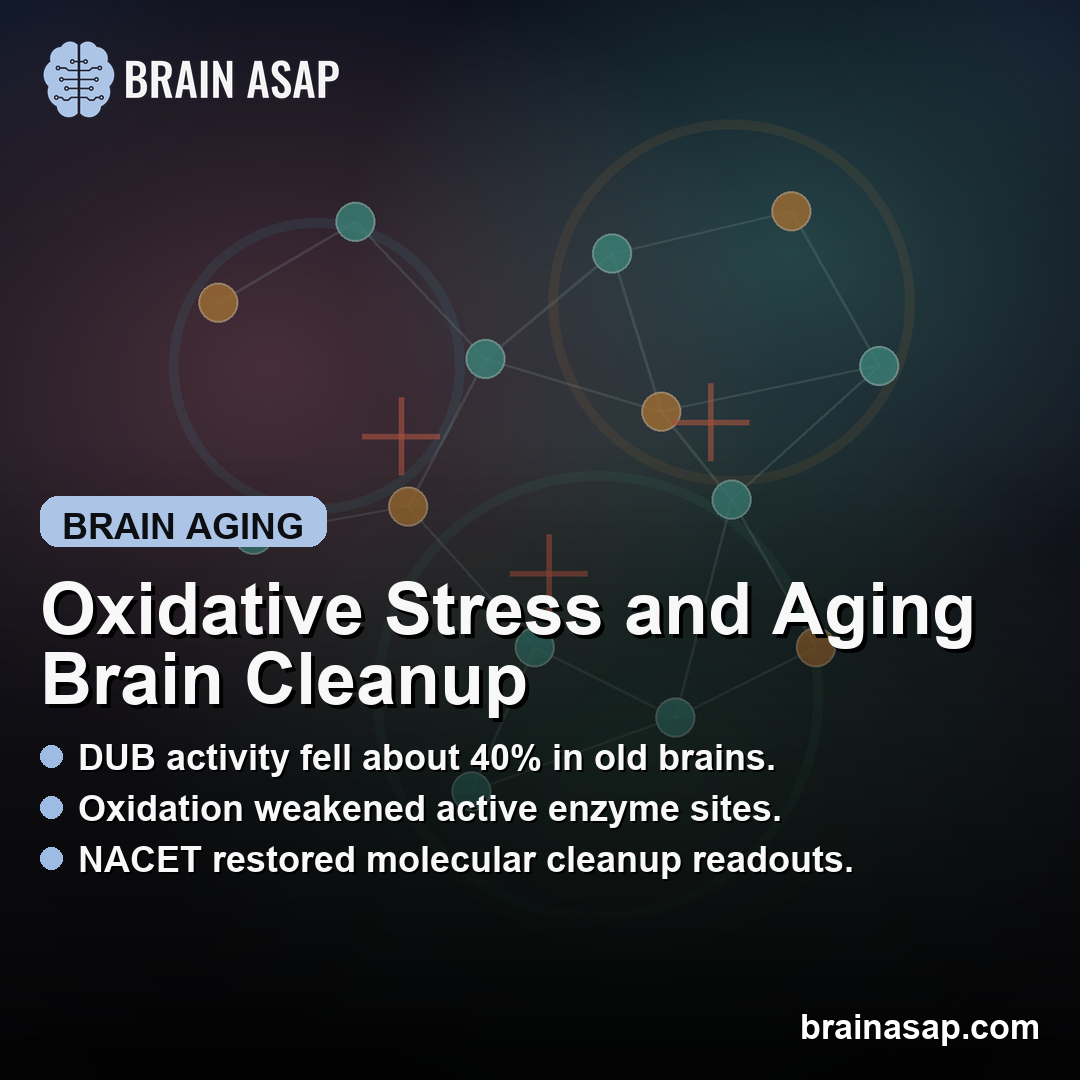
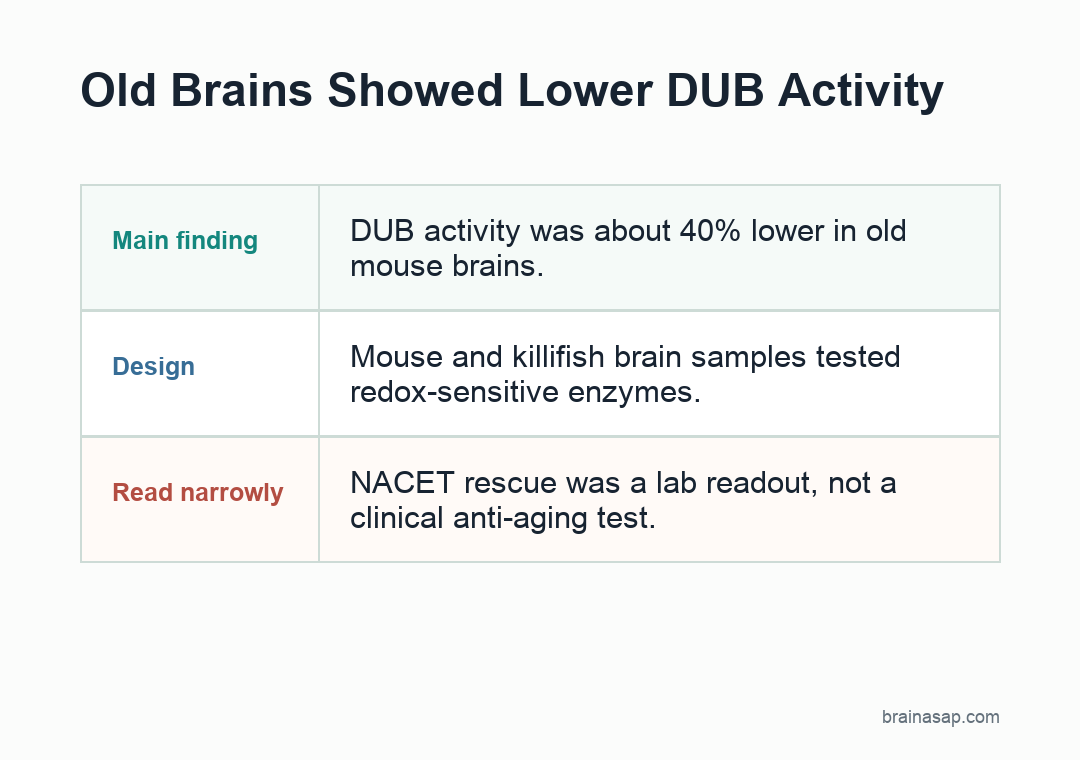
TL;DR: A 2026 Nature Communications study in aging mouse and killifish brains found that deubiquitylases (DUBs), enzymes that help edit protein-cleanup tags, lost about 40% of their catalytic activity with age even when many of the same enzymes were still present.
Key Findings
- Brain DUB activity fell with age: In old mouse brains, researchers saw lower overall deubiquitylase activity and reduced activity in 18 of 56 detected DUBs in the first cohort.
- The decline repeated in a second cohort: A validation cohort found lower activity in 20 of 54 detected DUBs, supporting the same aging pattern.
- Protein amount did not explain most changes: Many affected DUBs lost activity without a matching drop in protein abundance, pointing to chemical impairment rather than simple enzyme loss.
- Oxidation was the mechanism: The data linked DUB impairment to cysteine thiol oxidation, a redox change that can directly blunt cysteine-protease enzyme activity.
- NACET restored molecular function in aged mice: A 12-day N-acetylcysteine ethyl ester (NACET) treatment increased free thiols, restored DUB activity, reduced K48-linked ubiquitin buildup, and improved proteasome activity.
Source: Nature Communications (2026) | Sahu et al.
Protein-Cleanup Enzymes Lost Activity in Old Brains
Brain aging is often described as a buildup problem: damaged proteins accumulate, cellular stress rises, and neurons lose some of the quality-control systems that keep proteins folded, tagged, recycled, or destroyed.
This study focused on a less familiar part of that system: deubiquitylases, usually shortened to DUBs. Ubiquitin tags help mark proteins for cell signaling or breakdown.
DUBs remove or edit those tags. That editing helps decide whether a protein is recycled, stabilized, redirected, or sent toward degradation.
Researchers profiled cysteine-protease DUB activity in aging vertebrate brains. The main result was not just that old brains had different protein-cleanup machinery.
The sharper result was that many DUBs appeared to be present but chemically less active.
Mouse and Killifish Brains Showed the Same Aging Direction
The mouse work compared young and old brain lysates using fluorescent DUB activity assays and activity-based probes that capture enzymatically active DUBs. In one cohort, researchers detected 56 distinct DUBs and found lower activity in 18 of them in old brains.
A second mouse cohort pointed the same way: 20 of 54 detected DUBs showed reduced activity. Enzyme-activity proteomics can be noisy, especially in aged tissue.
Replication in a second cohort makes the same aging pattern more credible.
The same broad direction also appeared in killifish, a short-lived vertebrate model often used for aging studies. Old killifish brains showed lower global DUB activity compared with young brains, suggesting that the redox-sensitive DUB problem was not mouse-only.
Oxidation Explained Why Enzymes Were Present but Weaker
The most important distinction is activity versus abundance. If a cell simply makes less of an enzyme, the fix would be one kind of problem.
Here, many DUBs lost function even when protein abundance did not fall in the same way.
That points to redox chemistry. Cysteine-protease DUBs rely on a reactive cysteine site to do their work.
Oxidative stress can modify that thiol group and reduce catalytic activity. In practical terms, the enzyme can still be measured as a protein, but its active site is less ready to work.
Several details make the mechanism coherent:
- Activity-based probes: The method measured active enzymes rather than only total protein amount.
- Thiol oxidation: The proposed impairment involved oxidation of cysteine thiols, the chemical groups DUBs need for catalytic function.
- Stable abundance: Many age-affected DUBs did not show matching protein-abundance loss, which supports post-translational chemical inhibition.
- Cross-species pattern: Mouse and killifish brains both showed lower DUB activity with age.
DUB Loss Came Before Proteasome Decline
The study also placed DUB impairment in a time sequence. In mouse aging analyses, decreased DUB activity appeared before measurable proteasome decline and before broad accumulation of ubiquitylated proteins.
This timing is important because the proteasome is the cell’s main protein-disposal machinery. If DUB impairment comes first, then some age-related protein-cleanup failure may start upstream of the proteasome itself.
Human induced pluripotent stem cell-derived neurons added another test. Broad DUB inhibition and targeted inhibition of USP7, one strongly age-affected DUB, partly recreated age-like ubiquitylation changes seen in mouse brains.
USP7 inhibition did not explain the whole aging pattern, but it changed ubiquitylation in several protein groups:
- Proteostasis proteins: enzymes and systems involved in protein quality control.
- Cytoskeletal proteins: molecules related to neuronal structure and transport.
- Trafficking proteins: proteins involved in intracellular sorting and movement.
- Synaptic proteins: molecules tied to communication between neurons.
NACET Reversed Several Aged-Brain Molecular Readouts
The antioxidant experiment was the clearest reversibility test. Researchers treated aged mice, 22 to 24 months old, with N-acetylcysteine ethyl ester, or NACET, in drinking water for 12 days.
NACET is related to N-acetylcysteine but is more cell-permeable and can supply cysteine inside cells. In this study, NACET treatment increased free thiols in aged mouse brains and restored DUB activity.
It also reduced K48-linked polyubiquitin, a ubiquitin-chain marker tied to proteasomal degradation, and improved proteasome activity.
The key readouts moved together:
- Free thiols increased: Aged brains had more reduced thiol availability after NACET treatment.
- DUB activity recovered: The enzyme-activity readout improved after redox support.
- Ubiquitin-chain burden fell: K48-linked ubiquitin and several other aging-associated ubiquitin-chain types decreased.
- Proteasome activity improved: The downstream protein-clearance machinery showed better activity in treated aged brains.
NACET Was a Molecular Rescue, Not a Dementia Treatment Claim
The study is strongest as a mechanism paper. It does not show that NACET prevents dementia, reverses cognitive decline, or should be used clinically for brain aging.
The treatment experiment measured molecular readouts in aged mice over a short period.
The clinical relevance is still real. Several affected DUBs, including UCHL1, ATXN3, UCHL5, and YOD1, connect to pathways already implicated in neurodegenerative disease biology.
The study suggests that age-related oxidative stress can weaken protein-quality-control enzymes before the larger cleanup system visibly fails.
A careful takeaway is that brain aging may involve a reversible chemical inhibition step. The enzymes are not always gone.
Some are still there, but oxidation has made them less active. That is a different target than replacing lost cells or clearing late-stage protein aggregates.
Redox-sensitive DUBs add an early aging target: DUB activity fell before proteasome activity did, and antioxidant support restored several linked readouts in aged mouse brains.
Redox-sensitive DUB impairment may be an early step in age-related proteostasis decline.
For brain aging research, the result narrows the question. Instead of asking only why old brains accumulate damaged or ubiquitylated proteins, researchers can ask which enzyme-active sites become oxidized first.
The next test is whether restoring vulnerable DUBs changes neuronal function rather than only molecular markers.
The study does not turn NACET into a consumer brain-aging intervention. It does show that some protein-cleanup failure in old vertebrate brains may be chemically adjustable, at least in the laboratory.
That is a useful mechanistic foothold.
Citation: DOI: 10.1038/s41467-026-71921-y. Sahu et al. Oxidative stress causes a reversible decrease of deubiquitylases activity in old vertebrate brains. Nature Communications. 2026;17:3653.
Study Design: Activity-based proteomics and biochemical validation in aging mouse and killifish brains, with human iPSC-derived neuron experiments and an aged-mouse NACET treatment test.
Sample/Model: Mouse brain cohorts, killifish brain samples, and human induced pluripotent stem cell-derived neurons.
Key Statistic: Average DUB activity was reduced by about 40% in old brains, with reduced activity in 18 of 56 detected DUBs in one mouse cohort and 20 of 54 in a validation cohort.
Caveat: The NACET result is a short-term molecular rescue in aged mice, not evidence of clinical cognitive benefit in people.