TL;DR: A 2026 preprint in medRxiv used electroencephalography (EEG), a scalp electrical-activity recording method, and electrocardiogram (ECG) recordings to test whether brain-heart interplay, meaning coupling between brain-network organization and cardiac autonomic activity, tracks aging, Parkinson’s disease, cognitive screening scores, and freezing of gait.
Key Findings
- Three datasets: Researchers analyzed resting EEG-ECG data from healthy young adults, healthy older adults, and Parkinson’s disease patients, plus a separate freezing-of-gait dataset.
- Group differences: Brain-heart coupling differed across groups for beta efficiency-sympathetic activity and gamma efficiency-sympathetic activity.
- Cognitive link: In the Parkinson’s group, several brain-heart or brain-network measures correlated with Mini-Mental State Examination (MMSE), a brief cognitive screening score.
- Freezing pattern: Six usable freezing-of-gait events showed stable or increased coupling in most events, but the sample was too small for formal statistics.
- Main caveat: The study is a preprint that reused small open datasets, so the pipeline is exploratory rather than a diagnostic test.
Source: The paper is a medRxiv preprint and has not been certified by peer review.
Parkinson’s disease is usually described through movement symptoms, but the disease also affects sleep, cognition, autonomic control, and other body systems. This preprint asked whether a combined brain-heart coupling measure could capture part of that broader physiology.
The researchers did not treat the brain and heart as separate recordings. They measured brain-network organization from EEG, measured heart-rate-variability patterns from ECG, and then estimated how strongly those two streams moved together over time.
EEG and ECG Were Combined Across Three Open Datasets
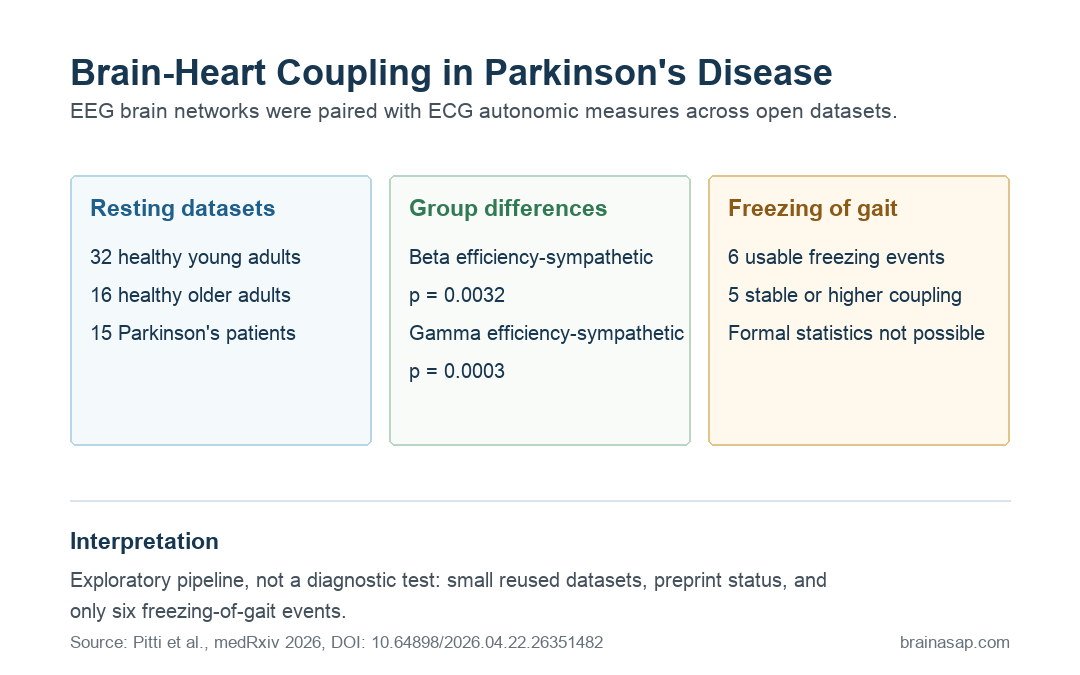
The analysis used three open-source datasets. Two datasets were used for resting-state comparisons, and one dataset was used to examine freezing of gait, a sudden inability to keep stepping that can occur in Parkinson’s disease.
The main resting comparison included 15 Parkinson’s disease patients tested off dopaminergic medication and 16 healthy older controls with a similar mean age. A second resting dataset added 32 healthy young adults.
The freezing-of-gait dataset included 12 Parkinson’s patients, although only a smaller subset of events passed the recording-quality rules.
The study pipeline had three linked parts:
- Brain network measure: EEG coherence was used to estimate how synchronized different brain-channel networks were in alpha, beta, and gamma frequency bands.
- Heart measure: ECG data were converted into cardiac autonomic measures, including sympathetic and parasympathetic activity indexes.
- Coupling measure: Maximal Information Coefficient was used to estimate brain-heart interplay, including nonlinear relationships between the two recording streams.
Parkinson’s disease can involve both neural-network changes and autonomic dysfunction. A combined measure could, in theory, show physiological organization that is missed when EEG and ECG are analyzed alone.
Brain-Heart Coupling Differed Across Aging and Parkinson’s Groups
Across healthy young adults, healthy older adults, and Parkinson’s patients, the clearest brain-heart coupling differences involved beta efficiency-sympathetic activity and gamma efficiency-sympathetic activity.
The beta coupling comparison was significant at p = 0.0032, and the gamma comparison was significant at p = 0.0003.
Efficiency here refers to a graph-theory measure of how easily information can move across the EEG network. Sympathetic activity refers to the autonomic branch associated with arousal and cardiovascular regulation.
Neither measure alone diagnosed Parkinson’s disease. The measured coupling differed across the study groups.
The comparison separated three layers of information:
- Brain-only metrics: EEG network features had the strongest group-discrimination pattern in this dataset.
- Heart-only metrics: cardiac autonomic measures also differed, but they were less discriminating than the brain-network measures.
- Brain-heart metrics: coupling measures performed better than heart-only indexes and added a systems-level view of the physiology.
The researchers also reported that healthy aging was associated with stronger alpha efficiency-sympathetic coupling in the healthy older group. That correlation was R = 0.5999 with p = 0.0148.
Similar age-correlation findings were not detected in the Parkinson’s group.
MMSE Scores Tracked Brain-Heart Measures in Parkinson’s Disease
The paper also tested whether the physiological metrics related to Mini-Mental State Examination (MMSE) scores. MMSE is a brief cognitive screening test scored from 0 to 30, where lower scores usually indicate worse cognitive performance.
In this dataset, significant MMSE relationships appeared in the Parkinson’s group rather than the healthy older group.
The strongest reported coupling examples involved alpha modularity-autonomic coupling, including R = 0.5311 for alpha modularity-sympathetic coupling and R = 0.6428 for alpha modularity-parasympathetic coupling.
Researchers also reported one significant brain-network-only relationship: alpha efficiency correlated negatively with MMSE in the Parkinson’s group (R = -0.5507). That means the direction of the relationship depended on the specific network measure, not simply on “more coupling” or “less coupling” being better.
The cognitive finding should be read narrowly for three reasons:
- Screening range: the cohort was in the no-cognitive-impairment MMSE range, so the result does not prove the method detects dementia or mild cognitive impairment.
- Small sample: the main Parkinson’s resting dataset had 15 patients, which makes outlier effects a real concern.
- Better tests needed: the researchers noted that Montreal Cognitive Assessment (MoCA), another cognitive screening tool, may be more sensitive in future Parkinson’s cohorts.
Freezing-of-Gait Events Showed Mostly Stable or Higher Coupling
The freezing-of-gait analysis focused on the transition from walking before a freezing event to the event onset. Only six freezing-of-gait events across the available recordings were usable after quality filtering.
Within those six events, brain-heart coupling was mostly stable or increased at freezing onset. Only one of the six events showed a decrease in coupling strength when the person entered the freezing state.
Freezing of gait is a fast, transient motor phenomenon. A metric that can follow second-by-second brain-heart coordination may eventually help researchers study why a walking pattern suddenly breaks down.
Still, the preprint is careful about the limits. With only six usable events, the freezing analysis was qualitative. It supports feasibility for the pipeline, not a clinical claim about predicting freezing episodes.
Small Open Datasets Keep the Brain-Heart Method Exploratory
The study’s useful contribution is the measurement idea. EEG and ECG are noninvasive, relatively accessible recordings, and the method combines them into a single systems-level analysis rather than treating brain activity and autonomic activity as unrelated.
The study’s strongest conclusion is methodological: brain-heart interplay may help characterize large-scale physiological changes in aging and Parkinson’s disease. This approach may be especially useful when symptoms involve both neural control and autonomic regulation.
The main limitations are direct:
- Preprint status: the findings have not yet been peer reviewed.
- Small datasets: the Parkinson’s resting dataset and freezing-event subset were too small for strong clinical conclusions.
- Low-density EEG: the EEG setups had limited spatial resolution compared with denser EEG or imaging methods.
- Heterogeneous symptoms: Parkinson’s disease varies widely across patients, and subtype-specific autonomic patterns may affect the results.
For now, the pipeline is exploratory. Larger studies with balanced cognitive-score ranges, more freezing events, and more sensitive cognitive measures will be needed before brain-heart coupling can be judged as a Parkinson’s biomarker.
Citation: DOI: 10.64898/2026.04.22.26351482. Pitti et al. Assessing ageing, cognitive ability and freezing of gait in Parkinson’s disease through integrated brain-heart network dynamics. medRxiv. 2026.
Study Design: Secondary analysis of three open EEG-ECG datasets, including resting-state aging/Parkinson’s comparisons and a freezing-of-gait event analysis.
Sample Size: 32 healthy young adults, 16 healthy older adults, 15 Parkinson’s disease patients in the resting analysis, and 12 Parkinson’s patients in the freezing-of-gait dataset.
Key Statistic: Group differences were significant for beta efficiency-sympathetic coupling (p = 0.0032) and gamma efficiency-sympathetic coupling (p = 0.0003).
Caveat: This is a non-peer-reviewed preprint using small reused datasets, and only six freezing-of-gait events were usable for the event analysis.