TL;DR: A 2026 preprint in medRxiv used whole-genome sequencing in two families with many obsessive-compulsive disorder (OCD) cases and prioritized rare variants in NPY5R, DLGAP1, and MAPK8IP3, but the findings still need replication and functional testing.
Key Findings
- Two densely affected families: Researchers sequenced 25 people from two multiplex OCD pedigrees, meaning families with several affected members.
- Bayesian family analysis: The team used BICEP, a Bayesian method that weighs predicted variant damage and whether a variant tracks with OCD across a family.
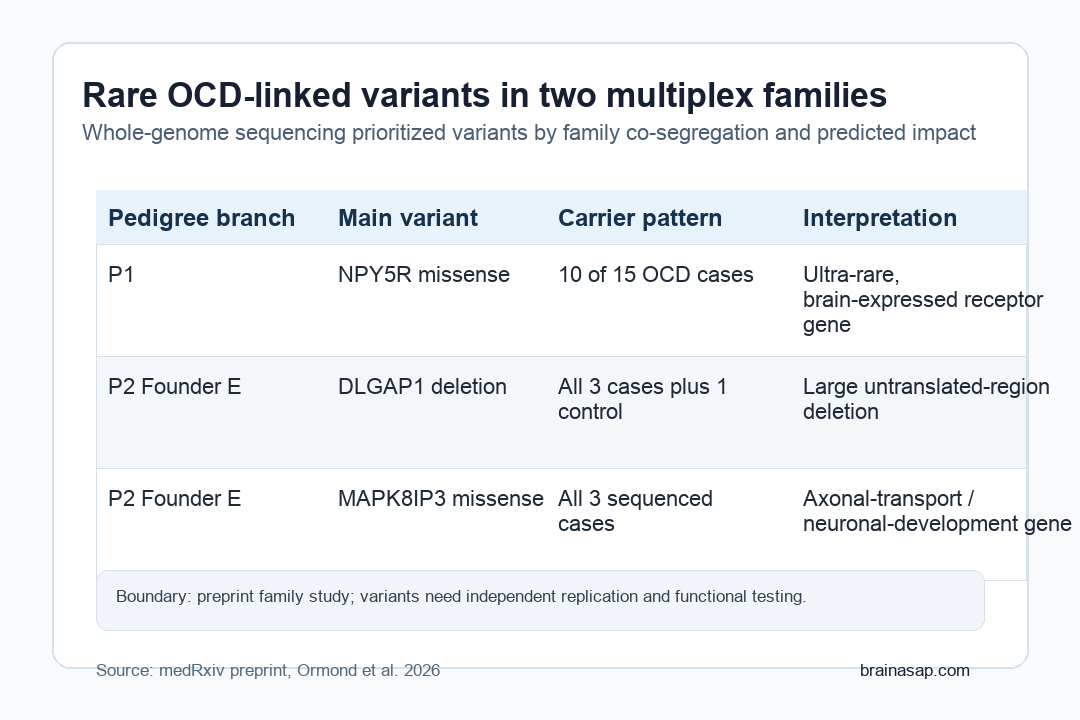
- NPY5R in one pedigree: An ultra-rare, predicted-deleterious NPY5R missense variant was carried by 10 of 15 OCD cases in the first family.
- DLGAP1 and MAPK8IP3 in one branch: In a branch of the second family, a DLGAP1 deletion and a MAPK8IP3 missense variant appeared in all three sequenced OCD cases.
- Common genetic scores did not explain the pattern: Polygenic risk scores for OCD, Tourette syndrome, and panic disorder did not show a clear trend across the pedigree members.
Source: medRxiv preprint (2026) | Ormond et al.
Whole-Genome Sequencing Looked for Rare OCD Variants in Families
Obsessive-compulsive disorder is partly heritable, but common genetic studies explain only part of that inheritance. This preprint asked a narrower question: in families with many OCD cases, could rare variants that disrupt brain-related genes help explain why the disorder clusters so strongly?
Researchers used whole-genome sequencing (WGS), which reads DNA across the genome rather than only checking common genetic markers. The sample was deliberately small but family-dense: 25 sequenced people across two multiplex pedigrees.
The analysis focused on variants that met three practical criteria:
- Rare in population databases: A candidate variant should not be common in general reference datasets.
- Predicted to matter biologically: The variant should be likely to alter a protein or disrupt a gene region.
- Track with OCD in the family: The variant should appear mainly in affected relatives, not randomly across the pedigree.
That design is not meant to estimate population-level OCD risk. It is a way to find possible high-impact variants in families where standard case-control genetics can miss a private or family-specific lead.
NPY5R Was the Strongest Signal in the First OCD Pedigree
In the first family, researchers did not find a rare single-nucleotide or small insertion/deletion variant in any of 36 known OCD risk genes. They also did not find a convincing copy-number variant, a larger DNA deletion or duplication, that explained the family pattern.
The most compelling candidate was instead an ultra-rare missense variant in NPY5R, a gene for a neuropeptide Y receptor. A missense variant changes one amino acid in a protein, which can matter if the substitution alters the protein’s function.
The variant was carried by 10 of the 15 OCD cases in that pedigree. It did not perfectly explain every case, but it had the best combination of predicted impact and family tracking among the top ranked candidates.
NPY5R is relevant because neuropeptide Y biology has been connected to stress regulation, feeding behavior, anxiety-related phenotypes, and other psychiatric traits. The paper also noted anxiety-related diagnoses in some family members, but a secondary analysis did not make the NPY5R pattern look stronger for anxiety than for OCD.
DLGAP1 and MAPK8IP3 Highlighted Synaptic Biology
The second family was analyzed by branch because the pedigree suggested more than one founder line. In one branch, several single-nucleotide or small indel candidates looked weak because they were carried by too few cases.
The clearest branch-specific pattern involved two genes:
- DLGAP1: Researchers found a 947-kilobase deletion overlapping the first three untranslated exons. It appeared in all three sequenced cases in that branch and one control.
- MAPK8IP3: A rare missense variant was carried by all three sequenced cases in the same branch, although predicted deleteriousness evidence was mixed.
DLGAP1 encodes a postsynaptic density protein. Postsynaptic density proteins help organize molecular machinery at synapses, the communication points between neurons.
The gene is biologically plausible in OCD because glutamate-related synapse biology has been a recurring research direction in the disorder.
MAPK8IP3 encodes a neuronal protein involved in axonal transport and development. The preprint connects it to prior neurodevelopmental findings, including autism-related and complex neurodevelopmental disorder evidence, but the OCD claim remains family-level and preliminary.
Polygenic Risk Scores Did Not Explain the Noncarriers
Family studies often leave a hard question behind: what about affected relatives who do not carry the highlighted rare variant? One possibility is that those relatives have higher burden from many common variants, each with small effect.
Researchers tested that idea with polygenic risk scores (PRS), summary scores that estimate inherited common-variant burden for a trait. They calculated scores for OCD, Tourette syndrome, and panic disorder across available pedigree members.
The PRS results did not show a clear pattern:
- No obvious carrier split: In the first family, NPY5R noncarriers did not have noticeably different PRS profiles from carriers.
- No strong family-wide trend: Across both families, pedigree members were spread across the reference distribution.
- Rare variants stayed the main lead: The common-variant scores did not explain why some cases lacked the prioritized rare variant.
That negative PRS finding narrows the interpretation. The study does not prove that rare variants caused OCD in these families, but it also did not find an easy common-variant explanation for the observed family patterns.
Why This Is Not Clinically Ready
The interpretation should stay modest: this preprint identifies plausible rare-variant leads in two families with unusually dense OCD history. It does not create a genetic test for OCD, and it does not show that these variants cause OCD in the general population.
Several limits matter before the finding can be used clinically:
- Small family sample: The study sequenced 25 people, not thousands of unrelated cases and controls.
- Incomplete co-segregation: The NPY5R variant was absent in five OCD cases in the first pedigree, so it cannot be the sole explanation.
- Control carrier in one branch: The DLGAP1 deletion appeared in all three sequenced cases in the branch, but also in one control.
- Functional evidence is still needed: Lab work would be needed to show whether these variants change receptor function, synaptic communication, axonal transport, or OCD-relevant behavior.
Still, the gene-level direction is coherent. NPY5R points toward stress and energy-homeostasis biology, while DLGAP1 and MAPK8IP3 point toward postsynaptic structure and neuronal development.
For OCD genetics, that combination is more informative than a vague claim that the disorder is heritable.
The practical takeaway is that family sequencing may help surface rare biological routes into OCD, especially when common-variant studies leave much of the inherited risk unexplained. The next test is whether independent OCD cohorts and functional experiments support the same genes.
Citation: DOI: 10.64898/2026.04.21.26350600. Ormond et al. Rare protein-disrupting variants in NPY5R, DLGAP1 and MAPK8IP3 segregate with OCD in two multiplex pedigrees. medRxiv. 2026.
Study Design: Whole-genome sequencing family study in two multiplex OCD pedigrees.
Sample Size: 25 sequenced individuals across two families with multiple OCD cases.
Key Statistic: The NPY5R variant was carried by 10 of 15 OCD cases in one pedigree; DLGAP1 and MAPK8IP3 variants appeared in all three sequenced cases in one branch of the second pedigree.
Caveat: This is a small preprint family study, not a validated OCD genetic test; replication and functional experiments are required.