TL;DR: A 2026 Nature Communications study found that small sets of amino-acid changes could swap ligand preference between beta2 adrenergic and D1 dopamine receptors, showing that receptor selectivity depends on both the binding pocket and surrounding structural interfaces.
Key Findings
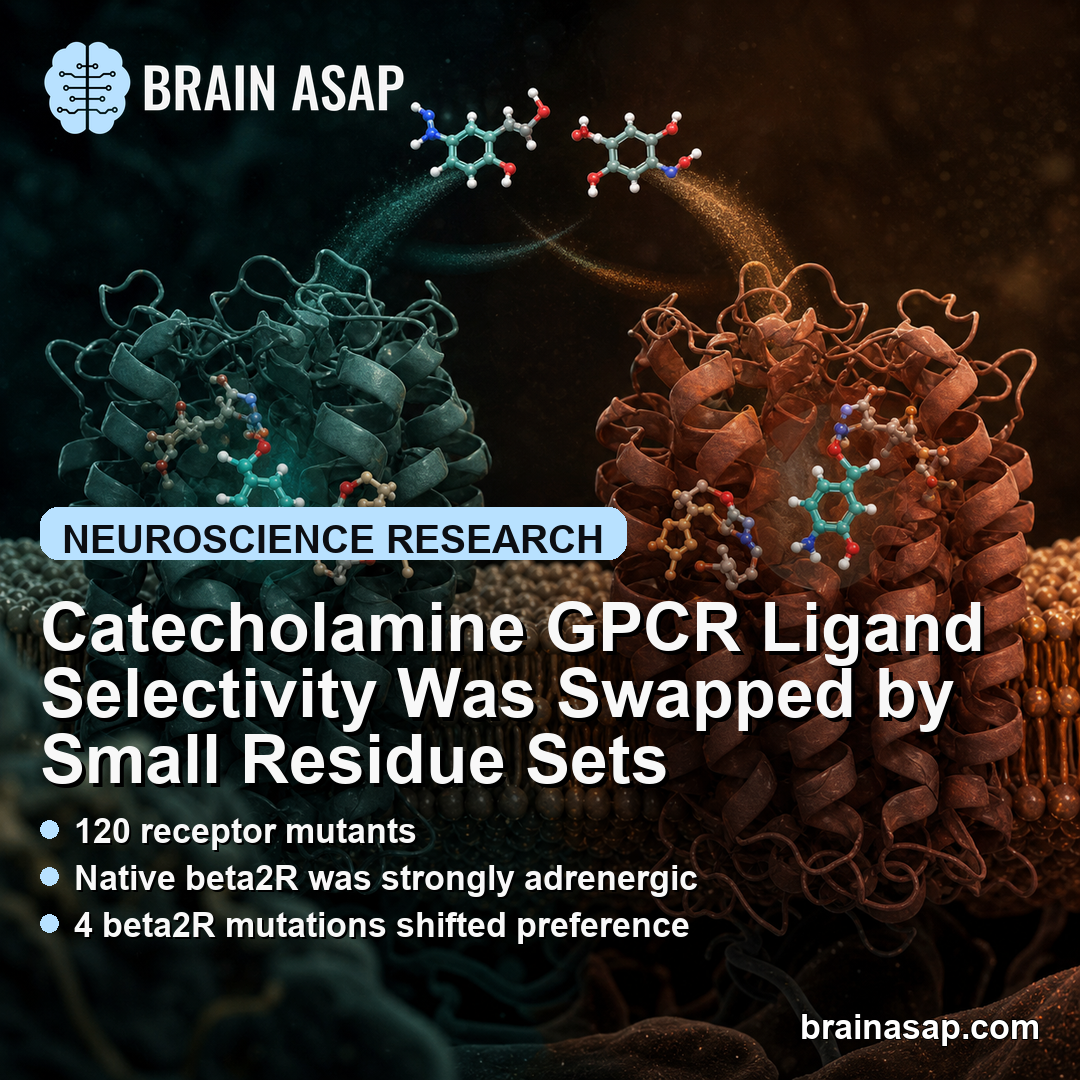
- 120 receptor mutants: Researchers tested 120 engineered catecholamine receptor mutants across beta2 adrenergic and D1 dopamine receptor systems.
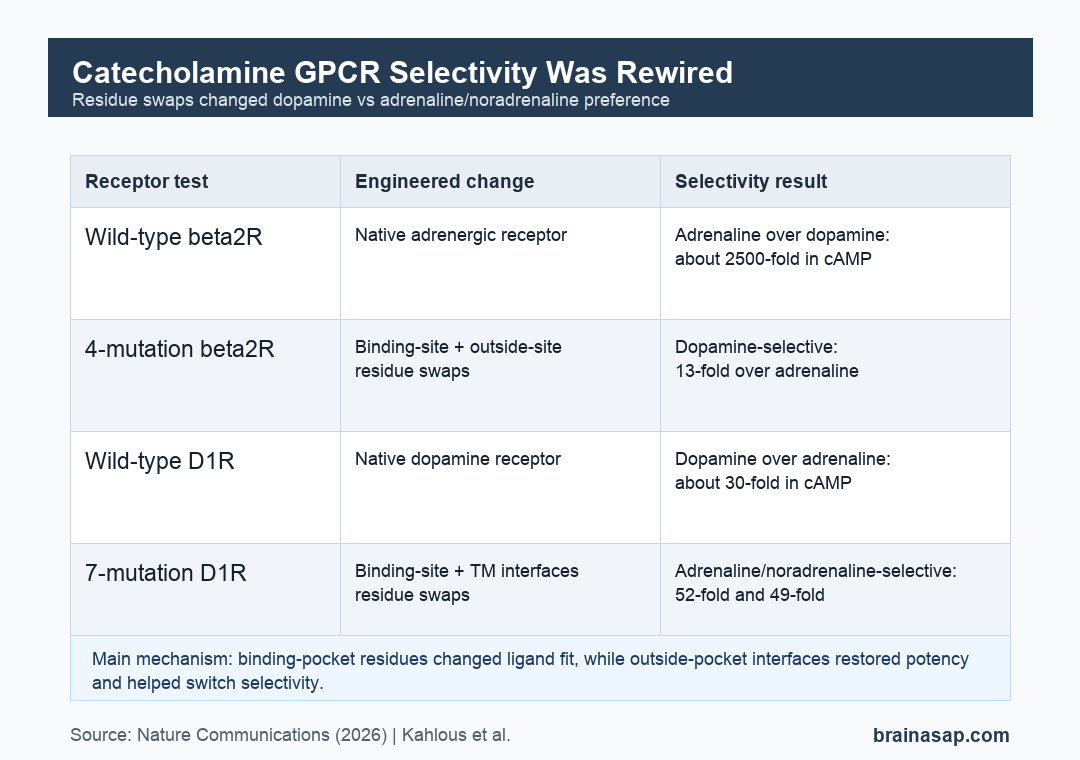
- Native beta2R was strongly adrenergic: In the cAMP assay, adrenaline was about 2500-fold more potent than dopamine at wild-type beta2R.
- 4 beta2R mutations shifted preference: The engineered beta2R mutant became dopamine-selective, with dopamine 13-fold more potent than adrenaline in cAMP signaling.
- 7 D1R mutations reversed the other direction: A D1R mutant became adrenaline/noradrenaline-selective, with 52-fold and 49-fold selectivity over dopamine in cAMP signaling.
- Binding-site changes were not enough: Mutations outside the orthosteric ligand pocket restored potency and helped complete the selectivity switch.
Source: Nature Communications (2026) | Kahlous et al.
Catecholamine Receptors Recognize Similar Chemical Messengers
G protein-coupled receptors (GPCRs) are cell-surface proteins that detect outside signals and trigger intracellular responses. Many brain and body drugs work by activating or blocking GPCRs.
This study focused on catecholamine receptors, especially the beta2 adrenergic receptor and the D1 dopamine receptor. These receptors are related, signal mainly through G-alpha-s pathways, and respond to chemically similar messengers.
The selectivity problem is subtle. Adrenaline, noradrenaline, and dopamine all contain a catecholamine scaffold, yet healthy signaling depends on receptors preferring the right native ligand.
In wild-type receptors, the difference was large. In cAMP signaling, beta2R preferred adrenaline over dopamine by about 2500-fold, while D1R preferred dopamine over adrenaline by about 30-fold.
Sequence and Structure Pointed to Selectivity Hotspots
The researchers compared receptor sequences across species and mapped the differences onto available receptor structures. That approach identified candidate selectivity hotspots, meaning positions likely to help decide which ligand a receptor favors.
Some hotspots were exactly where a reader would expect: inside the orthosteric binding site, the main ligand pocket where dopamine or adrenaline sits.
Other hotspots were more surprising. They sat outside the ligand pocket, in interfaces between transmembrane helices.
These regions did not directly touch the ligand in the structures, but they appeared to influence how the receptor handled activation.
The prioritized hotspots fell into three functional regions:
- Amine-binding pocket: residues near the part of the ligand that carries the amine group.
- TM3-TM4-TM5 interface: an outside-pocket region connected to receptor activation machinery.
- TM2-TM7 interface: another outside-pocket region that helped position ligand-recognition residues.
Binding-Pocket Mutations Reduced Selectivity but Also Hurt Potency
The first engineering tests changed residues inside the ligand-binding pocket. Those mutations often reduced native selectivity, but they did not reliably create a strong, functional receptor for the other ligand.
For beta2R, a double mutant involving positions 7×38 and 3×36 became modestly dopamine-selective. Dopamine was 10-fold and 9-fold more potent than adrenaline and noradrenaline, respectively.
The tradeoff was potency. Adrenaline potency dropped by about 6500-fold, and noradrenaline potency dropped by about 150-fold compared with wild-type beta2R.
The D1R binding-site mutants showed a similar pattern. Some mutations reduced dopamine preference or made the receptor less selective, but binding-pocket changes alone did not produce a clean, high-potency receptor swap.
The lesson is important for receptor biology. A ligand pocket is not just a static shape. It is connected to activation networks, so changing the pocket can disrupt the whole receptor response.
- Pocket fit changed: binding-site mutations altered how dopamine or adrenaline-like ligands sat in the receptor.
- Potency often fell: the receptor could lose response even when selectivity moved in the intended direction.
- Outside interfaces became necessary: surrounding regions helped recover signaling strength after the pocket was changed.
Outside-Pocket Mutations Restored Receptor Potency
The strongest result came when binding-pocket changes were combined with mutations outside the pocket. In beta2R, adding TM3-TM4-TM5 interface mutations improved agonist potency and produced a dopamine-selective receptor.
That 4-mutation beta2R receptor, V117S/E122L/T123N/N312V, gave dopamine a more physiologically relevant cAMP potency of pEC50 = 6.90 +/- 0.12. Dopamine was 13-fold more potent than adrenaline and 6-fold more potent than noradrenaline.
For D1R, the full switch required 7 mutations across the binding site and transmembrane interfaces. The engineered D1R mutant became selective for adrenaline and noradrenaline, with cAMP selectivities of 52-fold and 49-fold over dopamine.
The switched receptors were not simply promiscuous. Serotonin, histamine, and acetylcholine did not produce substantial cAMP responses at concentrations up to 100 micromolar.
- beta2R direction: an adrenergic receptor was shifted toward dopamine preference.
- D1R direction: a dopamine receptor was shifted toward adrenaline and noradrenaline preference.
- Specificity stayed constrained: unrelated messengers did not broadly activate the engineered receptors.
Cryo-EM and Simulations Explained the Receptor Switch
The study combined pharmacology with cryo-electron microscopy, a structural method for resolving protein shape, and molecular dynamics simulations, which model how atoms move over time.
Those methods supported a two-part mechanism. Binding-pocket residues changed the local fit for dopamine versus adrenaline-like ligands. Outside-pocket residues changed how the receptor stabilized an active signaling state after ligand binding.
The D1R result showed why the outside interfaces mattered. A TM2-TM7 interaction network helped position binding-site residues for ligand recognition, while a TM3-TM4-TM5 region enhanced receptor response.
Researchers also extended the analysis to other adrenergic, dopaminergic, and serotonergic receptors. Across 6 receptor-pair comparisons, 22 selectivity hotspot positions emerged, many near extracellular receptor regions.
Drug Design May Need Allosteric Selectivity Hotspots
For drug discovery, the main point is that receptor selectivity may be tuned outside the classic ligand pocket. Many GPCR drugs struggle to hit one receptor subtype without affecting related receptors.
The source highlighted allosteric opportunities, meaning drug sites away from the main orthosteric ligand pocket. These regions are often less conserved than the native binding site, which can make subtype-selective drugs easier to design.
The result also helps explain GPCR evolution. After gene duplication, receptor copies can keep enough function while gaining new ligand preference.
Outside-pocket mutations may create enough response to a new ligand before binding-pocket changes become optimized.
- Orthosteric sites: these main ligand pockets are highly conserved, which can make selectivity difficult.
- Allosteric pockets: outside-pocket regions may differ more between receptor subtypes.
- Simulation value: molecular dynamics can help predict how outside-pocket changes alter the main ligand site.
This is structural biology rather than a clinical trial. Still, catecholamine GPCRs are central to brain signaling, cardiovascular physiology, psychiatric pharmacology, and movement-related dopamine biology, so the mechanism has practical drug-design relevance.
Citation: DOI: 10.1038/s41467-026-71361-8. Kahlous et al. Molecular mechanisms of native ligand selectivity in catecholamine G protein-coupled receptors. Nature Communications. 2026.
Study Design: Structural biology, sequence analysis, receptor engineering, pharmacology, cryo-EM, and molecular-simulation study.
Sample/Model: Human beta2 adrenergic and D1 dopamine receptors, including 120 engineered receptor mutants.
Key Statistic: A 4-mutation beta2R mutant became dopamine-selective, while a 7-mutation D1R mutant became adrenaline/noradrenaline-selective with 52-fold and 49-fold cAMP selectivity over dopamine.
Caveat: The findings explain receptor mechanisms and drug-design possibilities, not clinical effects in patients.