TL;DR: A 2026 Nature Communications study followed 100 Swedish participants from age 4 to 24 and found that more than half of detectable blood proteins changed with age, with sex-related protein differences becoming much larger by adolescence and early adulthood.
Key Findings
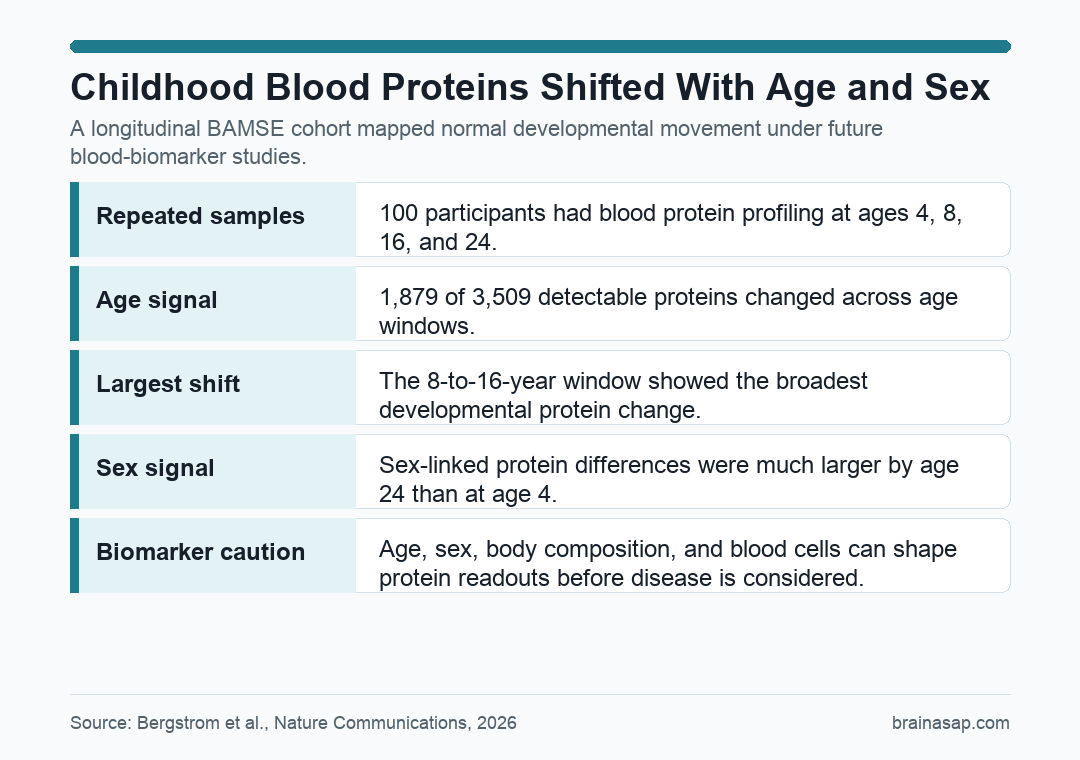
- Four repeated blood draws: Researchers measured plasma proteins at ages 4, 8, 16, and 24 in 100 participants from the Swedish BAMSE birth cohort.
- Large age pattern: Of 3,509 detectable proteins, 1,879 proteins, or 54%, differed across consecutive age windows.
- Puberty carried the largest shift: Between ages 8 and 16, 1,604 proteins changed, and 88% of those proteins were higher at age 16.
- Sex differences expanded later: Only a few proteins differed by sex at ages 4 and 8, but 183 differed at age 16 and 1,058 differed at age 24.
- Protein interpretation depends on developmental context: Age, sex, body composition, and blood cell counts can change protein levels before disease is even considered.
Source: Nature Communications (2026) | Bergstrom et al.
Blood proteomics can make a healthy child look biologically different from the same person years later. That sounds obvious for hormones and growth, but this study shows the scale of the shift across thousands of circulating proteins.
Researchers used the Olink Explore HT platform to measure 5,416 plasma proteins. After filtering for detectability, they analyzed 3,509 proteins across four follow-ups: age 4, age 8, age 16, and age 24.
The study was not trying to diagnose disease. It was trying to map the normal moving background that future blood-biomarker studies have to account for.
More Than Half of Detectable Blood Proteins Changed With Age
The main result was broad: 1,879 of 3,509 proteins showed at least one significant difference between two neighboring follow-ups. That means 54% of the detectable protein panel shifted somewhere between childhood and early adulthood.
Age did not act as one smooth upward or downward line. The researchers found different trajectories, including proteins that increased, proteins that decreased, and proteins that rose during adolescence before falling again by age 24.
- 4 to 8 years: Early-childhood changes were present, but they were not the largest transition in the dataset.
- 8 to 16 years: This was the strongest age window, with 1,604 changing proteins.
- 16 to 24 years: Some adolescent changes reversed or stabilized as participants moved into early adulthood.
The puberty-linked window matters because many pediatric biomarker studies compare children or teenagers across mixed ages. A protein difference can look disease-related when part of the difference is actually developmental timing.
Protein Trajectories Pointed to Growth, Neural Function, and Metabolism
The researchers grouped 1,879 age-associated proteins into eight trajectory clusters. These clusters helped show that the protein shifts were not random measurement noise.
Several clusters matched biological processes that make sense during development. Increasing clusters included protein-modification, cell-cycle, catabolic, and metabolic processes.
Fluctuating clusters included cellular respiration, immune-system terms, mitochondrial gene expression, chromosome organization, telomere structure, DNA replication, and mRNA processing.
For BrainASAP, the most relevant point is the decreasing cluster biology. Some proteins that fell across development were enriched for neuron projection morphogenesis, cell projection morphogenesis, cell adhesion, and positive regulation of hormone secretion.
The blood test did not measure brain structure directly. It showed that circulating proteins carried developmental patterns related to neural and cell-projection pathways.
This distinction is important when blood biomarkers are used as indirect readouts in pediatric neuroscience.
Sex-Related Protein Differences Were Small in Childhood and Large by Age 24
At ages 4 and 8, only a handful of proteins differed significantly between female and male participants. By age 16, 183 proteins differed by sex.
By age 24, the number rose to 1,058 proteins, or 30% of the detectable panel.
The direction was also striking. At age 16, 166 of 183 sex-different proteins were higher in male participants. At age 24, 1,030 of 1,058 were higher in male participants.
- Reproductive biology: Some of the strongest sex-linked proteins were expected reproductive or sex-chromosome-associated proteins.
- Immune biology: Several immune-related proteins also differed by sex, matching broader evidence that immune profiles differ between female and male participants.
- Body composition: Adjusting for body fat percentage reduced about 12% of the age-24 sex-related differences.
- Blood cell counts: Adjusting for leukocyte and erythrocyte counts reduced about 40% of the age-24 sex-related differences.
This is a practical warning for biomarker work. If a pediatric or young-adult study does not model sex, body composition, and blood cell counts carefully, disease patterns can get mixed with normal developmental biology.
The Study Gives Biomarker Research a Healthy Development Baseline
The useful contribution is a baseline map. Blood proteins are often studied because they are easier to collect than cerebrospinal fluid, imaging data, or tissue samples.
Easy access does not make the measurement simple.
A protein that changes with depression, neurodevelopmental risk, inflammation, or cognition may also change with age, pubertal timing, sex, body fat, and blood cell composition.
Those factors are not side details. They can shape the measured value before any disorder enters the analysis.
The developmental scale also matters for clinical translation. A child at age 8 and the same person at age 16 may sit in different molecular states even when both are healthy.
- For pediatric studies: Narrow age bands and repeated measurements can prevent developmental change from being mistaken for pathology.
- For adult comparisons: Sex differences seen in adulthood may begin emerging during adolescence, not appear suddenly later.
- For neuroscience biomarkers: Blood protein readouts tied to neural-function terms still need careful interpretation because blood is an indirect tissue source.
The Sample Was Small and Mostly White
The study’s strongest feature was repeated measurement in the same people over time.
Its main limitation was scale. The analysis used 100 participants, and the cohort was described as relatively small and mainly white.
The platform also did not cover the entire proteome. Olink Explore HT measured more than 5,000 proteins, but only 3,509 proteins passed the detectability filter for the main analysis.
Sample storage time and changing lab conditions could also affect some protein levels because blood samples came from different follow-up years. The authors could not fully rule out that kind of technical influence.
Even with those limits, the study is useful because it shows how much normal developmental movement sits underneath blood-protein biomarker research. Future studies will need larger, more diverse cohorts to test whether the same age and sex patterns hold across populations.
Citation: DOI: 10.1038/s41467-026-72095-3. Bergstrom et al. Longitudinal protein profiling of blood during childhood into early adulthood. Nature Communications. 2026;17:3700.
Study Design: Population-based longitudinal plasma-proteomics study with four childhood-to-adulthood follow-ups.
Sample Size: 100 participants from the Swedish BAMSE birth cohort.
Key Statistic: 1,879 of 3,509 detectable proteins, or 54%, differed across consecutive age windows.
Caveat: The cohort was small and mainly white, and the Olink panel did not cover the full human proteome.