TL;DR: A 2026 preprint in medRxiv using ABCD Study data found that childhood poverty strengthened the link between early-life adversity and later behavioral problems, while inhibitory-control brain and temperament profiles separated higher- and lower-risk patterns within poverty-exposed youth.
Key Findings
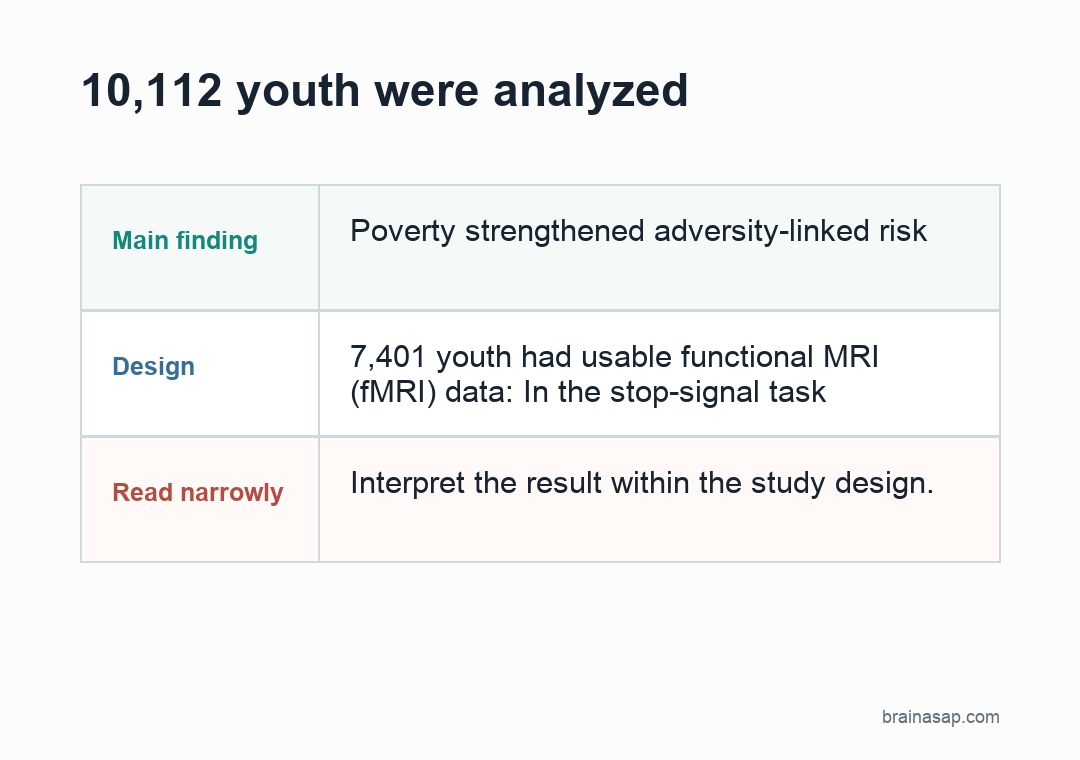
- 10,112 youth were analyzed: Researchers used the Adolescent Brain Cognitive Development Study to link baseline early-life adversity with Child Behavior Checklist Total Problems across four assessment waves.
- Poverty amplified adversity-linked risk: Childhood poverty strengthened the adversity-to-behavioral-problems slope at baseline and across follow-up, rather than acting only as a background demographic label.
- 7,401 youth had usable functional MRI (fMRI) data: In the stop-signal task subsample, researchers identified two inhibitory-control neurofunctional subtypes among poverty-exposed youth.
- Subtype 1 showed greater vulnerability: This poverty-exposed group had a steeper adversity-behavioral-problems association than higher-income youth.
- Subtype 2 looked more buffered: In subtype 2 youth with high temperamental inhibitory control, cumulative early-life adversity no longer significantly predicted later behavioral problems.
Source: medRxiv preprint (2026) | Hu et al.
Childhood Poverty Changed the Adversity-Behavior Slope
Childhood poverty is often treated as a broad risk category. This analysis asked a more specific question: whether poverty changes how strongly early-life adversity translates into later behavioral problems.
The researchers used the ABCD Study, a large U.S. cohort following children from late childhood into adolescence.
The main sample included 10,112 youth, with behavioral-problem data available across as many as four waves.
Behavioral problems were measured with the Child Behavior Checklist (CBCL) Total Problems score, a parent-reported measure that captures a broad mix of emotional and behavioral symptoms.
The important detail is the slope. Poverty-exposed youth did not simply have a different average symptom level.
Childhood poverty amplified the association between cumulative adversity and CBCL problems, meaning each added adversity carried a stronger behavioral-risk signal.
The Study Measured Adversity as a Cumulative Burden
The adversity index covered multiple parts of a child’s environment rather than a single exposure. Researchers built an early-life adversity score from indicators spanning prenatal exposure, child health or trauma, family functioning, peer adversity, school context, and neighborhood context.
This broad setup is important because poverty rarely arrives as one isolated stressor. It often clusters with other pressures, and the analysis tried to model the combined burden.
- Exposure: Childhood poverty was defined at wave 1 using the federal poverty threshold adjusted for household income and family size.
- Adversity measure: Cumulative early-life adversity was scaled from multiple indicators rather than a single yes-or-no event.
- Outcome: Later behavioral problems were tracked with CBCL Total Problems scores across follow-up waves.
- Main model: The statistical target was adversity-linked vulnerability, or the slope connecting adversity burden to behavioral problems.
At baseline, poverty amplified that adversity-behavior association with a reported coefficient of beta = 0.088 and P < .001. The same pattern persisted across the longitudinal waves.
Inhibitory-Control Brain Profiles Split Poverty-Exposed Youth
The next step focused on inhibitory control, the ability to stop or withhold a response. In the ABCD imaging task, researchers used the stop-signal task, where children must respond quickly but sometimes cancel the response when a stop signal appears.
The functional MRI (fMRI) subsample included 7,401 youth with usable stop-signal task activation data. Researchers applied a semi-supervised clustering method to identify neurofunctional subtypes among poverty-exposed youth, using activation across cortical and subcortical regions.
Two subtypes emerged. Subtype 1 showed a steeper adversity-CBCL slope than higher-income youth, with a reported coefficient of beta = 0.149 and P < .001.
Subtype 2 showed an attenuated slope that did not significantly differ from higher-income youth, with beta = 0.049 and P = .135.
High Temperamental Control Marked the Most Buffered Pattern
Brain activation was not the only inhibitory-control measure. Researchers also used caregiver-rated temperamental inhibitory control from the Early Adolescent Temperament Questionnaire-Revised, which reflects everyday self-regulation.
The most buffered pattern appeared when both levels aligned: poverty-exposed youth in subtype 2 who also had high temperamental inhibitory control. In that group, cumulative early-life adversity no longer significantly predicted later CBCL Total Problems.
Self-control did not make poverty harmless. The measured adversity-behavior slope was much weaker in one neurobehavioral subgroup.
- Brain task measure: Stop-signal fMRI captured neural activation during response inhibition.
- Temperament measure: Caregiver ratings captured everyday inhibitory-control behavior outside the scanner.
- Joint pattern: Lower-risk profiles appeared when subtype 2 activation paired with high temperamental inhibitory control.
This avoids a one-size-fits-all poverty story. Within the same high-risk context, some children showed a stronger adversity-linked symptom slope, while others showed a more buffered developmental pattern.
The Preprint Status Keeps the Claim Provisional
This source is a medRxiv preprint, so it has not been certified by peer review and should not guide clinical decisions by itself. The analysis is also observational, meaning it cannot prove that changing inhibitory control would directly reduce later behavioral problems.
The limitations are still clear enough to name. CBCL outcomes came from parent reports, which can carry reporting bias.
The sample was community-based but not fully representative. The researchers also note that apparent psychological resilience can sometimes come with physical-health trade-offs that this analysis did not resolve.
- Measurement limit: Behavioral outcomes relied on parent-reported CBCL Total Problems, not clinical interviews.
- Design limit: The study estimated associations and developmental slopes, not causal intervention effects.
- Generalizability limit: Findings may not transfer to children facing different forms of structural inequity.
- Health trade-off limit: Lower behavioral-problem slopes do not prove that the same children have lower physical stress burden.
The central estimate stays specific despite those limits. Childhood poverty strengthened the link between cumulative adversity and later behavioral problems, and inhibitory-control profiles helped separate which poverty-exposed children showed steeper versus weaker vulnerability patterns.
Citation: DOI: 10.64898/2026.04.18.26350994. Hu et al. Neurobehavioral Profiles of Inhibitory-Control Stratify Vulnerability and Resilience under Childhood Poverty. medRxiv. 2026.
Study Design: Prospective observational cohort analysis of ABCD Study data with stop-signal task fMRI subtyping in a large imaging subsample.
Sample Size: 10,112 youth in the primary analysis and 7,401 youth in the usable stop-signal task fMRI subsample.
Key Statistic: Poverty-exposed subtype 1 showed a steeper adversity-CBCL slope than higher-income youth (beta = 0.149; P < .001), while subtype 2 did not significantly differ from higher-income youth (beta = 0.049; P = .135).
Caveat: This is a non-peer-reviewed preprint using observational data and parent-reported behavioral outcomes.