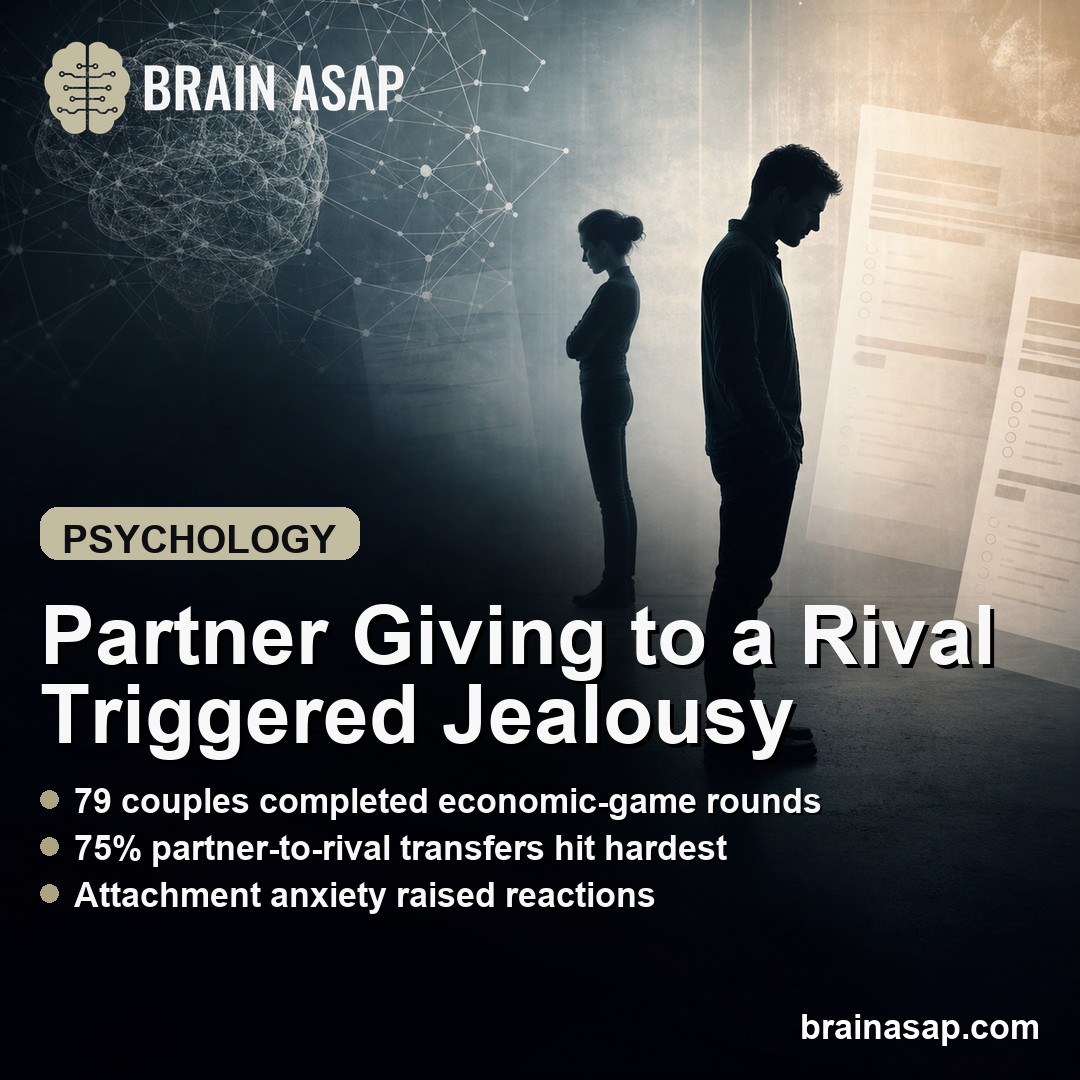
TL;DR: A 2025 study in Evolution and Human Behavior found that both men and women reported the strongest romantic jealousy when a partner actively gave most of a money allocation to an opposite-sex rival.
Key Findings
- Partner investment was the strongest trigger: Jealousy rose most when participants saw their partner give 75% of the available money to a potential rival.
- Men and women showed the same main pattern: The partner-giving condition produced high jealousy in both sexes, not only in women.
- Receiving money was weaker: A partner accepting resources from a rival produced lower jealousy than the partner actively giving resources away.
- Controls narrowed the claim: Unequal money movement between strangers did not explain the effect by itself.
- Relationship insecurity mattered: Digital jealousy and anxious attachment predicted stronger jealousy across the economic-game scenarios.
Source: Evolution and Human Behavior (2025) | Fernández et al.
Jealousy is often studied with imagined infidelity questions. This experiment used a different test: real couples watched money move between a partner and an opposite-sex stranger while rating their jealousy after each round.
The main response was direct: giving resources to a rival looked more threatening than passively receiving resources from that rival.
Men and women showed the same main response.
Economic Games Tested Romantic Jealousy in 79 Couples
The researchers recruited 79 heterosexual couples, for a total of 158 participants. Each couple had been together at least 6 months, and the average participant was around age 30.
Couples came to the lab together but sat behind a partition. Participants believed they were interacting online with their real partner and an opposite-sex stranger.
The stranger functioned as a possible romantic rival.
The task was based on a dictator game, a common economic game in which a person controls a pot of money and decides how much another person receives. Here, the money split was used as a controlled signal of partner attention and resource allocation.
The design separated several kinds of resource movement:
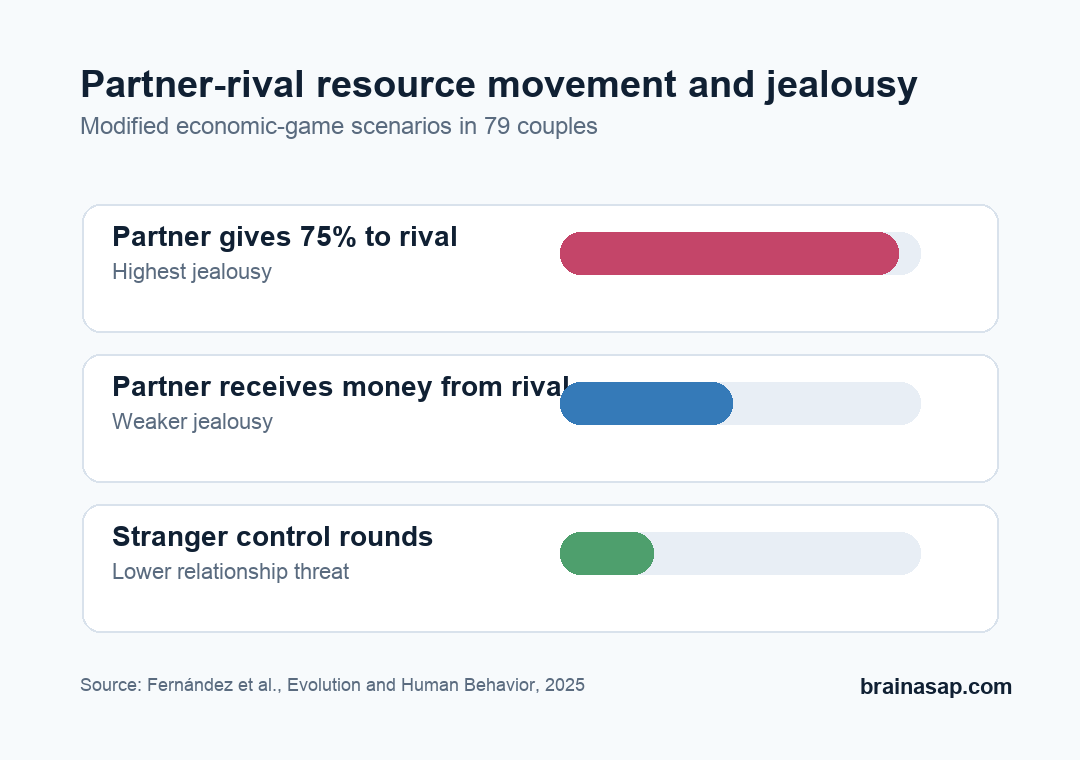
- Partner gives to rival: The participant saw the partner allocate most of the money to the opposite-sex stranger.
- Partner receives from rival: The participant saw the partner accept a large amount from the opposite-sex stranger.
- Stranger control rounds: Participants also watched money move between people who were not their own partner.
After each round, participants rated jealousy on a 1-to-5 scale. That made the study less dependent on a single imagined cheating vignette and more focused on how people reacted to a concrete partner-rival action.
Partner Giving 75% to a Rival Produced the Highest Jealousy
The strongest condition had the partner give 75% of the available money to the rival and keep only 25% for the participant.
In ordinary relationship terms, the partner was not just attracting attention. The partner was actively investing in someone else.
That active investment mattered. Both men and women rated this situation as the clearest jealousy trigger.
The finding does not fit a simple version of the idea that women should be uniquely sensitive to resource diversion while men should mainly respond to rival courtship.
The receiving condition was different. When a rival gave resources to the partner and the partner accepted them, jealousy was weaker and did not show the expected male-specific spike.
Accepting money from a rival may be ambiguous: it could signal interest, but it could also look like taking a free benefit.
Control Rounds Kept the Result Tied to the Relationship
The control rounds are important because unequal money splits can feel unfair even when no romantic threat exists. The study asked whether people were simply reacting to unfairness, opposite-sex interaction, or money movement in general.
The control rounds narrowed the claim. Jealousy was strongest when the money movement involved the participant’s own partner and a possible rival.
Watching strangers allocate resources did not reproduce the same reaction.
One control finding still pointed to a sex-linked vigilance pattern. Women reported jealousy when they saw a committed man give resources to a single woman, even when that man was a stranger.
That suggests some sensitivity to male resource allocation may generalize beyond the participant’s own relationship, but it was not the main driver of the partner-rival effect.
The cleanest interpretation is therefore specific:
- Resource transfer alone was not enough: The control scenarios reduced the chance that the effect reflected only unfair allocation.
- Opposite-sex contact alone was not enough: Jealousy was tied to partner-relevant threat, not just observing men and women interact.
- Partner intent carried weight: Actively giving away resources looked more relationally meaningful than receiving resources.
Attachment Anxiety and Digital Jealousy Raised Reactions
The researchers also measured relationship-insecurity traits. Two stood out: digital jealousy, meaning worry about a partner’s online interactions, and attachment anxiety, meaning fear of abandonment and high need for reassurance.
Participants higher on these traits reported more jealousy across the scenarios. The economic-game manipulation still mattered.
It means the same partner-rival cue landed harder in people who were already more alert to relationship loss.
Attachment avoidance was part of the broader questionnaire set, but the main reader-facing point is that jealousy was not only a situation effect. It reflected both the cue and the person’s relationship-security profile.
What This Jealousy Experiment Can and Cannot Show
The study gives a controlled way to test a relationship emotion without asking only about imaginary infidelity. The 79-couple lab design let researchers compare partner giving, partner receiving, and stranger-control conditions inside the same broad setup.
The limits are also clear. Small money allocations are not the same as actual betrayal, and jealousy was measured by self-report.
Participants were mostly young, educated, heterosexual couples, so the result should not be stretched to every age group, culture, relationship structure, or sexual orientation.
The experiment also names the cue precisely. The strongest jealousy response came from active partner investment in a rival.
Receiving attention from a rival was weaker than watching a partner choose to send resources outward.
Citation: DOI: 10.1016/j.evolhumbehav.2025.106816; Fernández et al. Resource allocation and romantic jealousy: An experimental test of sex differences using economic games. Evolution and Human Behavior. 2025.
Study Design: Laboratory experiment using modified economic games with real heterosexual couples.
Sample Size: 79 couples, or 158 individual participants.
Key Statistic: The main jealousy condition showed a partner allocating 75% of the money to an opposite-sex rival.
Caveat: Lab money decisions and self-reported jealousy do not capture the full emotional weight of real-world infidelity.