TL;DR: A 2026 study in Evolutionary Psychological Science linked more conservative social attitudes with a slightly higher reported number of biological children across 72 countries, with stronger patterns for women on some attitude measures.
Key Findings
- Cross-national sample: the final analytic sample covered 78,754 adults from 72 countries after missing-data and country-size exclusions.
- Conservative attitude measures: right-wing ideology, religiousness, preference for a religious partner, and lower support for gender equality were linked with higher reported fertility.
- Age dominated: the attitude associations were small compared with age, the strongest predictor of number of biological children.
- Women showed stronger links: right-wing ideology and lower gender-equality support were more strongly tied to fertility among women than men.
- Causality remains open: the cross-sectional design cannot show that attitudes caused fertility differences or prove evolutionary selection.
Source: Međedović, DOI: 10.1007/s40806-026-00476-4.
A large cross-national analysis found that adults who endorsed more socially conservative attitudes tended to report having more biological children. The pattern appeared across a nearly 80,000-person analytic sample, but the effect should not be read as a simple claim that politics alone determines family size.
The study treated social conservatism as a broad attitude cluster rather than a single party label. It included political ideology, religiousness, desired partner religiousness, and support for gender equality, then tested how those measures related to reported fertility.
Conservative Social Attitudes Were Linked With More Children
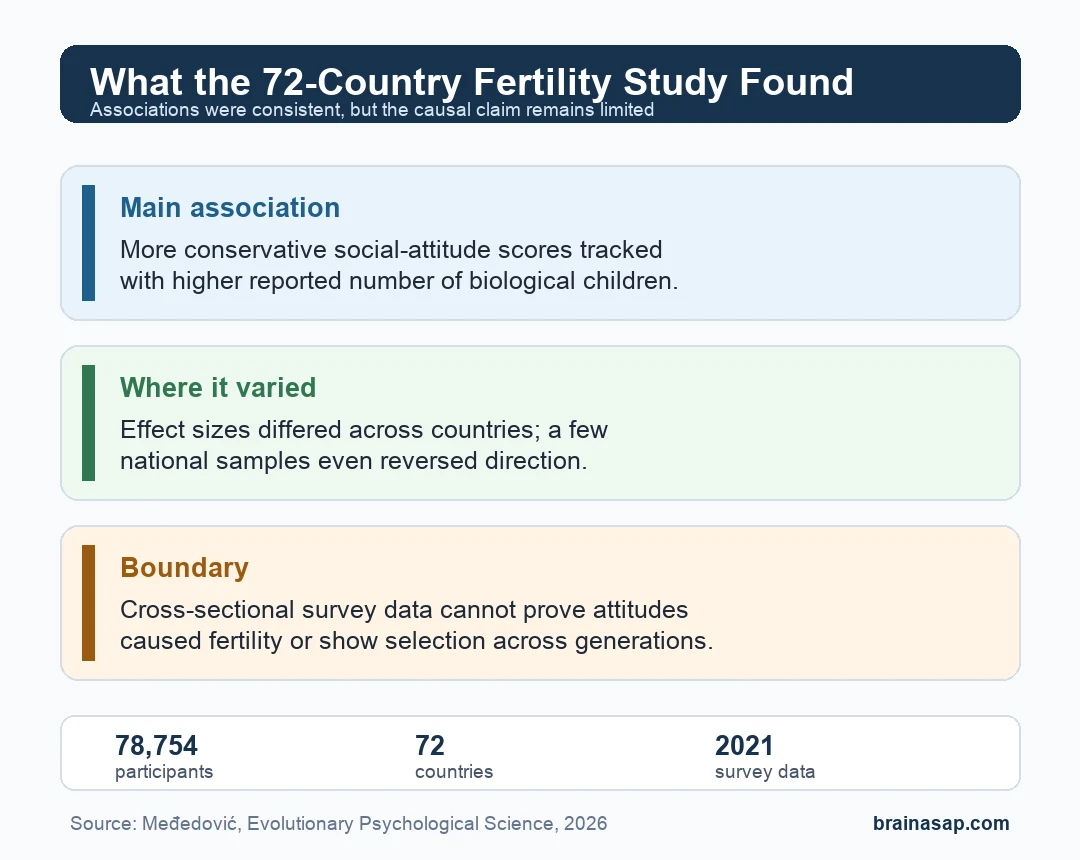
The analysis used a public dataset originally collected for research on romantic love and mate preferences. After exclusions, the final sample included 78,754 participants from 72 countries, with most data collected online in 2021.
Participants reported their number of biological children and answered items about several social attitudes. The main pattern was consistent: people with more conservative scores tended to report more children.
- Right-wing ideology: more right-leaning self-placement was associated with higher reported fertility.
- Religiousness: more religious participants tended to report more biological children.
- Partner preference: wanting a more religious romantic partner was also linked with higher fertility.
- Gender-equality attitudes: lower support for gender equality was associated with more reported children.
Those relationships were statistically reliable in the large sample, but they were not the biggest forces in the model. Age was by far the strongest predictor, which is expected because older adults have had more time to have children.
The Fertility Pattern Varied Across Countries
The association was not identical everywhere. The researcher found that effect sizes varied across national samples, and in a small number of countries the direction even reversed.
Country variation is central because fertility is shaped by more than individual belief. Access to education, contraception, childcare, labor markets, religious institutions, family norms, housing costs, and national policy can all change how attitudes translate into actual family size.
The study therefore supports a narrower conclusion: social attitudes and fertility were linked in this dataset. It does not show a universal mechanism that works the same way in every country.
Women Showed Stronger Links for Some Attitudes
Several gender-specific patterns stood out. Right-wing ideology and lower support for gender equality were more strongly associated with fertility among women than among men.
One practical interpretation is that attitudes about family roles may be more directly connected to women’s reproductive outcomes in this dataset.
This is still an association, not a causal result. The pattern was stronger for women after accounting for the variables included in the model.
- Ideology difference: right-wing ideology predicted higher fertility more clearly among women.
- Gender-equality difference: lower support for gender equality also had a stronger fertility association among women.
- Education difference: right-wing ideology predicted fertility among less educated participants, but not among highly educated participants.
Religiousness also interacted with partner preference. Participants who were low in religiousness and preferred nonreligious partners had especially low reported fertility, according to the study summary.
Positive Directional Selection Is a Hypothesis, Not a Proven Result
The paper frames the findings around positive directional selection, a term from evolutionary research. The phrase means a trait could become more common over generations if people who have the trait tend to have more children, and if the trait is at least partly heritable.
That is a possible interpretation here, but the study cannot prove it directly. The dataset measured attitudes and self-reported children at one point in time.
It did not follow families across generations or test whether specific attitudes were transmitted genetically, culturally, or through both pathways.
- Cross-sectional design: the study cannot establish that attitudes caused higher fertility.
- Young sample: average ages were about 31.5 years for men and 29.5 years for women, so many participants may not have completed childbearing.
- Measurement limits: several attitudes were measured with single survey items, which can reduce precision.
- Sample composition: women and more educated participants were likely overrepresented.
The strongest takeaway is more modest and more useful: social attitudes belong in fertility research. They may help explain why people in similar economic or national settings still make different family-size choices.
Why This Fertility Study Needs Careful Wording
Because the topic touches politics, gender roles, religion, and evolution, wording matters. A small association in a large survey should not be converted into a sweeping claim about personality, morality, or destiny.
The data show that attitude patterns tracked reported fertility. They do not show that conservative attitudes are biologically superior, that any ideology should be promoted for population reasons, or that people with different attitudes cannot have the family size they want.
For psychology and population research, the finding is still important. It suggests that fertility differences may reflect not only income, education, policy, and age, but also the social values people bring to partnership and family decisions.
Citation: DOI: 10.1007/s40806-026-00476-4. Međedović. Conservative Social Attitudes are Linked with Fertility: A Potential for Positive Directional Selection. Evolutionary Psychological Science. 2026.
Study Design: Cross-national survey analysis using a public romantic-love and mate-preference dataset.
Sample Size: 78,754 participants from 72 countries after exclusions.
Key Statistic: Conservative attitude measures were consistently associated with higher reported fertility, although age was the strongest predictor.
Caveat: Cross-sectional survey data cannot prove causality, completed fertility, or evolutionary selection across generations.