TL;DR: A 2026 rat study in Hippocampus found that the dentate gyrus (DG), a hippocampal memory region, gained about 385,000 granule neurons from 2 to 18 months of age even though older development-born neurons were also being lost.
Key Findings
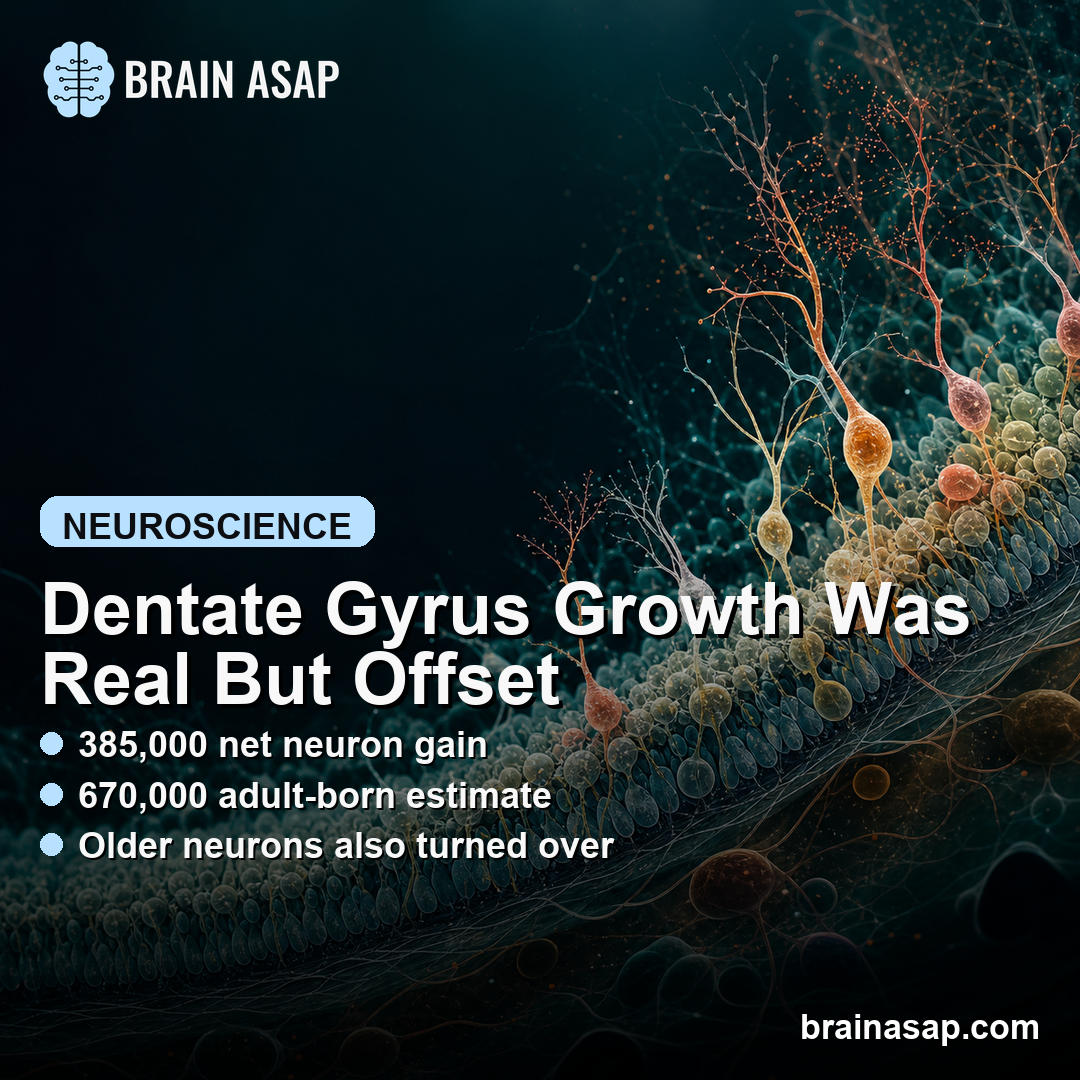
- 385,000-cell net gain: Total DG granule neuron counts increased by about 385,000 cells from 2 to 18 months, a roughly 20% increase.
- 670,000 adult-born estimate: Ki67+ proliferating-cell counts suggested about 670,000 adult-born neurons were added over the same age window.
- Development-born loss: CldU-labeled neurons born on postnatal day 6 declined by about 30,000 cells, or 19%, between 2 and 18 months.
- Turnover narrowed growth: Net DG growth was smaller than the adult-born-neuron estimate, suggesting that new-neuron addition and old-neuron loss happened together.
- Male-rat limitation: The work used male Long-Evans rats, so the result should not be read as a direct human hippocampus estimate.
Source: Hippocampus (2026) | Ciric et al.
The dentate gyrus is part of the hippocampus, a brain system involved in memory processing. It is also one of the best-known mammalian regions where new neurons can still be produced after early development.
That has created a simple but unsettled test: if adult neurogenesis keeps adding neurons, should the dentate gyrus visibly grow across adulthood? Researchers addressed the issue by counting neuron birth, neuron loss, and total granule-cell number in the same age framework.
Researchers Counted Neuron Addition and Neuron Loss Across Rat Adulthood
Researchers used male Long-Evans rats examined at 2, 4, 6, 12, and 18 months of age. The design let them compare young adulthood with later adult ages rather than only asking whether very old animals had lost cells.
The study tracked three related measurements:
- Ki67+ cells: Ki67 is a proliferation marker, used here as a proxy for new adult-born neuron production in the DG.
- CldU+ cells: CldU given on postnatal day 6 labeled developmentally born neurons so researchers could estimate how many persisted with age.
- Cresyl violet counts: Stereological counting of stained granule cells estimated the total DG granule-neuron population.
The three-measure design reduced a specific interpretation risk. Adult-born neurons can increase the population, while older development-born neurons can disappear at the same time.
Adult-Born Neuron Estimates Were Larger Than Net DG Growth
Ki67+ proliferating-cell counts declined strongly with age and plateaued by 12 months. The age pattern was best fit by a cubic model, and the integrated estimate suggested about 670,000 adult-born cells were added from 2 to 18 months.
Total granule-cell counts told a related but smaller story. Stereological cresyl violet counts estimated about 24,000 added granule cells per month, producing about 385,000 net added cells across the 16-month window.
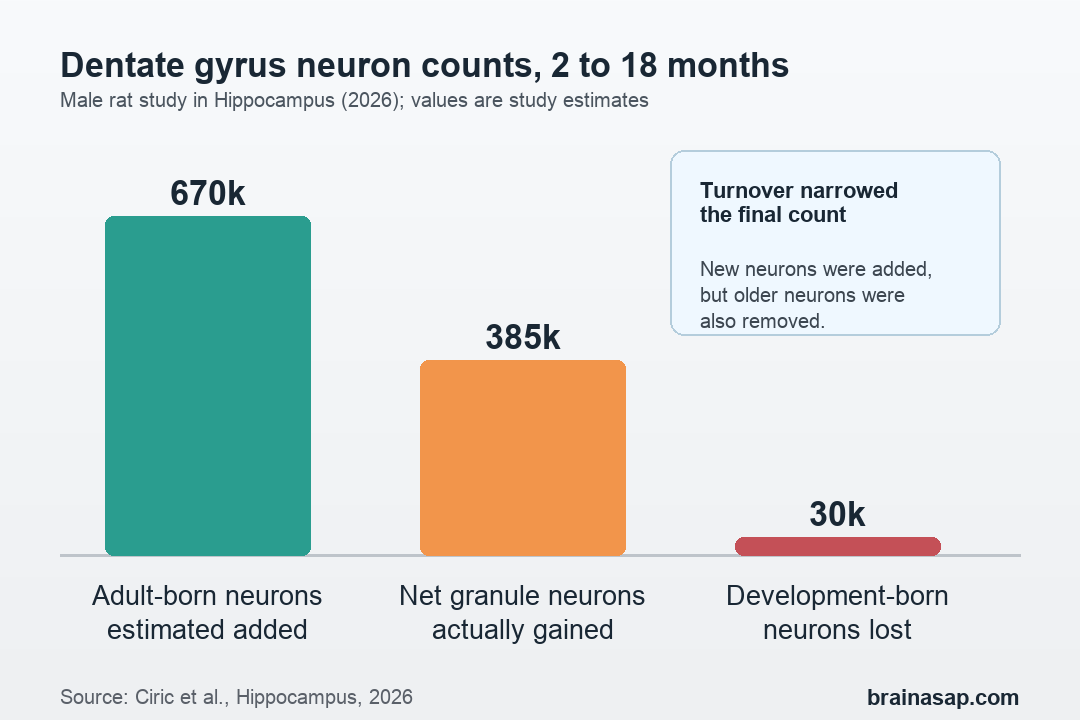
The difference shows why total DG growth cannot be read from adult neurogenesis alone. If adult neurogenesis alone had determined the total count, net growth would have approached the larger Ki67-based estimate.
Instead, total DG growth was substantial but partly offset.
Development-Born Neurons Declined During the Same Window
The offset came from older neurons. CldU-labeled cells born on postnatal day 6 declined with age, with linear regression estimating about 1,900 P6-born cells lost per month.
Across the full 2-to-18-month interval, that equaled about 30,000 labeled cells lost, or a 19% decline in that labeled development-born population.
Study authors argued that scaling that single-day loss across the peak developmental birth period could explain much of the gap between 670,000 added adult-born cells and 385,000 net added cells.
The apoptosis analysis supported the idea that mature granule cells were part of the turnover process. Activated caspase-3 positive cells were rare, but some dying cells sat in more superficial regions of the granule-cell layer, where older development-born neurons are expected rather than the newest immature neurons.
The Result Changes How DG Growth Should Be Interpreted
The study does not say that the adult dentate gyrus is simply expanding without loss. A more accurate reading is that neuron addition and neuron turnover both shaped the final count.
That distinction helps explain why earlier studies could miss DG growth. If a study starts too late in adulthood, uses small samples, or focuses mainly on aging-related loss, it may miss the period when adult-born neurons contribute most to net growth.
The paper’s comparison with prior work points to several interpretation issues:
- Age window: The current study started at 2 months, before much of the adult-born-neuron accumulation had already happened.
- Counting method: The total neuron estimate used stereological principles rather than relying only on marker-positive snapshots.
- Turnover problem: Net growth can look modest when development-born neuron loss is happening at the same time.
Human Translation Is Plausible but Not Direct
For human brain health, the careful point is not that adult humans gain the same number of hippocampal neurons. Species, lifespan, developmental timing, and sex all matter, and this experiment used male rats only.
The finding still informs how hippocampal volume and dentate gyrus cell number are discussed in depression, schizophrenia, electroconvulsive therapy, aging, and memory research. The analysis argues that volume changes should not be attributed to adult neurogenesis alone.
Several mechanisms can affect hippocampal size or cell counts:
- New-neuron addition: Adult-born granule neurons can add cells to the DG population.
- Development-born turnover: Older neurons may be removed, narrowing the net growth seen in total counts.
- Dendritic remodeling: Changes in neuronal branches can alter hippocampal volume without requiring matching neuron-number changes.
- Cell packing: This study found DG granule-cell density increased even as granule-cell-layer volume decreased.
Memory Theories May Need Both Addition and Removal
The memory implication is exploratory, but it is the clearest biological question raised by the cell-count pattern. New neurons could increase dentate gyrus storage capacity, while removal of older neurons could help clear or remodel older hippocampal traces.
Researchers were careful not to prove that specific memories were removed by specific cell deaths. The study counted cells, not memory traces.
Still, the pattern supports a useful model: hippocampal plasticity may depend on both adding adult-born neurons and selectively removing older cells. Future experiments would need to test whether learning, stress, disease, or treatment changes that balance.
Citation: DOI: 10.1002/hipo.70099. Study authors et al. Ciric et al. The Dentate Gyrus Grows Throughout Life Despite Turnover of Developmentally-Born Neurons. Hippocampus . 2026;36:e70099.
Study Design: Cross-sectional male-rat histology study using proliferation, birthdating, apoptosis, and stereological cell-count measures across adulthood.
Sample/Model: Male Long-Evans rats examined at five adult ages from young adulthood through 18 months.
Key Statistic: Total DG granule neurons increased by about 385,000 cells across the adult-age window, while Ki67-based modeling estimated about 670,000 adult-born cells added.
Caveat: Ki67, CldU, and cresyl violet counts are indirect snapshots across animals, and the study does not establish the same growth pattern in humans or female rats.