TL;DR: A 2026 review in Translational Neurodegeneration found that most repurposed multiple system atrophy drugs failed to show disease-slowing effects in trials, while ubiquinol produced the clearest placebo-controlled motor-progression signal.
Key Findings
- No proven disease-modifying therapy: Multiple system atrophy remains a rapidly progressive neurodegenerative disease without an approved treatment that slows progression.
- Four target classes dominated: Repurposed drugs targeted alpha-synuclein aggregation, neuroinflammation, mitochondrial dysfunction/excitotoxicity, and impaired neurotrophic support.
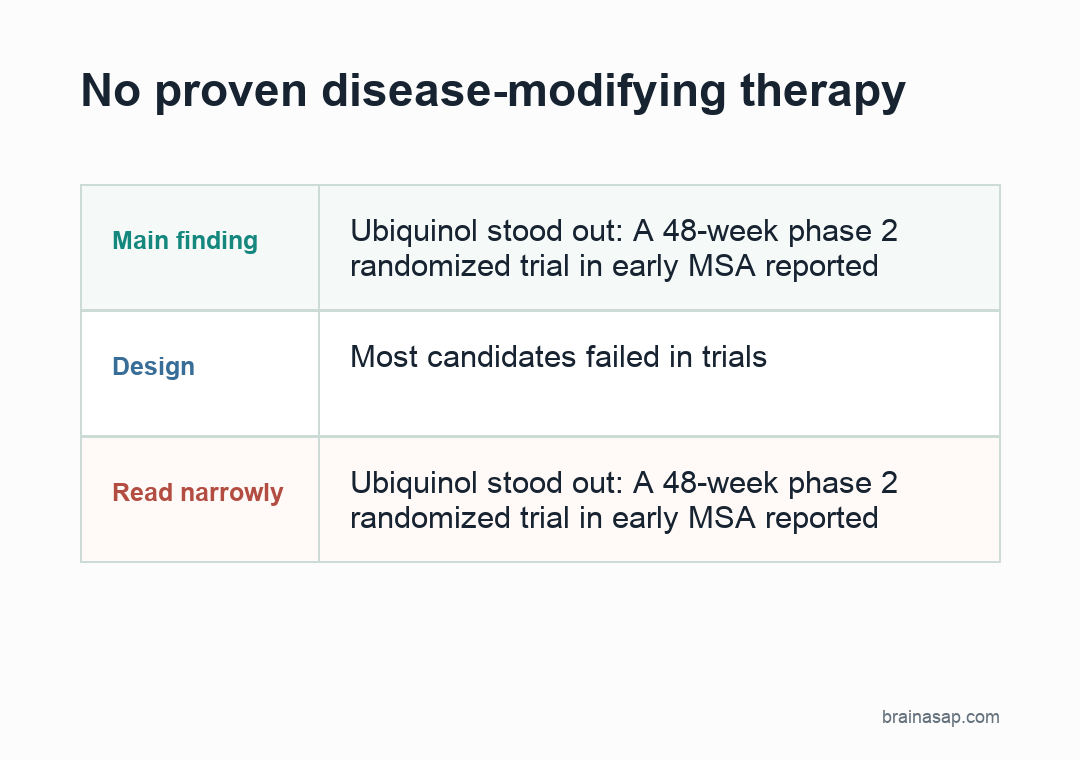
- Many trials failed: Rifampicin, lithium, EGCG, minocycline, rasagiline, and riluzole did not establish clear disease-slowing benefit in MSA trials.
- Ubiquinol stood out: A 48-week phase 2 randomized trial in early MSA reported smaller worsening in UMSARS Part II motor scores versus placebo.
- Exenatide remained uncertain: A 48-week open-label phase 2 study showed less UMSARS I+II worsening, but biomarkers did not confirm disease modification.
Source: Translational Neurodegeneration (2026) | Jeong et al.
MSA Drug Repurposing Has Produced More Failures Than Treatments
Multiple system atrophy (MSA) is an adult-onset neurodegenerative disease marked by parkinsonism, cerebellar ataxia, autonomic failure, and rapid disability.
The disease is an alpha-synuclein disorder, but it differs from Parkinson’s disease because alpha-synuclein accumulates mainly in oligodendroglial cells as glial cytoplasmic inclusions.
The review covered repurposed drugs tested as disease-modifying candidates for MSA. An existing drug can move faster than a new compound if its mechanism fits the disease.
The clinical record is still sobering. Many agents looked promising in cells or animals, then failed to slow progression in clinical trials.
That failure pattern is not surprising for MSA. The disease progresses quickly, clinical subtypes differ, and trials may enroll patients after substantial striatonigral or olivopontocerebellar damage has already occurred.
- Protein aggregation: sirolimus, rifampicin, lithium, nilotinib, and EGCG aimed at alpha-synuclein handling or proteostasis.
- Inflammation: minocycline and intravenous immunoglobulin targeted glial or immune activation.
- Mitochondrial stress: ubiquinol, rasagiline, safinamide, and riluzole targeted energy failure, oxidative stress, or excitotoxicity.
- Trophic support: fluoxetine, insulin, and exendin-4 aimed at survival signaling or metabolic-neurotrophic pathways.
Rifampicin, Lithium, EGCG, and Minocycline Did Not Translate Cleanly
The review’s main pattern is the gap between preclinical rationale and clinical outcome. Rifampicin reduced alpha-synuclein burden in MSA mice, but a phase 3 trial in early MSA found no difference in motor decline versus placebo and was stopped for futility.
Lithium had autophagy and neurotrophic rationale, but an MSA phase 2 trial was terminated early because of toxicity and did not show benefit. EGCG, a green-tea polyphenol, reached phase 2/3 testing but did not significantly slow progression and raised hepatotoxicity concerns at high dose.
Anti-inflammatory strategies also struggled. Minocycline and IVIg had biological logic, but the review did not treat either as established disease-modifying therapy.
The repeated lesson was translation, not absence of biology. A drug can reduce alpha-synuclein in a model, reduce inflammatory markers, or improve mitochondrial stress in cells without producing a measurable clinical effect in a fast-moving human disease.
Ubiquinol Had the Clearest Placebo-Controlled MSA Signal
The review identified ubiquinol, a reduced form of coenzyme Q10, as the most notable exception to the broader trial-failure pattern.
A 48-week randomized trial of high-dose ubiquinol in early MSA reported significantly smaller declines in UMSARS Part II, the motor-examination part of the Unified Multiple System Atrophy Rating Scale, compared with placebo.
The mechanism fits a mitochondrial hypothesis. COQ2 variants, especially in East Asian populations, can reduce coenzyme Q10 synthesis and increase vulnerability to mitochondrial oxidative stress.
That does not make ubiquinol a finished answer. It does make mitochondrial-targeted trials and COQ2/genetic stratification more credible for future MSA studies.
Exenatide Improved UMSARS Scores Without Biomarker Confirmation
Exenatide, a glucagon-like peptide-1 receptor agonist used in diabetes care, was another notable candidate. In MSA mice, exendin-4 reduced alpha-synuclein accumulation and preserved dopaminergic neurons, although motor behavior did not clearly improve.
A UK phase 2 open-label study randomized 50 participants to weekly exenatide or standard care for 48 weeks, followed by washout. UMSARS I+II worsening was smaller with exenatide, with mean change of +6.1 versus +13.3 points in controls.
The adjusted mean difference was -7.4 points, with P < 0.001. Biomarkers, including serum neurofilament light, cerebrospinal fluid (CSF) alpha-synuclein oligomers, and MRI measures, did not differ between groups.
That mix keeps the result promising but unsettled. An open-label design can inflate clinical ratings, and biomarker uncertainty weakens a disease-modification claim.
Earlier Enrollment and Biomarkers Are Now Trial Design Priorities
The review argues that future trials need better patient selection and biological readouts. Late-stage enrollment may miss the window when neuroprotection is most plausible.
Biomarkers could also reduce noise. Neurofilament light, alpha-synuclein assays, MRI markers, and genetic stratification may help identify whether a treatment is changing disease biology rather than only symptoms.
The review also emphasized patient stratification. COQ2 variants and related mitochondrial-pathway differences may help identify people more likely to respond to coenzyme Q10 or ubiquinol-style approaches.
The next generation of MSA repurposing studies will likely need several design improvements:
- Earlier MSA cohorts: treatment before severe disability may be more biologically plausible.
- Target engagement: biomarkers should show whether the drug is affecting its proposed pathway.
- Genetic stratification: COQ2 and related pathway variants could identify mitochondrial-treatment responders.
- Combination strategies: MSA may require paired approaches across aggregation, inflammation, mitochondrial stress, and trophic support.
The current evidence does not support casual off-label use of failed agents for MSA disease modification. It does support more focused trials around the few signals that survived clinical testing.
Citation: DOI: 10.1186/s40035-026-00551-7. Jeong et al. Drug repurposing for disease-modifying effects in multiple system atrophy. Translational Neurodegeneration. 2026;15:15.
Study Design: Narrative review of repurposed drugs studied for disease-modifying effects in MSA across preclinical studies and clinical trials.
Sample/Model: MSA-relevant cell and animal models plus human clinical trials, including ubiquinol and exenatide studies.
Key Statistic: Exenatide open-label phase 2 trial: UMSARS I+II mean change +6.1 versus +13.3 points with standard care at 48 weeks; adjusted mean difference -7.4 points.
Caveat: Most candidates failed clinical testing, and several positive signals require blinded placebo-controlled confirmation with biomarkers.