TL;DR: A 2026 study in Acta Neuropathologica Communications used Boolean-network AI analysis of Alzheimer’s RNA-seq data to identify a 40-gene disease signature and validate CgA-KO/PS19 mice as a model of asymptomatic Alzheimer’s-like resilience.
Key Findings
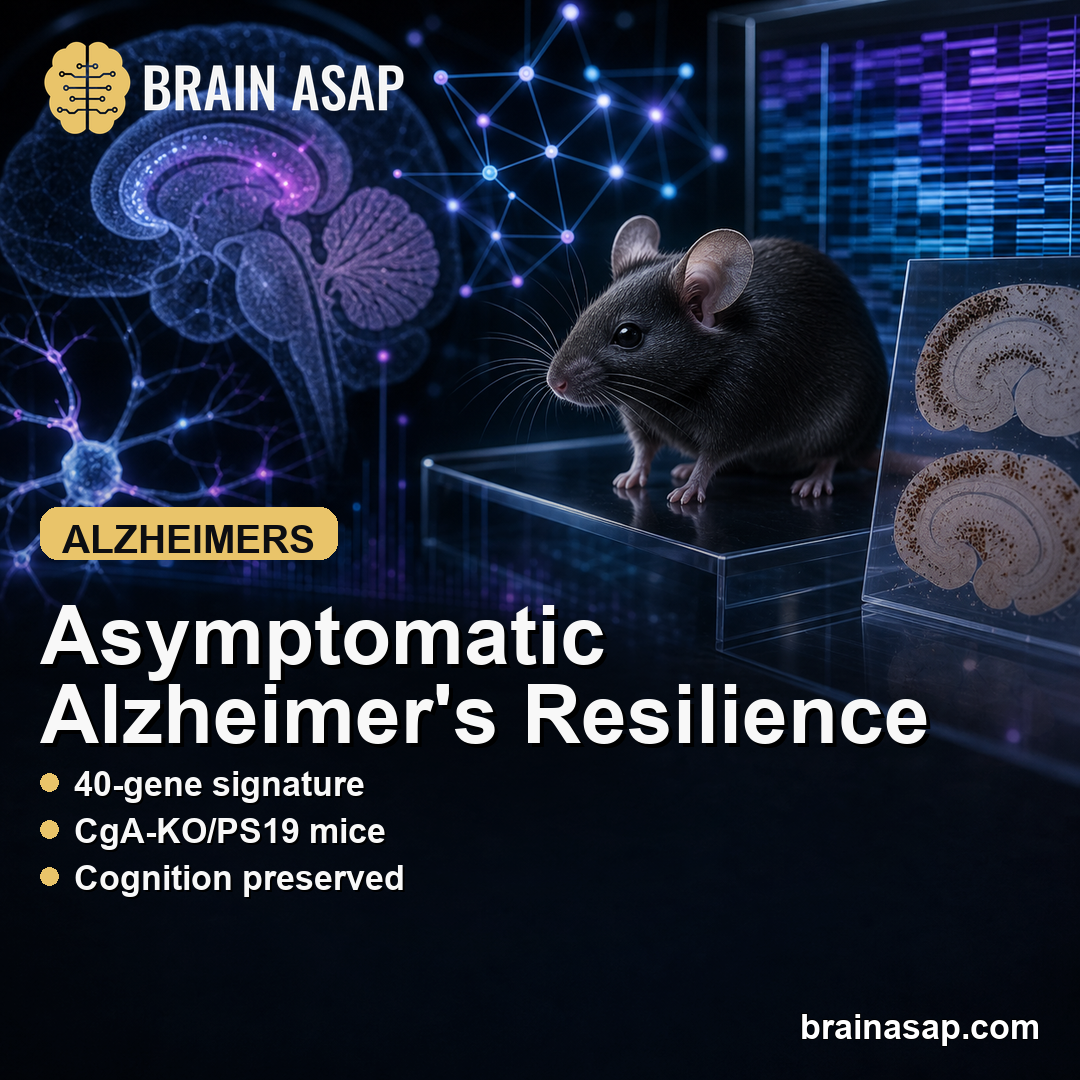
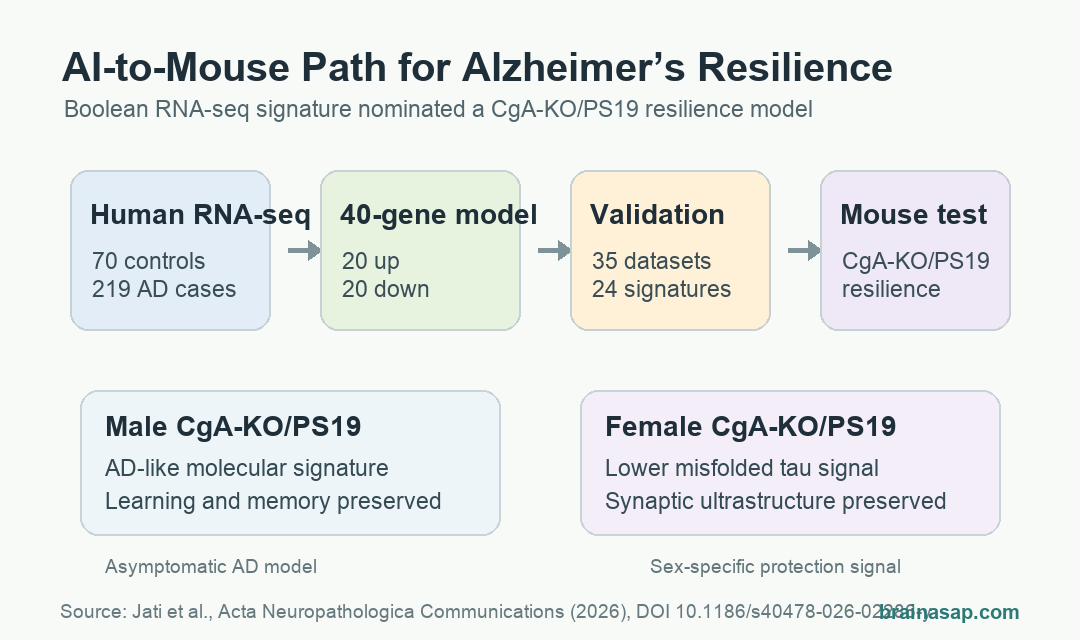
- 289-person training set: Boolean Network Explorer was trained on cortical RNA-seq data from 70 cognitively normal controls and 219 Alzheimer’s disease cases.
- 40-gene signature: The final Alzheimer’s signature contained 20 upregulated and 20 downregulated genes tied to synaptic function, vesicle trafficking, and inflammatory signaling.
- 35 validation datasets: The Boolean signature was benchmarked against 24 published Alzheimer’s gene signatures across independent human RNA-seq datasets.
- Male resilience model: Male CgA-KO/PS19 mice showed Alzheimer’s-like transcriptomic and neuropathological features while retaining learning and memory performance.
- Female protection pattern: Female CgA-KO/PS19 mice showed stronger protection, including reduced misfolded tau staining and preserved synaptic ultrastructure.
Source: Acta Neuropathologica Communications (2026) | Jati et al.
Asymptomatic Alzheimer’s disease describes people who carry substantial amyloid and tau pathology but remain cognitively intact. The biology separates brain pathology from the clinical endpoint of cognitive decline.
The study combined computational gene-network analysis with mouse validation. Its main claim is not that AI diagnosed Alzheimer’s in patients, but that a stable human molecular signature helped identify an animal model for cognitive resilience.
Boolean AI Modeled Alzheimer’s RNA-Seq Logic Across Human Cohorts
The first step used Boolean Network Explorer (BoNE), a systems-biology method that searches for stable directional relationships among genes. Instead of asking only which genes are higher or lower on average, the model looks for gene-expression rules that hold across many samples.
Researchers trained the model on a large cortical RNA-sequencing dataset called GSE125583, which included 70 cognitively normal controls and 219 Alzheimer’s disease cases.
- Training contrast: The model separated Alzheimer’s cases from cognitively normal controls using cortical gene-expression data.
- Regional refinement: The team refined the model with three independent cortical-region datasets from fusiform gyrus, frontal cortex, and entorhinal cortex.
- Boolean logic: Gene pairs were evaluated for invariant relationships rather than simple pairwise correlation.
The output was a 40-gene Alzheimer’s signature. It included 20 genes with higher expression and 20 with lower expression in the disease pattern.
The 40-Gene Alzheimer’s Signature Outperformed Published Gene Sets
The signature was biologically plausible. Pathway analysis linked it to synaptic function, vesicle trafficking, and inflammatory signaling, all major themes in Alzheimer’s disease biology.
The validation step was broader than a single training-test split. Researchers compared the Boolean signature with 24 previously published Alzheimer’s gene signatures across 35 independent validation datasets.
- Performance metric: Classification was measured with receiver operating characteristic area under the curve, or ROC-AUC.
- Dataset spread: Validation datasets covered multiple brain regions and study designs.
- Cell-type clue: A single-cell brain atlas analysis highlighted astrocyte transcriptional changes in Alzheimer’s samples.
The model also reflected known disease anatomy. Scores were elevated in vulnerable regions such as the entorhinal cortex and hippocampus before broader neocortical involvement.
Reverse Translation Pointed to CgA-KO/PS19 Mice
The next move was reverse translation: applying the human-derived signature to mouse transcriptomic datasets. The model tracked disease progression in several established amyloid and tau mouse models.
The key finding came from CgA-KO/PS19 mice. PS19 mice model tauopathy, while CgA-KO removes chromogranin A, a neuroendocrine secretory protein linked in prior work to tau pathology and Alzheimer’s vulnerability.
- APP23 model: Boolean scores diverged between wild-type and Alzheimer’s-model mice only at 18 and 24 months.
- 5xFAD model: The hippocampus showed early disease stratification, while cortex did not show the same early separation.
- CgA-KO/PS19 model: The model identified a dissociation between molecular pathology and preserved behavior.
That dissociation anchors the mouse-model claim. Male CgA-KO/PS19 mice clustered transcriptomically with PS19 tauopathy mice, indicating an Alzheimer’s-like molecular state, but they retained spatial learning and memory in behavioral assays.
Male CgA-KO/PS19 Mice Modeled Cognitive Resilience Despite Pathology
In asymptomatic Alzheimer’s disease, pathology and cognition do not line up in the usual way. The male CgA-KO/PS19 mice were important because they reproduced that split in an experimentally tractable animal model.
Male CgA-KO/PS19 mice retained AD-like transcriptomic signatures and tau-associated neuropathology in the prefrontal cortex. Despite that molecular and tissue-level burden, they preserved learning and memory performance relative to the disease model expectation.
- Transcriptomic burden: Male CgA-KO/PS19 mice scored like PS19 mice on the Alzheimer’s molecular signature.
- Cognitive preservation: Behavioral testing showed intact spatial learning and memory despite that molecular state.
- Model value: The pattern resembles human asymptomatic Alzheimer’s disease more closely than a model that simply has less pathology.
This makes the model useful for resilience research. It allows investigators to ask why some brains tolerate pathology better, rather than only asking how to reduce pathology itself.
Female CgA-KO/PS19 Mice Showed Stronger Tau and Synapse Protection
The sex-stratified pattern was even more specific. Female CgA-KO/PS19 mice preserved cognition and showed reduced tau pathology with better synaptic ultrastructure.
Electron microscopy suggested that female CgA-KO/PS19 mice preserved synaptic vesicle structure more like wild-type controls. Tau staining also showed lower misfolded tau burden in hippocampal subregions compared with PS19 females.
- Neurofibrillary tangles: Female CgA-KO/PS19 mice were largely free of cortical neurofibrillary-tangle accumulation in the reported ultrastructural analysis.
- Misfolded tau: MC1-positive tau staining was reduced by about 23% in dentate gyrus and about 33% in CA3 compared with PS19 females.
- Synaptic structure: Clear synaptic vesicle density was preserved in female CgA-KO/PS19 mice, unlike the disrupted pattern seen in PS19 mice.
The female result should not be read as evidence that women are protected from Alzheimer’s disease. Sex changed the biology of this mouse model, supporting sex-stratified resilience analysis.
CgA Is a Candidate Resilience Node, Not a Proven Treatment
Chromogranin A (CgA) is elevated in cerebrospinal fluid in Alzheimer’s disease, has been linked to tau pathology, and localizes to neurofibrillary tangles. In this study, CgA deletion helped separate cognitive outcome from Alzheimer’s-like molecular and tissue findings.
The finding remains preclinical. Whole-body genetic deletion in mice is not the same as a drug target in humans, and transcriptomic data alone cannot explain all resilience biology.
The stronger reading is practical for research design: Boolean AI analysis can nominate a molecular disease signature, and mouse validation can test whether a candidate pathway changes the relationship between pathology and cognition. For Alzheimer’s prevention research, that shifts attention toward protective biology before irreversible decline.
Citation: DOI: 10.1186/s40478-026-02286-y. Jati et al. AI guided discovery of a murine model of asymptomatic Alzheimer’s disease. Acta Neuropathologica Communications. 2026;14:110.
Study Design: Systems-biology and mouse-validation study combining Boolean-network modeling of human RNA-seq datasets with transcriptomic, behavioral, immunohistochemical, and electron-microscopy analyses in Alzheimer’s mouse models.
Sample/Model: Initial human training data included 70 cognitively normal controls and 219 Alzheimer’s disease cases; mouse validation focused on PS19 tauopathy and CgA-KO/PS19 mice.
Key Statistic: The Boolean model produced a 40-gene Alzheimer’s signature and was benchmarked against 24 published signatures across 35 validation datasets; female CgA-KO/PS19 mice showed about 23% lower MC1-positive tau staining in dentate gyrus and 33% lower staining in CA3 versus PS19 females.
Caveat: The findings identify a preclinical resilience model and candidate molecular node, not a human treatment or clinical diagnostic test.