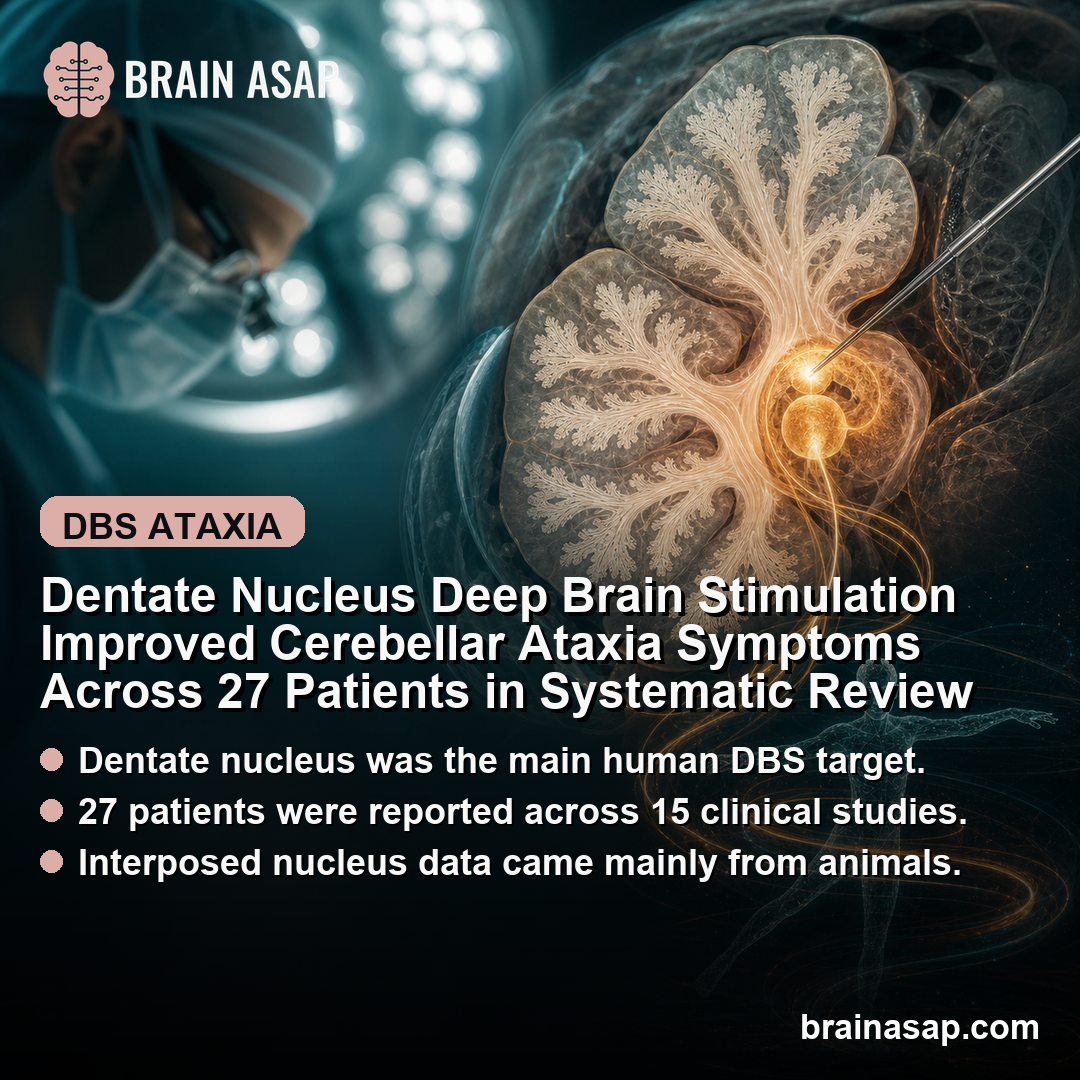
TL;DR: A 2026 systematic review in The Cerebellum found that deep brain stimulation (DBS) produced modest symptom improvement in selected cerebellar ataxia patients, with dentate nucleus stimulation most common in humans and interposed nucleus stimulation emerging from animal studies.
Key Findings
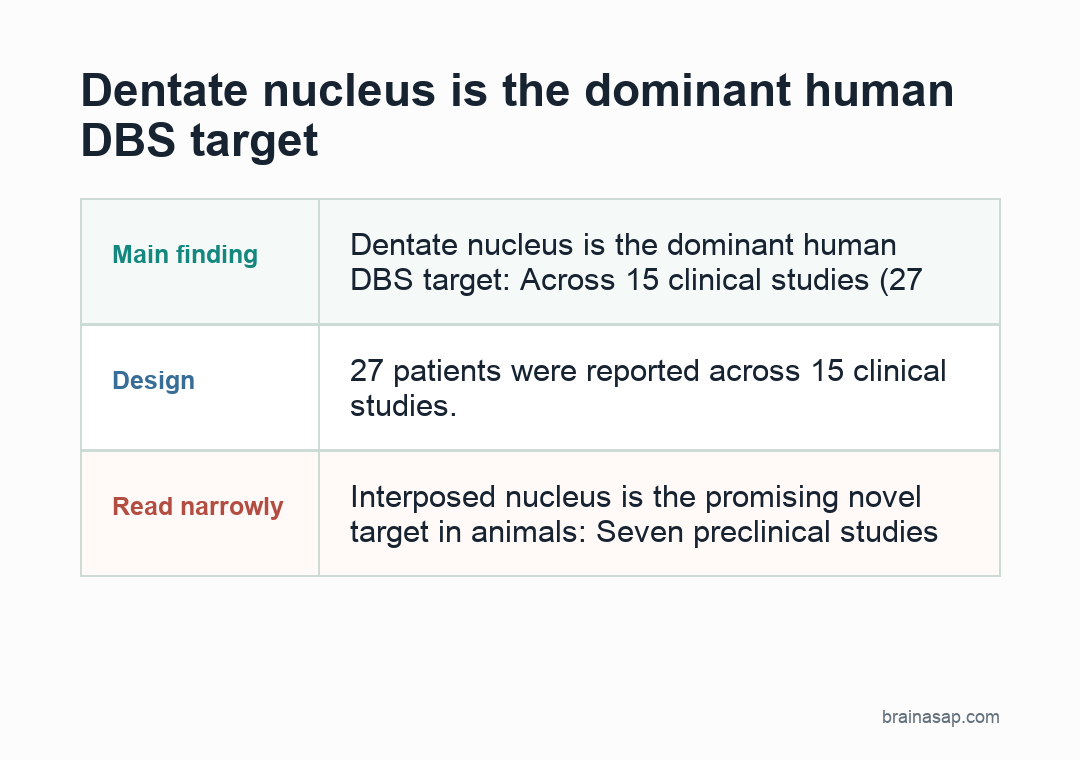
- Dentate nucleus is the dominant human DBS target: Across 15 clinical studies (27 patients), the dentate nucleus was the most frequently targeted structure and produced modest but clinically meaningful improvements in ataxic symptoms, especially in hereditary and post-lesional forms.
- Thalamic stimulation works for tremor-dominant phenotypes: When the dominant symptom is cerebellar tremor rather than gait/coordination ataxia, thalamic stimulation produced consistent benefit across multiple studies.
- Interposed nucleus is the promising novel target in animals: Seven preclinical studies highlighted the interposed nucleus, which restored motor coordination and cerebello-thalamo-cortical signaling robustly in animal models — a candidate for future human trials.
- Evidence base remains small: The clinical evidence base included 27 patients across 15 clinical studies, with case series rather than randomized trials dominating the literature.
- Heterogeneous ataxia etiology limits universal protocols: Hereditary, post-lesional, and other ataxia subtypes respond differently. DBS in cerebellar ataxia is not yet a one-size-fits-all therapy.
Source: The Cerebellum (2026) | Mantovani et al.
Cerebellar ataxia exposes a hard treatment gap. Patients lose the smooth coordination of movement that healthy cerebellums make automatic, and symptoms often worsen over years with little to slow them down.
Most ataxias have no disease-modifying treatment. Symptomatic options such as physical therapy, balance training, and occasional pharmacological adjuncts help around the edges.
Deep brain stimulation has been emerging as a potential alternative, and the Mantovani review synthesized the published clinical and preclinical evidence.
Why Cerebellar Ataxia Has Resisted Treatment for So Long
The cerebellum makes most of human movement smooth, automatic, and coordinated — but it does this through cellular machinery that, once degenerated, doesn’t regenerate. Ataxias come in many flavors:
- Hereditary ataxias like spinocerebellar ataxias (SCAs) and Friedreich’s ataxia — genetic conditions with progressive cerebellar degeneration.
- Multiple system atrophy (MSA-C) — a neurodegenerative condition with prominent cerebellar features.
- Post-lesional ataxias — following stroke, surgery, or trauma to the cerebellum.
- Acquired and toxic ataxias — from alcohol, immune-mediated processes, or paraneoplastic conditions.
The shared problem across these conditions is that as cerebellar cortical neurons die, the deep cerebellar nuclei lose their normal regulation. Those nuclei receive cortical inhibition and project the cerebellum’s output to the rest of the brain.
This produces abnormal output that disrupts coordination. The DBS rationale is to modulate that abnormal output directly, since the upstream cortical tissue cannot be replaced.
Why the Dentate Nucleus Is the Surgical Target of Choice
Of the four deep cerebellar nuclei, the dentate is the largest in primates and humans and serves as the main output channel for cerebellar contributions to movement and cognition. The Mantovani review found:
- Human target: Dentate nucleus targeting was the most common approach in human DBS for ataxia.
- Responding groups: Selected hereditary ataxias and post-lesional ataxias responded with modest but real symptom improvement.
- Clinical meaning: The benefit was described as clinically meaningful, not transformative but visible to patients and clinicians.
- Safety context: Adverse-event profiles were consistent with general DBS surgery risk levels rather than ataxia-specific complications.
Why Tremor-Dominant Patients Look Different
Cerebellar pathology can produce tremor that resembles essential tremor: a rhythmic shaking that worsens with intentional movement. For these patients, the review found that thalamic DBS targeting the ventral intermediate nucleus, the standard target for essential tremor, produced consistent benefit.
The biology fits the symptom profile. If the dominant symptom is tremor rather than ataxia itself, the thalamic relay between cerebellum and cortex is a plausible point to intervene.
The implication for treatment selection is clear: matching the DBS target to the dominant symptom matters. Cerebellar ataxia is heterogeneous enough that no single target will serve every patient.
Why the Interposed Nucleus Is the Future to Watch
The seven preclinical animal studies in the review pointed toward the interposed nucleus as a promising novel target that hasn’t been widely tried in humans. In animal models:
- Motor coordination: Interposed nucleus DBS produced robust restoration of motor coordination.
- Network signaling: The intervention modulated cerebello-thalamo-cortical signaling more broadly than dentate DBS.
- Translation path: Side-effect profiles in animals were favorable, supporting a credible path to human trials.
The translational gap is real — animal model success often doesn’t transfer cleanly to human DBS — but the interposed nucleus is one of the more concrete preclinical leads in this small literature, and the mechanistic rationale (broader cerebello-thalamo-cortical engagement) is biologically coherent.
What 27 Patients Across 15 Studies Can and Can’t Establish
The honest scope of this review is constrained by the underlying evidence base:
- 27 total patients in published clinical studies is small for any treatment claim. Most reports are case series or small open-label studies, not randomized controlled trials.
- Selection effects are likely. Ataxia patients chosen for DBS are typically those who failed other options, who have specific phenotypes thought likely to respond, and who can tolerate surgery.
- Publication bias is plausible. Successful cases are more likely to be written up and published than ambiguous or negative ones, inflating the apparent efficacy.
- Outcome measures vary across studies, making meta-analysis difficult and limiting comparisons across reports.
- Long-term durability of benefit is poorly characterized. Most reports cover relatively short follow-up windows; whether DBS-derived improvement holds up over years remains uncertain.
DBS Evidence Is Small but Clinically Relevant for Selected Ataxia Patients
For ataxia patients, the available treatment menu is short enough that even modest evidence shifts the calculus. The Mantovani review accomplishes three things:
- Establishes that DBS is a credible option, not an experimental long shot, for selected ataxia patients — particularly hereditary forms with prominent dentate-related symptoms or tremor-dominant cerebellar phenotypes.
- Identifies the most-promising targets with current evidence — dentate for ataxia symptoms, thalamus for tremor — helping surgical teams plan target selection rationally.
- Flags the interposed nucleus as the next translational priority based on convergent preclinical findings — helping the field organize its limited DBS-trial resources.
What cerebellar ataxia research needs next:
The path forward is uncomfortable for any review of a small literature: more, larger, prospectively designed studies. Specifically:
- Prospective registries capturing every DBS-for-ataxia case with standardized outcome measures so that the literature isn’t dominated by selection-biased case reports.
- Randomized blinded crossover trials (DBS on vs DBS off) where ethical and feasible, since open-label benefits in DBS are notoriously inflated by expectation effects.
- First-in-human interposed nucleus targeting to test whether the preclinical promise translates.
- Phenotype-stratified analyses — separating tremor-dominant from coordination-dominant ataxia, hereditary from post-lesional — rather than lumping ataxias together.
For patients with cerebellar ataxia today, the clinical point is practical: the review gives selected patients and clinicians a reason to discuss DBS during specialist care.
The expectation should be modest improvement, not cure, and the target should match the dominant symptom rather than defaulting to one approach for all ataxia patients.
Citation: DOI: 10.1007/s12311-026-01999-z. Mantovani et al. Deep Brain Stimulation for Cerebellar Ataxia: A Systematic Review on Indications, Targets and Outcomes. The Cerebellum. 2026;25:59.
Study Design: PRISMA 2020-compliant systematic review of MEDLINE/PubMed and Scopus for clinical and preclinical studies of DBS for cerebellar ataxia. Qualitative analysis of ataxia etiology, stimulation targets, clinical outcomes, and adverse effects.
Sample Size: 15 clinical studies covering 27 patients plus 7 preclinical animal studies.
Key Statistic: Dentate nucleus was the most frequent human target with modest but clinically meaningful symptom improvement; thalamic stimulation worked consistently for tremor-dominant phenotypes; interposed nucleus emerged as the most promising novel target in animal models.
Caveat: Small total patient numbers (n=27) across heterogeneous ataxia etiologies; case series rather than randomized trials dominate; selection and publication bias likely; long-term durability and head-to-head target comparisons remain undefined.