TL;DR: A 2026 iScience study recorded human substantia nigra neurons during Parkinson’s surgery and found that putative dopamine-neuron firing was higher after a prior reward, while the next response was modestly faster.
Key Findings
- Direct human recordings: Researchers recorded 27 substantia nigra neurons across 13 sessions in 11 Parkinson’s disease patients undergoing deep-brain stimulation surgery.
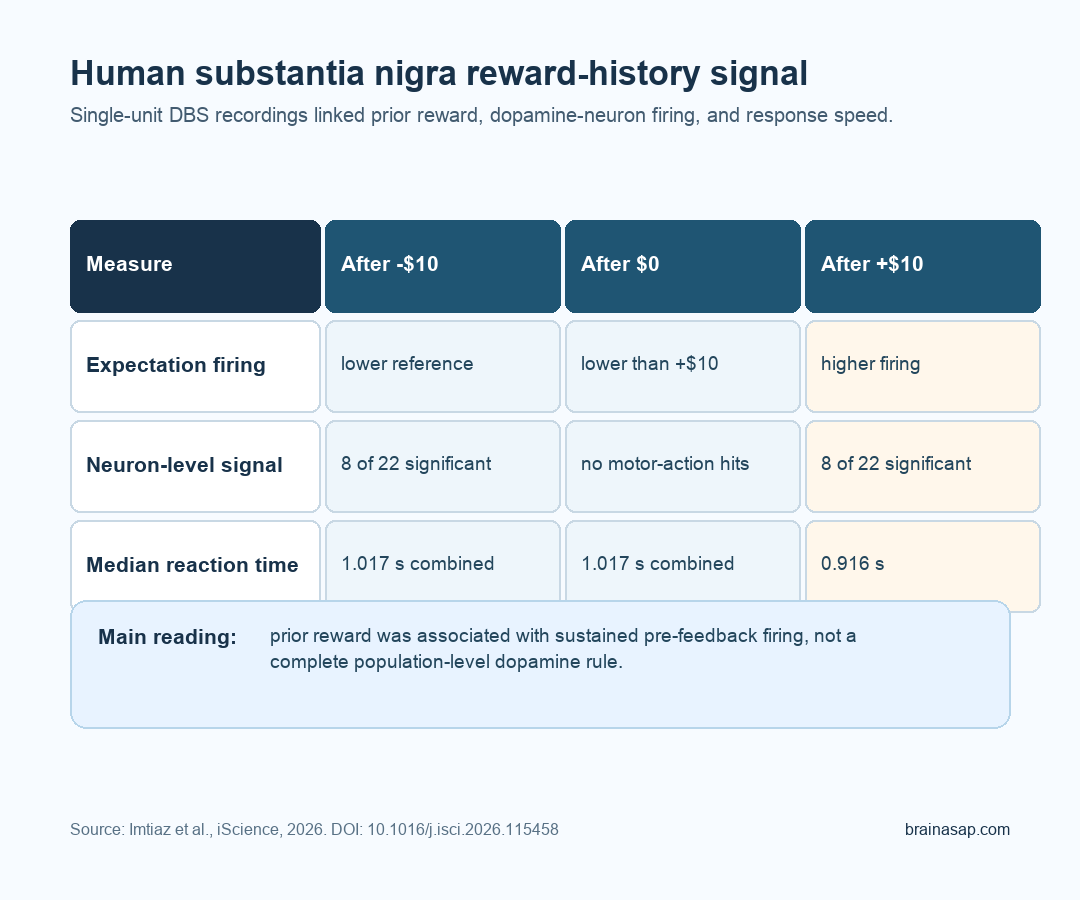
- Reward history changed firing: Among 22 putative dopamine neurons, expectation-period firing was higher after a +$10 outcome than after neutral or negative outcomes.
- Eight neurons showed the effect: Individual-neuron models found 8 of 22 putative dopamine neurons with a significant previous-outcome effect.
- Responses were faster: Median reaction time was 0.916 seconds after a positive prior outcome versus 1.017 seconds after neutral or negative outcomes.
- Main caveat: The study was small, intraoperative, and limited to Parkinson’s patients, so it cannot be treated as a normal-population dopamine map.
Source: Imtiaz et al. 2026 iScience article.
Substantia Nigra Neurons Were Recorded During Parkinson’s Surgery
The substantia nigra is a midbrain region that contains dopamine-producing neurons involved in movement, reward learning, and motivation.
Dopamine is often described through reward prediction error, the difference between expected and received reward. This study asked a narrower human question: whether recent reward history could still be seen in substantia nigra firing before the next outcome appeared.
Researchers recorded single-unit activity from patients with Parkinson’s disease who were already undergoing deep-brain stimulation lead implantation. During the operation, patients played a two-armed bandit task, a repeated choice task in which two options had different probabilities of better or worse outcomes.
The dataset included 13 recording sessions from 11 patients, with 27 recorded neurons. Based on firing rate and waveform width, researchers classified 22 neurons as putative dopamine neurons and 5 neurons as putative GABAergic interneurons.
- Task structure: Each patient played reward, punishment, and mixed blocks with 35 trials per block.
- Choice setup: One option had an 80% chance of the better outcome and the other had a 20% chance.
- Outcome types: Trials used positive +$10, neutral $0, or negative -$10 feedback depending on the block.
The patients performed above chance, which matters for interpretation. If choices had been random, it would be harder to connect neural firing to recent reward history or response vigor.
Prior Reward Was Linked to Higher Expectation-Period Firing
The main neural result came from the expectation period, the 3 seconds after a patient chose a slot machine but before the outcome appeared.
During that period, putative dopamine-neuron firing depended on what happened in the previous trial. Firing rates were higher after +$10 outcomes than after -$10 or $0 outcomes.
The statistical pattern was not just a single-neuron anecdote. In individual-neuron models, 8 of 22 putative dopamine neurons showed a significant previous-reward-outcome effect, while no neurons showed significant effects for previous motor action or previous reward-prediction-error estimates.
At the group level, previous reward outcome was associated with expectation-period firing in the mixed model, with p = 6.91e-8. The effect was stronger during the expectation period than during the earlier choice period.
The study did not find strong group-level reward encoding after the outcome appeared. A small subset of neurons changed firing after feedback.
The feedback-period result was weaker and more heterogeneous than the pre-feedback reward-history pattern.
Recent Rewards Also Tracked Faster Reaction Times
The behavioral result matched the neural direction. Patients responded faster after a positive previous outcome than after neutral or negative previous outcomes.
Median reaction time was 0.916 seconds after +$10 feedback, compared with 1.017 seconds after $0 or -$10 feedback. That difference was significant in a Wilcoxon rank-sum test, with p = 0.0175.
Researchers also tested whether expectation-period firing itself related to the next reaction time. The mixed model estimated a negative association, meaning higher firing tended to predict faster responses, with p = 0.0458 when block type was included.
That association should be read carefully. When block type was removed, the p value rose to 0.0529, and the model did not fully remove possible residual influence from prior reward.
The result still supports a plausible link between dopamine activity and response vigor, but it is not a large standalone behavioral proof.
- Choice behavior: Patients’ choices fit either a high-learning-rate Rescorla-Wagner model or a win-stay/lose-shift strategy.
- Neural timing: The clearest firing difference appeared before the next outcome, not mainly after feedback.
- Behavioral timing: Positive prior outcomes were followed by faster next choices.
The Study Points to Reward History, Not a Full Dopamine Rule
The paper’s useful contribution is direct human access. Human dopamine-neuron recordings are rare because they usually require a clinical neurosurgical setting.
In this setting, recent reward history appeared to shape sustained firing before the next result. That could provide a short-term baseline for evaluating the next outcome, which is part of how reward-prediction-error computations are usually framed.
The finding also fits the broader idea that dopamine activity is related to motivational vigor, or the speed and energy with which a person acts when reward expectations are favorable.
Still, the result should not be overstated. These were recordings from Parkinson’s patients during surgery, not healthy volunteers in a standard laboratory task.
Parkinson’s disease affects dopaminergic systems, and the operating-room task had to be brief.
- Small sample: The paper analyzed 27 neurons, not hundreds or thousands of cells.
- Clinical context: All participants had Parkinson’s disease and were undergoing DBS surgery.
- Cell identity limit: Dopamine-neuron classification used firing rate and waveform width, not direct neurochemical confirmation.
- Task limit: The short intraoperative task may have emphasized recent outcomes more than gradual learning.
Human Dopamine Studies Need This Kind of Cautious Detail
This study is valuable because it shows reward-history patterns in individual human substantia nigra recordings, a level of evidence that is hard to obtain in living people.
The strongest interpretation is specific: in a small Parkinson’s DBS sample, putative dopamine-neuron firing during the expectation period was higher after a positive previous outcome, and positive previous outcomes were followed by faster responses.
That does not prove how healthy dopamine neurons encode every form of reward expectation. It gives researchers concrete human data to compare against animal work, computational models, positron emission tomography (PET) studies, and future intraoperative recordings.
Citation: DOI: 10.1016/j.isci.2026.115458. Study authors et al. Imtiaz et al. Sustained activity of human substantia nigra neurons reflect prior rewards. iScience . 2026;29:115458.
Study Design: Intraoperative single-unit recording study with computational modeling during a two-armed bandit reward task.
Sample Size: 13 recording sessions from 11 Parkinson’s disease patients; 27 recorded neurons, including 22 classified as putative dopamine neurons.
Key Statistic: Expectation-period firing was higher after positive prior outcomes; median reaction time was 0.916 seconds after +$10 versus 1.017 seconds after $0 or -$10.
Caveat: The recordings came from a small Parkinson’s DBS cohort, and neuron identity was inferred from firing properties rather than direct neurochemical confirmation.