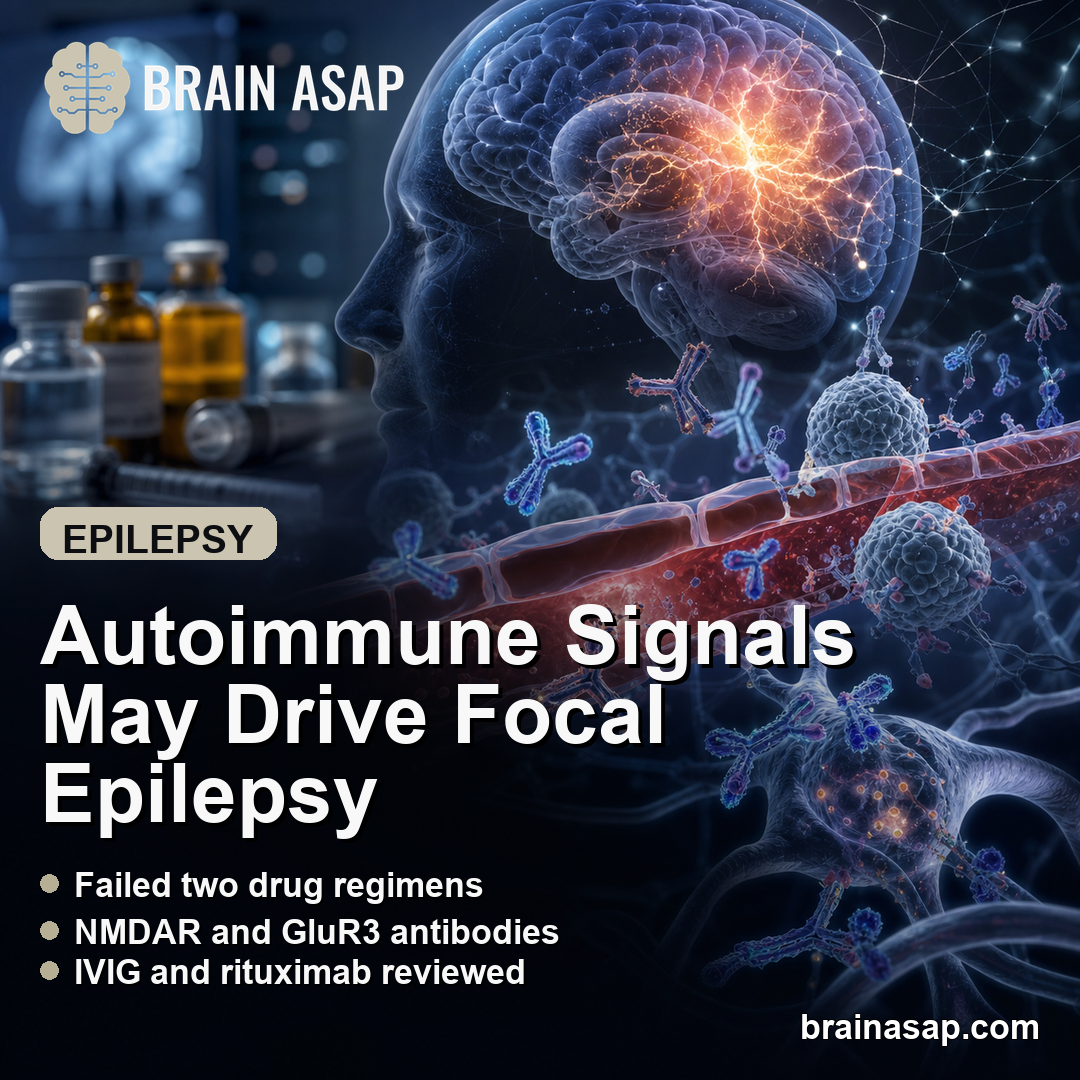
TL;DR: A 2026 review in Advances in Clinical and Experimental Medicine argues that autoimmune mechanisms may explain a subset of drug-resistant focal epilepsy, especially when seizures persist despite standard antiseizure drugs and immune markers are present.
Key Findings
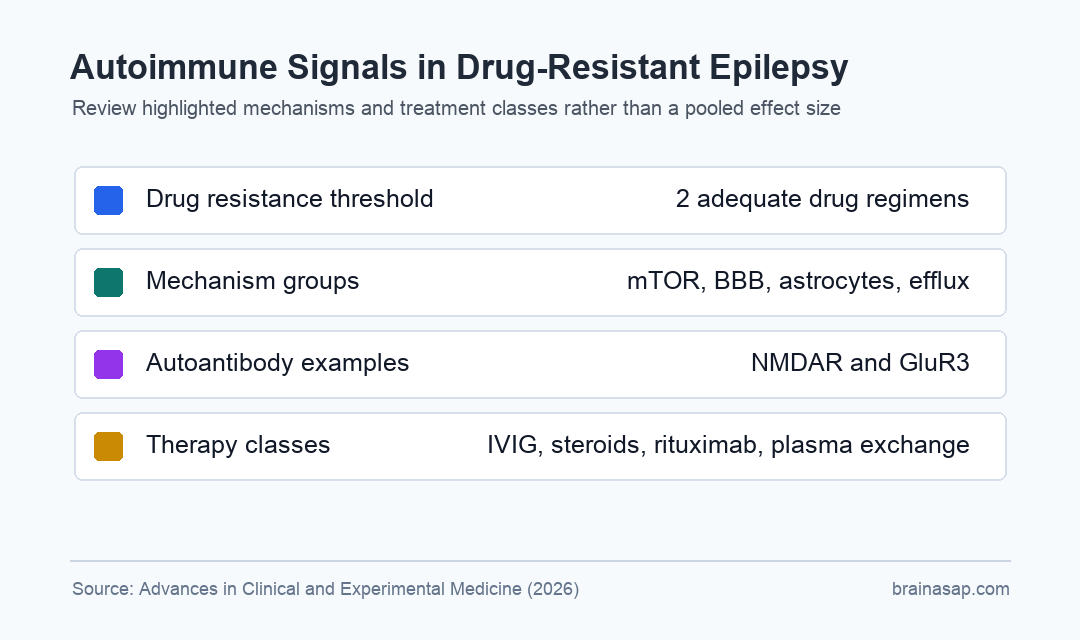
- Drug resistance definition: Drug-resistant epilepsy was defined as persistent seizures despite at least two appropriately selected, tolerated, and dosed antiseizure drug regimens.
- Four mechanism groups: The review emphasized mTOR signaling, blood-brain barrier dysfunction, astrocyte activation, and efflux transporter overexpression.
- Autoantibodies highlighted: NMDAR and GluR3 antibodies were discussed as examples of neuronal autoantibodies linked to focal epilepsy and immune-mediated seizure mechanisms.
- Therapies reviewed: The most frequently reported immunomodulatory approaches included intravenous immunoglobulin, corticosteroids, rituximab, and plasmapheresis.
- No meta-analysis: The review used descriptive synthesis because study designs, patient groups, biomarkers, and response measures were too heterogeneous for pooled estimates.
Source: Advances in Clinical and Experimental Medicine (2026) | Kunecki and Dziadkowiak
Drug-resistant focal epilepsy means seizures continue despite properly chosen and tolerated antiseizure medications. The review follows the common threshold of failure after two adequate drug regimens.
The central argument is not that every refractory seizure disorder is autoimmune. It is that immune mechanisms are clinically important in a subset, especially when standard pharmacology fails and biomarkers or clinical patterns point toward neuroinflammation.
Autoimmune Epilepsy Review Focused on Focal Drug Resistance
The review searched PubMed, ClinicalTrials.gov, International League Against Epilepsy documents, and neuroimmunology literature through February 2025. It included case reports, clinical trials, registry data, original studies, reviews, and systematic reviews when they involved possible autoimmune drug-resistant epilepsy.
Eligible reports had to address clinical response or immunomodulatory treatment. The review excluded animal-only studies, generalized epilepsy studies outside the focal-autoimmune focus, and case reports not tied to autoimmune mechanisms.
- Population focus: Patients with drug-resistant epilepsy of possible or confirmed immunologic origin.
- Treatment focus: IVIG, methylprednisolone or other corticosteroids, rituximab, and plasmapheresis.
- Outcome focus: Seizure frequency, electroencephalography (EEG) findings, neuroimaging, neurological status, and clinical response.
Because the studies used different designs and response definitions, the review did not pool effects. The missing pooled estimate is a limitation, but it is also an honest choice for a field with uneven evidence.
The review protocol was registered in PROSPERO, but the paper still described the work as narrative because the included evidence was too varied for formal meta-analysis. The search was structured, while the synthesis stayed cautious.
mTOR, BBB Dysfunction, Astrocytes, and Efflux Transporters Were Linked
The review grouped several mechanisms that connect immunity and pharmacoresistance. The mTOR pathway was described as a regulator of cell growth, metabolism, synaptic plasticity, and epileptogenesis when overactive.
Blood-brain barrier (BBB) dysfunction may allow antibodies or inflammatory mediators to reach neuronal targets. Astrocyte activation and efflux transporters can then shape seizure persistence or reduce antiseizure-drug penetration into brain tissue.
- mTOR activation: Hyperactive signaling can support abnormal neuronal excitability and network remodeling.
- BBB leak: Barrier disruption can expose brain tissue to immune factors that usually remain outside the parenchyma.
- Transporter overexpression: P-glycoprotein and related efflux systems can lower antiseizure-drug access at epileptic tissue.
This mechanism stack helps explain why an immune-related epilepsy case does not respond like a standard medication-selection problem.
It also explains why timing matters. If inflammation, antibody exposure, and barrier dysfunction become self-reinforcing, delayed recognition can allow a reversible immune problem to become a more persistent epileptic network problem.
NMDAR and GluR3 Antibodies Pointed to Treatable Immune Subgroups
The review highlighted neuronal autoantibodies, including NMDAR and GluR3, as examples of immune markers that can be relevant in focal seizures. It also discussed LGI1, CASPR2, GAD65, and related autoimmune encephalitis contexts.
Antibodies do not automatically prove causality in every patient. Some markers are more clinically meaningful than others, and nonspecific or low-level results can mislead if they are interpreted without seizure semiology, MRI, EEG, and clinical context.
- NMDAR antibodies: These are linked to anti-NMDAR encephalitis and can involve psychiatric, cognitive, movement, and seizure symptoms.
- GluR3 antibodies: The review connected them to autoimmune focal epilepsy discussions and drug resistance.
- LGI1 and CASPR2: These markers are important because broad voltage-gated potassium-channel labels can obscure the actual antigen.
For clinicians, the point is targeted suspicion. Immune testing has the most value when the clinical pattern supports it, not as a broad fishing expedition detached from the case.
That clinical pattern can include new focal seizures with psychiatric or cognitive symptoms, inflammatory cerebrospinal-fluid findings, MRI changes suggestive of limbic involvement, or seizure onset in the context of another autoimmune syndrome.
IVIG, Steroids, Rituximab, and Plasmapheresis Need Better Evidence
Immunomodulatory treatment can reduce seizures in selected autoimmune epilepsy cases. The review discussed intravenous immunoglobulin (IVIG), corticosteroids, rituximab, and plasmapheresis as recurring options in the literature.
Evidence remains uneven. The review repeatedly notes small study populations, heterogeneous biomarkers, and variable response measures, which make it difficult to predict who benefits most.
- Clinical promise: Some patients with immune-linked epilepsy show seizure reduction after immunotherapy.
- Evidence gap: Study sizes and designs are too variable for a clean pooled effect estimate.
- Practical direction: Early immune recognition can guide personalized treatment when standard antiseizure drugs fail.
The review’s best use is as a diagnostic reminder. In focal epilepsy that remains drug-resistant, autoimmune mechanisms should be considered when symptoms, antibody findings, inflammation, MRI, electroencephalography (EEG), or treatment history make that pathway plausible.
That does not replace epilepsy surgery evaluation, device therapy, ketogenic dietary approaches, or careful antiseizure-drug optimization. It adds an immune branch to the differential diagnosis for selected patients who otherwise risk being labeled simply refractory.
Citation: DOI: 10.17219/acem/218006. Kunecki and Dziadkowiak. Autoimmune mechanisms in drug-resistant focal epilepsy: Pathophysiology, biomarkers, and therapeutic implications. Advances in Clinical and Experimental Medicine. 2026.
Study Design: Narrative review of clinical and experimental literature on autoimmune mechanisms and immunomodulatory therapy in drug-resistant focal epilepsy.
Sample/Model: Published case reports, clinical trials, registry data, reviews, and biomarker studies available through February 2025.
Key Statistic: No pooled effect estimate was calculated; the review emphasized heterogeneity and descriptive synthesis across IVIG, corticosteroids, rituximab, and plasmapheresis reports.
Caveat: Autoimmune mechanisms likely apply to a subset of drug-resistant focal epilepsy, and antibody results require clinical context before treatment decisions.