TL;DR: A 2026 randomized trial in JMIR Mental Health found that a 4-week executive-function training app reduced depression and anxiety symptoms at 12-week follow-up, while a self-guided CBT app mainly improved workplace well-being.
Key Findings
- Workplace app trial: Participants with mild-to-moderate depression and anxiety symptoms were assigned to waitlist control, NeuroNation executive-function training, or Moodfit self-guided CBT.
- 4-week app period: Active-arm participants were asked to use their assigned app at least 21 times before the postintervention assessment.
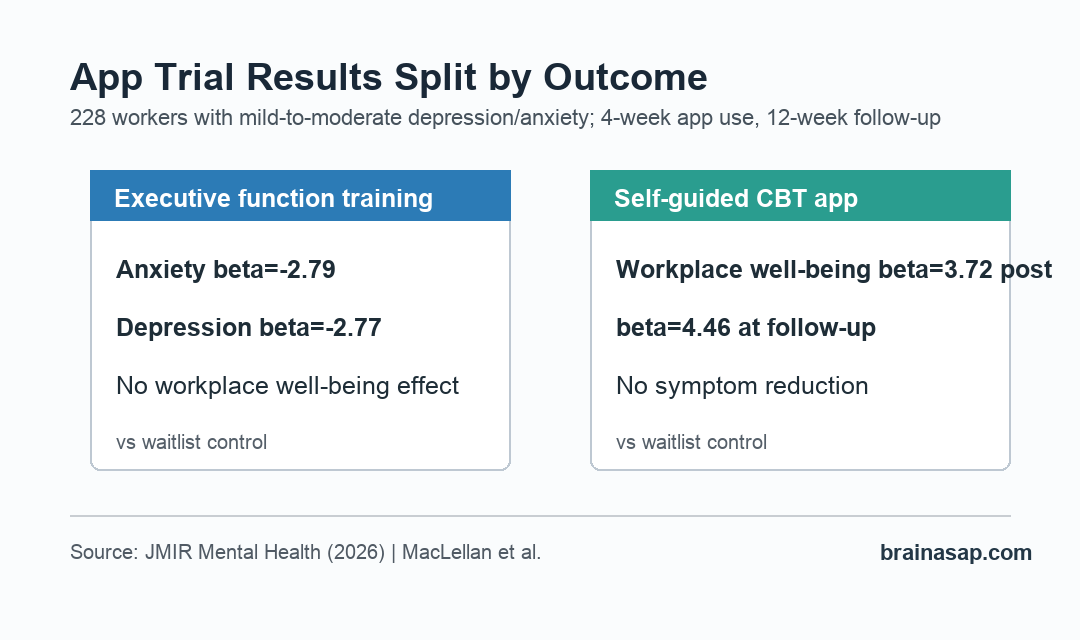
- Anxiety fell later: Executive-function training reduced anxiety symptoms at 12-week follow-up (beta=-2.79; P=.004), but not immediately after the 4-week intervention.
- Depression also fell later: Executive-function training reduced depressive symptoms at follow-up (beta=-2.77; P=.02), while the CBT app did not reduce depression or anxiety versus waitlist.
- Workplace well-being split: The CBT app improved workplace well-being at postintervention (beta=3.72; P=.02) and follow-up (beta=4.46; P=.02), but executive-function gains did not explain the outcomes.
Source: JMIR Mental Health (2026) | MacLellan et al.
Digital mental-health apps are often marketed as flexible support for workers who have symptoms but may not be in formal treatment. This randomized trial tested whether two different app approaches changed depression, anxiety, and workplace well-being in adults with mild-to-moderate symptoms.
The main result was not a simple “apps worked” conclusion. The executive-function app and the self-guided CBT app affected different outcomes, and the proposed executive-function mechanism was not supported.
NeuroNation and Moodfit Were Tested Against a Waitlist Control
The trial recruited 228 participants, including 147 female participants, through online methods. All had mild-to-moderate symptoms of depression and anxiety and were randomized to one of three groups.
The two active interventions were distinct enough to require separate interpretation. NeuroNation trained executive-function skills through gamified cognitive tasks, while Moodfit offered self-guided cognitive behavioral therapy tools.
- Executive-function training: NeuroNation was intended to train cognitive control processes such as working memory and related executive skills.
- Self-guided CBT: Moodfit included CBT-based strategies, plus mindfulness and positive psychology components.
- Waitlist control: The control group did not receive an active app during the intervention window.
- Assessment timing: Outcomes were measured at baseline, after the 4-week intervention, and again at 12-week follow-up.
Participants in the active arms were asked to use their assigned app at least 21 times. That design made the study more practical than a tightly supervised lab intervention, but it also introduced real-world adherence and attrition issues.
Executive-Function Training Reduced Symptoms at Follow-Up
The clearest symptom result came from the executive-function training arm. Compared with waitlist, NeuroNation reduced anxiety symptoms at follow-up with beta=-2.79 and P=.004.
Depressive symptoms followed the same delayed pattern. The executive-function training group showed lower depression symptoms at follow-up, beta=-2.77 and P=.02, but the paper did not find the same benefit immediately after the 4-week period.
- Timing: The symptom effects appeared at 12 weeks rather than at the immediate postintervention assessment.
- Outcome type: The executive-function app affected depression and anxiety symptoms, not workplace well-being.
- Comparator: Effects were estimated against the waitlist control rather than against an active placebo app.
That timing is important for interpretation. A delayed symptom effect may reflect continued use, delayed consolidation, regression patterns, or other unmeasured factors, so the study does not prove that training cognitive control directly caused the symptom change.
The CBT App Improved Workplace Well-Being Without Symptom Reduction
Moodfit did not reduce depressive or anxiety symptoms versus waitlist. Its positive finding was instead workplace well-being, which improved at both measured post-baseline time points.
The workplace effect was beta=3.72 at postintervention and beta=4.46 at 12-week follow-up, with both P values reported as .02. That suggests the CBT-based app may have helped people function or feel better at work even when symptom scales did not show clear reductions.
- Symptom scales: Moodfit did not show a significant reduction in depression or anxiety symptoms versus waitlist.
- Work outcome: Workplace well-being improved after the 4-week intervention and remained improved at follow-up.
- Different target: The result fits the idea that CBT tools can change coping, work appraisal, or daily functioning even when symptom severity is unchanged.
This distinction is useful for employers and clinicians. A workplace app should not be judged only by a depression score if the intended outcome is work functioning, but symptom claims also should not be inferred from a well-being result.
Executive-Function Change Did Not Explain the App Effects
The trial also tested a mechanism: whether improved executive function mediated changes in symptoms or workplace well-being. That mediation result was negative.
In practical terms, the study did not show that the executive-function app worked because executive function improved. It also did not show that the CBT app changed outcomes through executive-function gains.
- Mechanism tested: Participants completed a working-memory task alongside symptom and workplace measures.
- No mediation: Changes in executive function did not explain intervention-related changes in depression, anxiety, or workplace well-being.
- Claim boundary: The result supports outcome-level caution, not a broad statement that cognitive training repairs the mechanism behind depression.
That is the most important boundary in the paper. The executive-function training arm had symptom benefits at follow-up, but the proposed cognitive pathway did not carry the result.
High Adherence Was Offset by High Follow-Up Attrition
Self-reported adherence was strong among people who remained engaged. The executive-function group reported 48 of 54 participants meeting the use target, or 89%, and the CBT group reported 52 of 54, or 96%.
The larger limitation was follow-up loss. The paper reported 58% missing data at follow-up, which makes the delayed effects less secure than they would be in a trial with stronger retention.
- Sample source: Participants were recruited online, not through a workplace clinic or employer health plan.
- Blinding limits: Participants knew whether they were using an app or waiting, so expectations may have influenced self-reported outcomes.
- Retention issue: High missingness at follow-up weakens confidence in the durability of the effects.
The practical takeaway is narrower than most app marketing. App-based mental-health tools may help specific outcomes, but the evidence depends on the outcome, the app model, and whether follow-up data are complete enough to trust the pattern.
Citation: DOI: 10.2196/91564. MacLellan et al. The Effectiveness and Mechanisms of Action of App-Based Interventions for Improving Mental Health and Workplace Well-Being: Randomized Controlled Trial. JMIR Mental Health. 2026;13:e91564.
Study Design: Three-arm randomized controlled trial comparing executive-function training, self-guided CBT, and waitlist control.
Sample Size: 228 adults with mild-to-moderate depression and anxiety symptoms.
Key Statistic: Executive-function training reduced anxiety at follow-up (beta=-2.79; P=.004), while the CBT app improved workplace well-being at postintervention (beta=3.72; P=.02) and follow-up (beta=4.46; P=.02).
Caveat: Follow-up attrition was high, with 58% missing data, and executive-function improvement did not mediate the intervention effects.