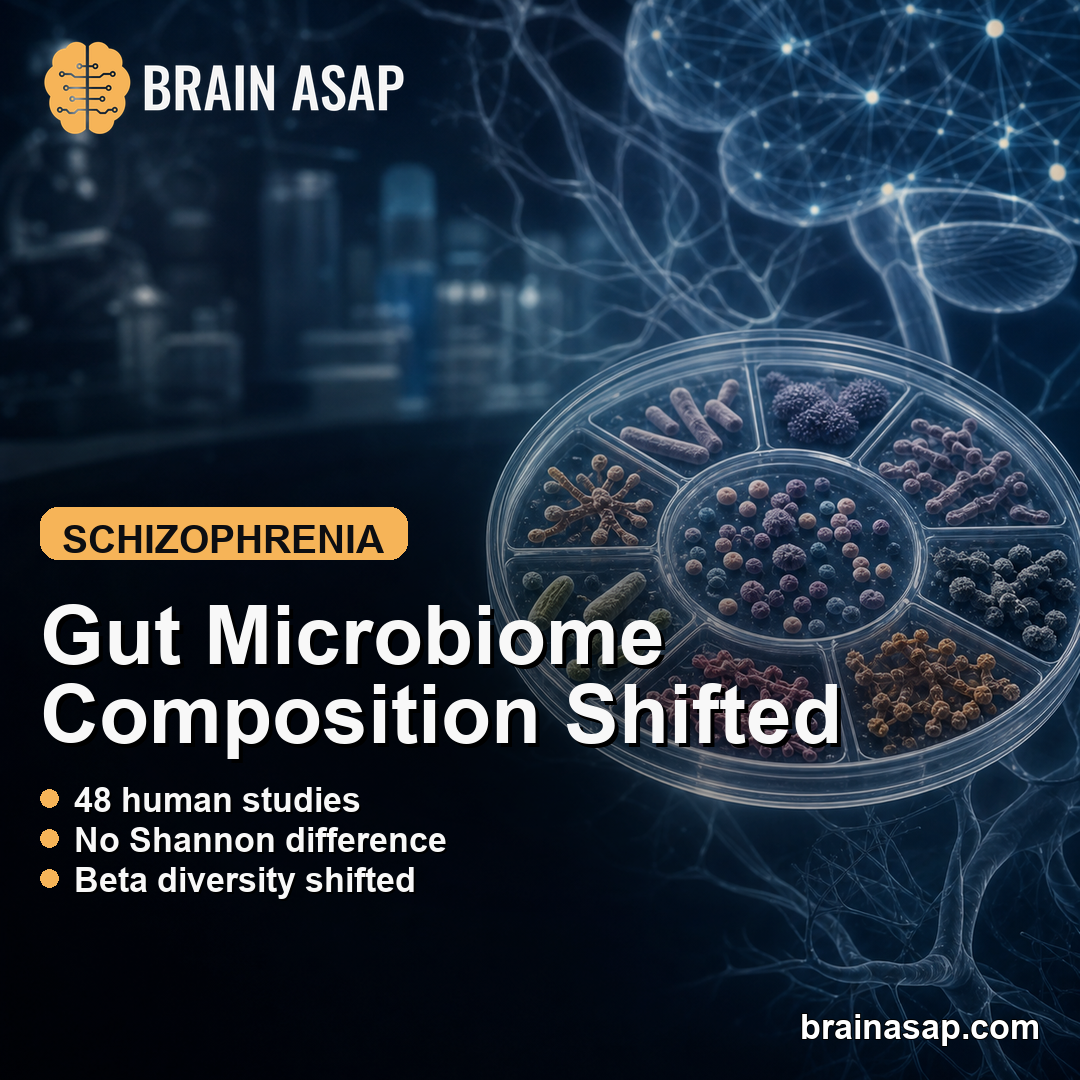
TL;DR: A 2026 systematic review and meta-analysis in International Journal of Molecular Sciences found no significant global gut-microbiome alpha-diversity difference in schizophrenia, but reported recurring community-composition and taxonomic shifts.
Key Findings
- 48 studies: The review included 48 human observational studies published between 2017 and 2025.
- 14 meta-analyzed studies: Only 14 studies provided enough data for random-effects meta-analyses of alpha-diversity indices.
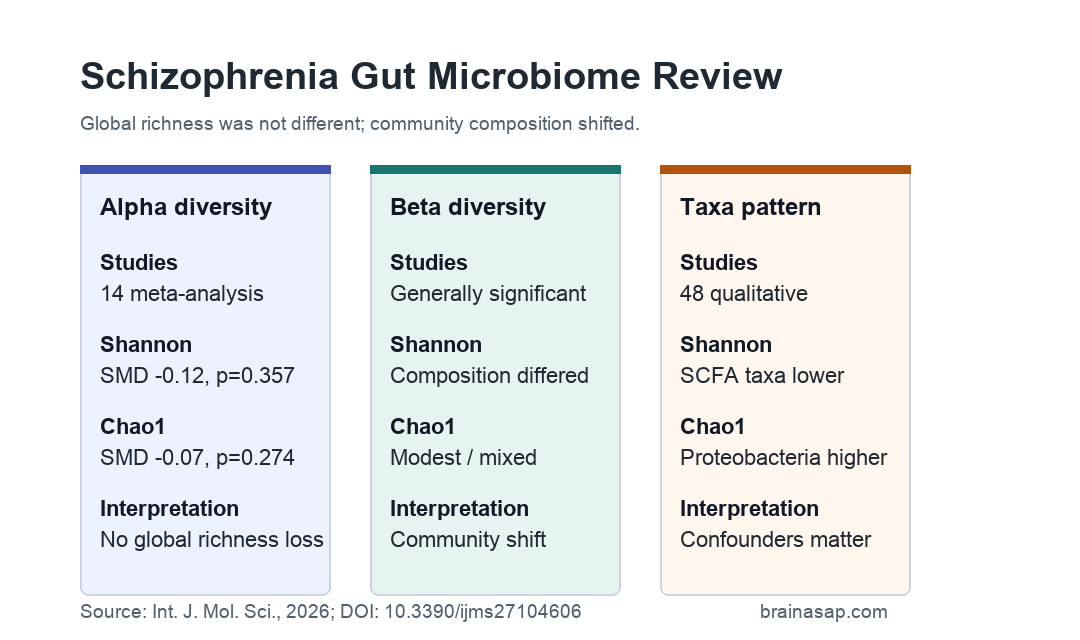
- No Shannon difference: Shannon diversity did not significantly differ between schizophrenia and control groups, SMD = -0.12, p = 0.357.
- No Chao1 difference: Chao1 richness also did not significantly differ, SMD = -0.07, p = 0.274, with I2 = 0%.
- Composition shift: Beta-diversity analyses generally showed group-level community-composition differences, alongside recurrent but heterogeneous taxonomic shifts.
Source: International Journal of Molecular Sciences (2026) | Militaru et al.
Gut microbiota refers to the microbial community living in the gastrointestinal tract. In schizophrenia research, the gut-brain axis has become a target because immune signaling, metabolism, and microbial products can interact with brain and behavior pathways.
This review separates 2 questions that are often blurred: whether schizophrenia shows a global loss of microbial diversity, and whether the community composition differs in more specific ways.
Schizophrenia Microbiome Evidence Came From 48 Human Studies
The review followed PRISMA 2020 methods and searched Web of Science, PubMed, and MDPI for observational studies from 2017 to 2025. Eligible studies compared adults with schizophrenia against healthy controls and reported fecal microbiome outcomes.
The final qualitative synthesis included 48 studies. A smaller subset of 14 studies had enough extractable data for random-effects meta-analysis of alpha diversity.
- Alpha diversity: This measures richness and evenness within one person’s microbial community.
- Beta diversity: This measures how different microbial communities are between people or groups.
- Taxonomic synthesis: This compares which microbial groups were enriched or depleted across studies.
- Study designs: Included studies were observational, not interventional trials.
Observational microbiome studies can identify patterns, but they cannot prove that microbiome changes cause schizophrenia symptoms. They are also sensitive to sample handling, sequencing platform, antibiotic exposure, and how carefully a study records diet or medication use.
Alpha Diversity Did Not Show a Global Richness Loss
The main quantitative result was negative: pooled alpha-diversity indices did not significantly differ between schizophrenia and healthy control groups. The review tested Shannon, Simpson, ACE, Observed species, and Chao1 indices separately.
Shannon diversity, which reflects richness and evenness, used 13 studies with 861 schizophrenia participants and 719 controls. The pooled SMD was -0.12, 95% CI -0.40 to 0.16, p = 0.357.
- Simpson: 11 studies, SMD = -0.03, p = 0.867.
- ACE: 7 studies, SMD = -0.42, p = 0.353.
- Observed species: 8 studies, SMD = -0.17, p = 0.123.
- Chao1: 7 studies, SMD = -0.07, p = 0.274.
Heterogeneity was high for some metrics. Shannon had I2 = 83.21%, Simpson had I2 = 87.24%, and ACE had I2 = 96.18%. Chao1 was more consistent, with I2 = 0%.
The alpha-diversity null therefore has 2 layers. Chao1 and Observed species gave relatively consistent estimates, while Shannon, Simpson, and ACE varied strongly across studies.
The mixed heterogeneity profile argues for caution rather than a single simple conclusion. The pooled data do not support a reliable global richness loss, but inconsistent methods could still hide subgroup effects in medication status, disease stage, or diet.
Beta Diversity Pointed to Community Composition Changes
Alpha diversity asks whether the total within-person microbial richness or evenness differs. Beta diversity asks whether the overall community composition differs between groups.
The review reported that beta-diversity analyses generally demonstrated significant differences in microbial community composition between schizophrenia and healthy control groups. The effects were described as consistent but modest and heterogeneous.
- Compositional shift: Schizophrenia samples did not simply have fewer microbial types overall.
- Community structure: Group differences appeared more often in how microbes were arranged across the community.
- Interpretation limit: Different sequencing methods, diets, medication exposure, and lifestyle factors can all affect beta-diversity results.
This distinction changes the biological interpretation. A global diversity-loss model is too simple; the better-supported pattern is a community-composition shift that may vary across cohorts.
SCFA-Producing Taxa Were Often Lower, While Pro-Inflammatory Taxa Were Higher
The taxonomic synthesis found recurrent but not fully consistent patterns. Short-chain fatty acid (SCFA)-producing taxa, including Faecalibacterium, Roseburia, and Lachnospiraceae, were often depleted.
SCFAs are microbial metabolites involved in gut barrier function, immune regulation, and metabolic signaling. Lower SCFA-producing taxa could fit a gut-immune-brain hypothesis, but the review does not prove causality.
- Lower SCFA producers: Faecalibacterium, Roseburia, and Lachnospiraceae appeared as recurring depleted taxa.
- Higher pro-inflammatory taxa: Proteobacteria and Fusobacterium appeared as recurring enriched taxa.
- Potential mechanism: The review discussed intestinal permeability, endotoxin production, systemic immune activation, and neuroinflammation as plausible pathways.
The authors also noted that taxa such as Proteus and Fusobacterium may contribute to lipopolysaccharide-related immune activation. That is a mechanistic hypothesis from microbiome biology, not a demonstrated causal chain in schizophrenia patients.
Confounding Still Limits Schizophrenia Microbiome Claims
The review repeatedly emphasizes confounding. Antipsychotic medication, diet, smoking, metabolic status, body weight, lifestyle, geography, and sequencing methods can all change gut microbiome results.
Many studies did not control these factors well enough for strong biological interpretation. That is why the review frames the findings as biomarker and hypothesis-generation material rather than ready clinical microbiome tests.
Future studies would need repeated sampling and clearer clinical metadata. A stronger design would track antipsychotic dose, diet, body mass index, smoking, metabolic disease, and symptom stage alongside microbiome sequencing.
The clearest conclusion is specific: schizophrenia microbiome studies do not currently show a robust global loss of alpha diversity. They more consistently suggest compositional and taxonomic differences that need standardized, longitudinal, multi-omics, and controlled-intervention research.
Citation: DOI: 10.3390/ijms27104606. Militaru et al. Gut Microbiota in Schizophrenia: Taxonomic Shifts, Beta-Diversity Alterations, and Biomarker Potential: A Systematic Review. International Journal of Molecular Sciences. 2026;27:4606.
Study Design: Systematic review and random-effects meta-analysis of human observational gut microbiome studies in schizophrenia.
Sample Size: 48 studies in qualitative synthesis; 14 studies contributed alpha-diversity meta-analysis data.
Key Statistic: Shannon alpha diversity was not significantly different, SMD = -0.12, 95% CI -0.40 to 0.16, p = 0.357.
Caveat: Medication, diet, lifestyle, metabolic status, and sequencing-method differences limit causal interpretation.