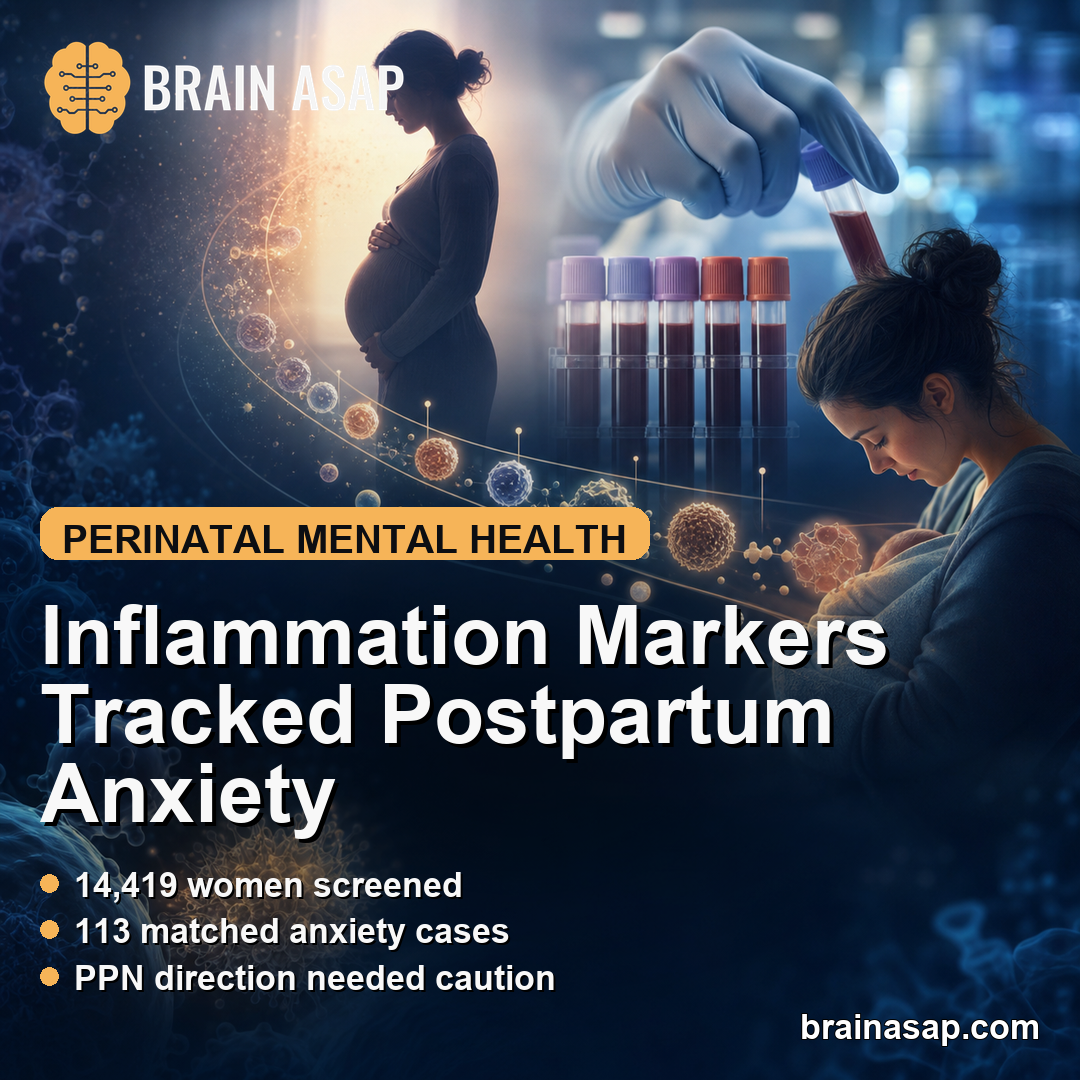
TL;DR: A 2026 study in Brain, Behavior, & Immunity – Health linked composite inflammatory biomarkers during pregnancy and postpartum with postpartum anxiety symptoms, but the strongest associations ran in the unexpected direction of lower anxiety risk at higher biomarker levels.
Key Findings
- 14,419 postpartum women were screened: Researchers calculated inflammatory biomarkers during the 2nd trimester, 3rd trimester, and postpartum period.
- 226 matched women entered the final comparison: Propensity score matching paired 113 women with postpartum anxiety symptoms and 113 without symptoms.
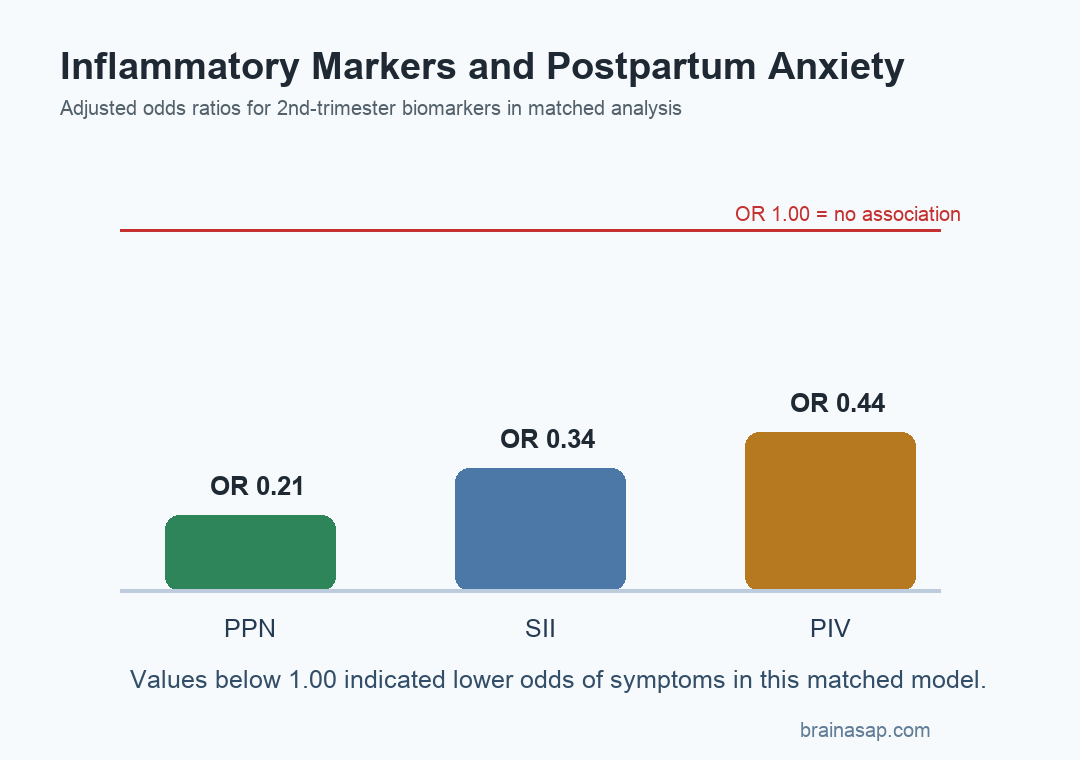
- Higher PPN was linked to lower anxiety odds: Elevated 2nd-trimester platelet-neutrophil product (PPN) had adjusted OR = 0.21 for postpartum anxiety symptoms.
- Other biomarkers showed the same direction: 2nd-trimester systemic immune-inflammation index had OR = 0.34, and pan-immune-inflammation value had OR = 0.44.
- Prediction was moderate: PPN AUCs were 0.67, 0.65, and 0.66 across the 3 time points, while an SVM-Radial model reached AUCs from 0.73 to 0.86.
Source: Brain, Behavior, & Immunity – Health (2026) | Xie et al.
Inflammatory Biomarkers Were Measured Across Pregnancy and Postpartum
Postpartum anxiety is common, but inflammation evidence has been thinner than it is for some other psychiatric outcomes.
Xie et al. studied whether routine blood-count-derived immune markers were associated with postpartum anxiety symptoms.
The source cohort included 14,419 eligible postpartum women. Anxiety symptoms were assessed at 5 to 8 weeks after childbirth using the Self-Rating Anxiety Scale (SAS), with SAS >= 50 used as the symptom threshold.
Researchers calculated several composite inflammatory markers at 3 time points:
- 2nd trimester: pregnancy-phase inflammatory markers before delivery.
- 3rd trimester: later pregnancy markers closer to birth.
- Postpartum period: inflammatory markers after delivery.
The main markers included platelet-neutrophil product (PPN), systemic inflammatory response index, systemic immune-inflammation index, and pan-immune-inflammation value.
These markers are practical because they can be calculated from ordinary blood counts. They are also biologically broad, so they should not be treated as direct measures of one cytokine, pathway, or psychiatric mechanism.
Matched Analysis Compared 113 Anxiety Cases With 113 Controls
Because postpartum anxiety can be shaped by many clinical and demographic factors, the researchers used propensity score matching. The final matched comparison included 113 women with postpartum anxiety symptoms and 113 asymptomatic women.
This matched design reduced confounding from measured covariates, but it also means the headline odds ratios come from a much smaller comparison than the initial 14,419-woman cohort.
The most striking result was direction. Higher inflammatory biomarker levels were associated with reduced odds of postpartum anxiety symptoms, not higher odds.
- PPN: adjusted OR = 0.21, 95% CI 0.10 to 0.45.
- SII: adjusted OR = 0.34, 95% CI 0.16 to 0.72.
- PIV: adjusted OR = 0.44, 95% CI 0.26 to 0.75.
The same broad pattern was reported during the 3rd trimester and postpartum period after false-discovery-rate correction.
That repeated direction across time points argues against treating the finding as a single-window accident. It also makes the biological question more specific: what does a relatively higher cell-count composite represent during late pregnancy and early postpartum recovery?
PPN Showed Moderate Discrimination Across 3 Time Points
The study also tested whether PPN could classify postpartum anxiety symptoms. The PPN receiver operating characteristic results were modest: AUC = 0.67 in the 2nd trimester, 0.65 in the 3rd trimester, and 0.66 postpartum.
An AUC near 0.65 to 0.67 is not strong enough for stand-alone screening. It suggests some discrimination, but not enough to identify individual patients without clinical context.
The authors also reported acceptable calibration and favorable net clinical benefit for PPN, then tested machine-learning models. The SVM-Radial model performed better, with AUCs from 0.73 to 0.86 across time points.
Those machine-learning results should be read cautiously. Better model discrimination can come from combining many features, and performance needs external validation before clinical use.
The Direction of the Association Needs Careful Interpretation
The result does not support a simple statement that inflammation causes postpartum anxiety. In this dataset, higher levels of several composite inflammatory markers were associated with lower odds of symptoms.
There are several possible explanations, and the paper cannot fully separate them:
- Timing: immune activity changes across pregnancy and postpartum, so a biomarker may mean different things at different stages.
- Composite markers: PPN, SII, and PIV combine blood-cell counts rather than measuring a single cytokine pathway.
- Residual confounding: matched analyses only adjust for measured variables, not every clinical or social factor.
- Symptom measurement: postpartum anxiety symptoms were assessed once by SAS at 5 to 8 weeks after childbirth.
The study is still valuable because it places immune markers into a large perinatal mental-health dataset and checks multiple time points. It also shows why risk direction must be stated plainly.
PPN May Be a Research Marker, Not a Stand-Alone Screen
For now, PPN is better described as a research marker than a ready clinical screen. The AUC values around 0.65 to 0.67 are not high enough to replace direct assessment of postpartum anxiety symptoms.
The more practical takeaway is that routine blood-count-derived immune markers may help researchers study perinatal mental-health biology. Future work needs external cohorts, repeated anxiety assessment, and clearer mechanistic testing.
The supported claim is narrow: in this Chinese postpartum cohort, higher composite inflammatory biomarker levels were statistically associated with lower odds of postpartum anxiety symptoms after matching and adjustment.
Citation: DOI: 10.1016/j.bbih.2026.101214. Xie et al. Association of inflammatory biomarkers during pregnancy and the postpartum period with the risk of postpartum anxiety symptoms. Brain, Behavior, & Immunity – Health. 2026.
Study Design: Observational matched cohort analysis with regression, ROC, decision-curve, and machine-learning models.
Sample Size: 14,419 eligible postpartum women; final propensity-matched analysis of 113 symptom cases and 113 controls.
Key Statistic: Elevated 2nd-trimester PPN was associated with lower postpartum anxiety odds, adjusted OR = 0.21, 95% CI 0.10 to 0.45.
Caveat: Anxiety symptoms were measured once by SAS, and biomarker associations need external validation before clinical screening use.