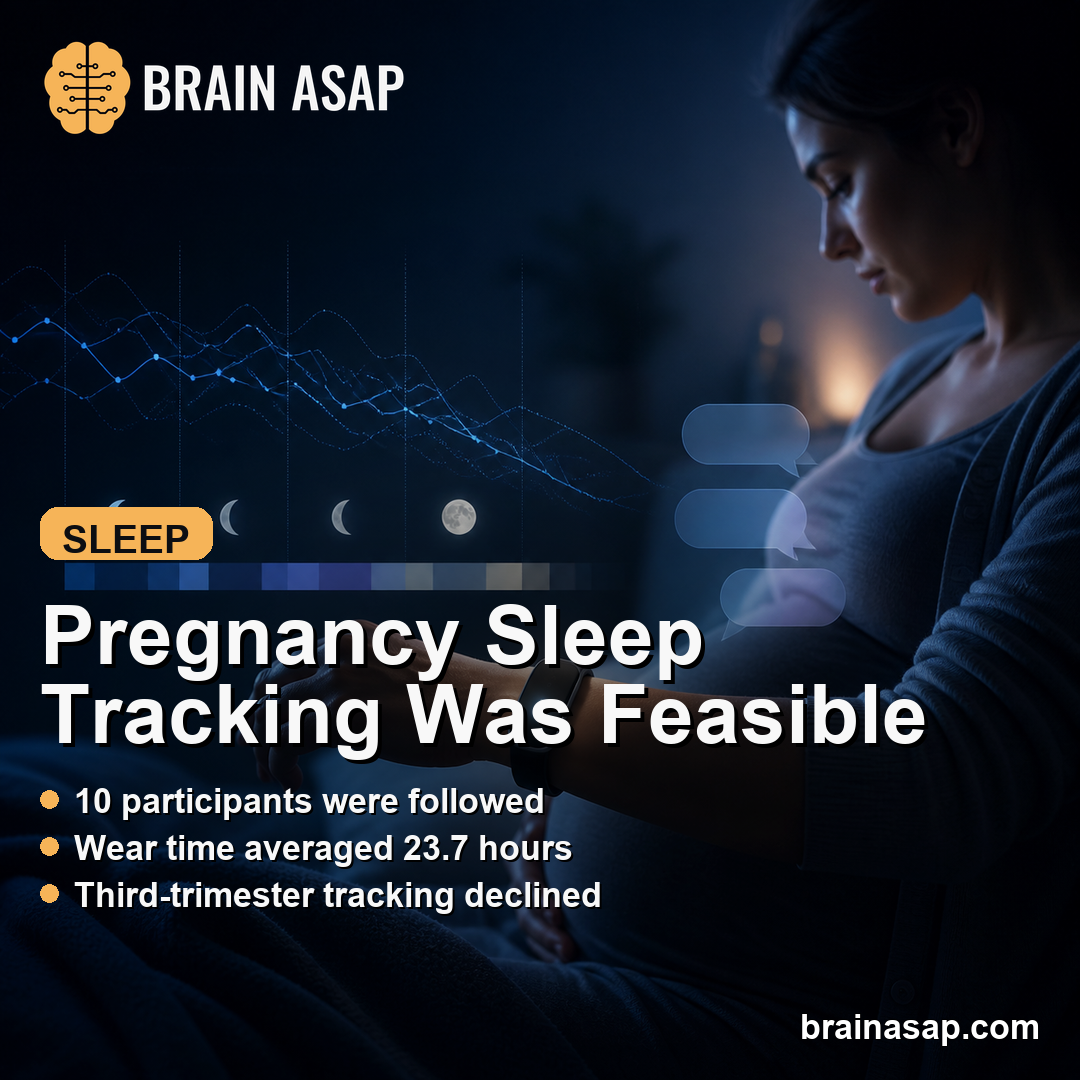
TL;DR: A 2026 feasibility study in the Journal of Activity, Sedentary and Sleep Behaviors found that pregnant participants could use a research-grade accelerometer plus text-message sleep diaries across much of pregnancy, although third-trimester wear declined.
Key Findings
- 10 pregnant participants: The pilot recruited Kaiser Permanente Northern California members at 10 weeks’ gestation and followed them until 35 weeks.
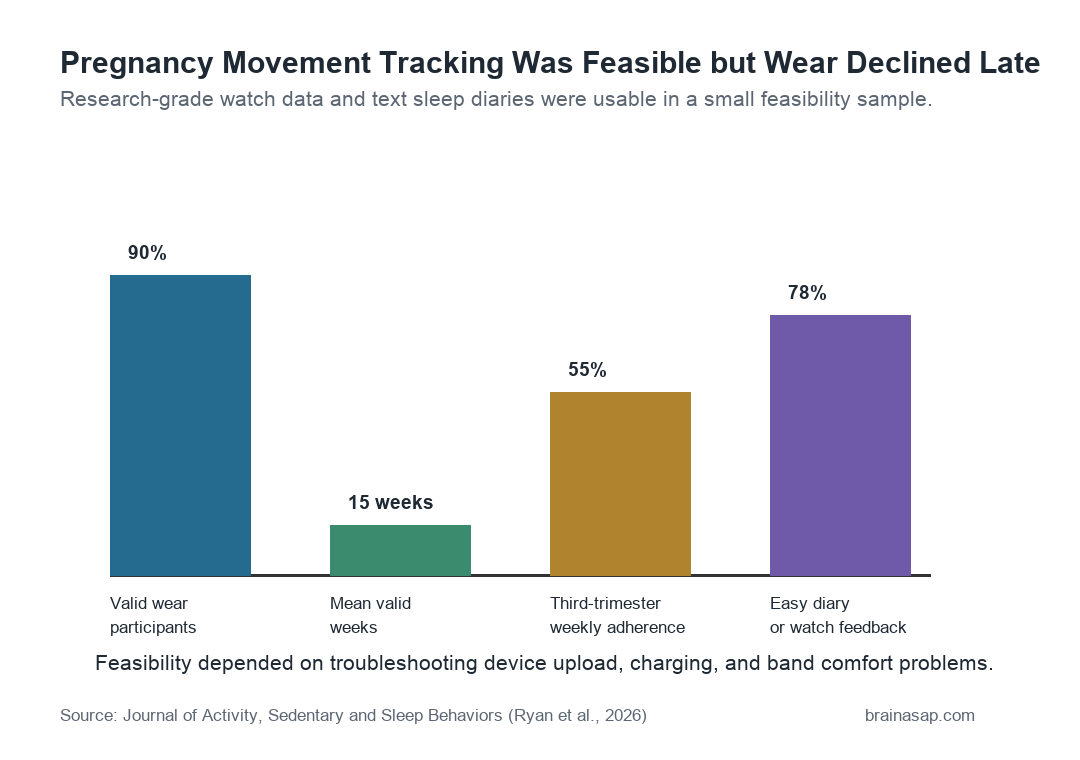
- 90% accelerometer feasibility: 9 participants provided at least 4 valid accelerometer wear days per week for a mean of 15 weeks.
- 23.7 daily wear hours: Among participants who contributed valid accelerometer data, average daily wear time was 23.7 hours.
- Sleep diaries held up: All 10 participants completed at least 4 text-based sleep diaries during assigned diary weeks for a mean of 5 months.
- Late-pregnancy decline: The proportion meeting the weekly accelerometer threshold fell to 55% in the third trimester.
Source: Journal of Activity, Sedentary and Sleep Behaviors (2026) | Ryan et al.
Twenty-four-hour movement profiles combine sleep opportunity, sedentary time, light activity, and moderate-to-vigorous physical activity across a full day. Pregnancy is a demanding test case because sleep, discomfort, activity, and routines change quickly.
The research team tested whether a research-grade wrist accelerometer plus daily sleep diaries could collect this kind of longitudinal data from early to late pregnancy.
Research-Grade Wearables Were Tested From 12 to 35 Weeks
The study enrolled 10 pregnant individuals at about 10 weeks’ gestation. Participants were asked to wear an ActiGraph CentrePoint Insight accelerometer continuously on the wrist and to upload data regularly.
Sleep diaries were sent by text message for 7 consecutive days each month until 35 weeks. The diary questions covered bedtime, wake time, time to fall asleep, awakenings, naps, perceived sleep quality, and perceived sleep sufficiency.
- Valid accelerometer day: At least 10 hours of waking wear time counted as valid.
- Weekly adherence: Four or more valid accelerometer days per week met the feasibility threshold.
- Diary adherence: Four or more completed daily sleep diaries during a diary week met the diary threshold.
The combined design fills a measurement gap because devices alone do not capture the subjective parts of sleep health. A wearable can estimate timing and movement, but it cannot fully capture sleep satisfaction or daytime consequences.
Enrollment began in the 10th gestational week, and movement profiles were summarized by gestational week and trimester. That structure let the team test data processing across pregnancy, even though the pilot was not powered to estimate population-level activity change.
Accelerometer Wear Was Strongest Before the Third Trimester
9 of the 10 participants contributed at least 4 valid accelerometer days per week for a mean of 15 weeks. Across those participants, total weeks with any accelerometer data ranged from 10 to 23 weeks.
Average daily wear time was high at 23.7 hours, with a range from 11.8 to 24.0 hours among valid contributors. Weekly adherence was strongest in gestational weeks 13 through 26, when 60% to 90% of participants met the four-day threshold.
- Midpregnancy adherence: Weeks 13 through 26 kept most participants above the weekly wear threshold.
- Third-trimester drop: Starting around week 27, adherence declined, and only 55% met the threshold in the third trimester.
- Technical burden: Upload, connectivity, charging, and band comfort problems reduced sustained wear.
Text-Message Sleep Diaries Were Easier to Sustain
Sleep diary completion was generally high. All 10 participants completed at least 4 daily diaries during assigned diary weeks for a mean of 5 months, with a range of 3 to 6 months and a median of 6.
At the final feedback survey, participants described the diary format as manageable. Most respondents, 78%, reported that the sleep diaries were easy to answer and that the watch was comfortable, although several described the band as bulky.
- Text preference: All participants selected text message delivery rather than email for sleep surveys.
- Setup clarity: All respondents said equipment setup instructions were easy to understand and follow.
- Watch drawbacks: One-third reported technical difficulties such as upload, connectivity, or charging problems.
The diary result is useful for sleep research because it suggests subjective sleep data can be collected repeatedly without relying only on retrospective trimester-level questionnaires.
Repeated morning prompts also reduce recall burden. Instead of asking someone late in pregnancy to reconstruct weeks of sleep, the diary captured recent sleep timing, awakenings, naps, and perceived sleep quality while the details were still fresh.
Pregnancy Sleep and Activity Studies Need Device Support Plans
The study was not designed to produce generalizable pregnancy activity norms. The sample was small, highly educated, fully employed, and followed only from late first trimester onward.
The stronger conclusion concerns research logistics. Continuous pregnancy monitoring appears feasible, but sustained participation may depend on device size, band comfort, battery alerts, data-upload support, and extra follow-up during mid-to-late pregnancy.
That distinction is important for interpreting the 55% third-trimester threshold. Lower late-pregnancy adherence may reflect discomfort, cumulative study burden, technical problems, or all 3 together, not simply low motivation.
- Comfort planning: Future studies should match watch and band size to participants more carefully.
- Technical support: Research teams should prepare troubleshooting for upload, charging, and connectivity issues.
- Later-pregnancy reminders: Additional contact may help preserve wear as discomfort increases in the third trimester.
The practical finding is that a combined wearable-and-diary design can work, but it should be treated as an active participant-support workflow rather than a passive device handoff.
Citation: DOI: 10.1186/s44167-026-00101-6. Ryan et al. Feasibility and acceptability of longitudinal measurement of 24-hour movement profiles across pregnancy using research-grade devices paired with sleep diaries. Journal of Activity, Sedentary and Sleep Behaviors. 2026.
Study Design: Small longitudinal feasibility and acceptability study of wrist accelerometer wear plus monthly text-message sleep diaries during pregnancy.
Sample Size: 10 pregnant participants recruited at 10 weeks’ gestation and followed through 35 weeks.
Key Statistic: 9 participants provided at least 4 valid accelerometer days per week for a mean of 15 weeks, and average daily wear time among valid contributors was 23.7 hours.
Caveat: The sample was small and socioeconomically narrow, so movement patterns should not be treated as pregnancy norms.