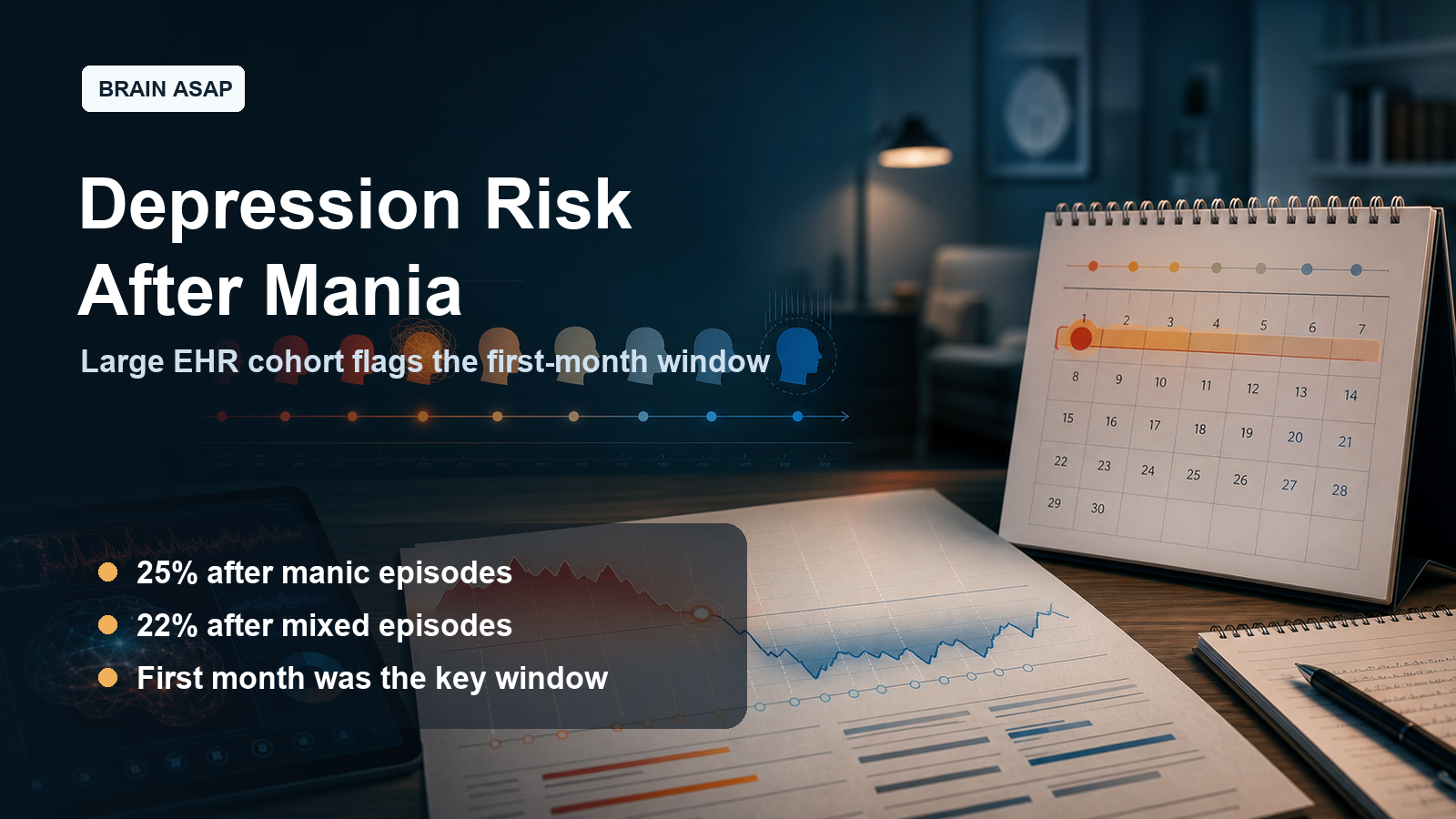
TL;DR: A 2026 medRxiv retrospective cohort study found that depression often followed bipolar manic or mixed episodes quickly, with 25% of manic episodes and 22% of mixed episodes transitioning to depression within 1 month.
Key Findings
- First-month risk window: Researchers analyzed 10,437 people, 42,314 mood episodes, and 90,727 person-years in a U.S. electronic health record database.
- Fast post-mania depression: 25% of manic episodes transitioned to depression within 1 month.
- Fast post-mixed depression: 22% of mixed episodes transitioned to depression within 1 month.
- Prior pattern predicted risk: Previous short transition times were associated with much higher risk of another short transition.
- Lithium association: Lithium prescribed during hospital-associated manic or mixed episodes was associated with longer transition time, but the study was observational.
Source: medRxiv (2026) | Choi et al.
Bipolar disorder is often described by the presence of manic, mixed, depressive, and euthymic periods. This preprint focused on a narrower clinical question: after a manic or mixed episode, how quickly does depression tend to arrive?
The first weeks after a manic or mixed episode may therefore warrant closer monitoring for emerging depression.
Depression Often Started Within 1 Month After Mania
Researchers used the NeuroBlu health record database, which contains de-identified U.S. clinical records. The cohort included 10,437 people with bipolar disorder, 42,314 mood episodes, and 90,727 person-years of data from 1959 to 2025.
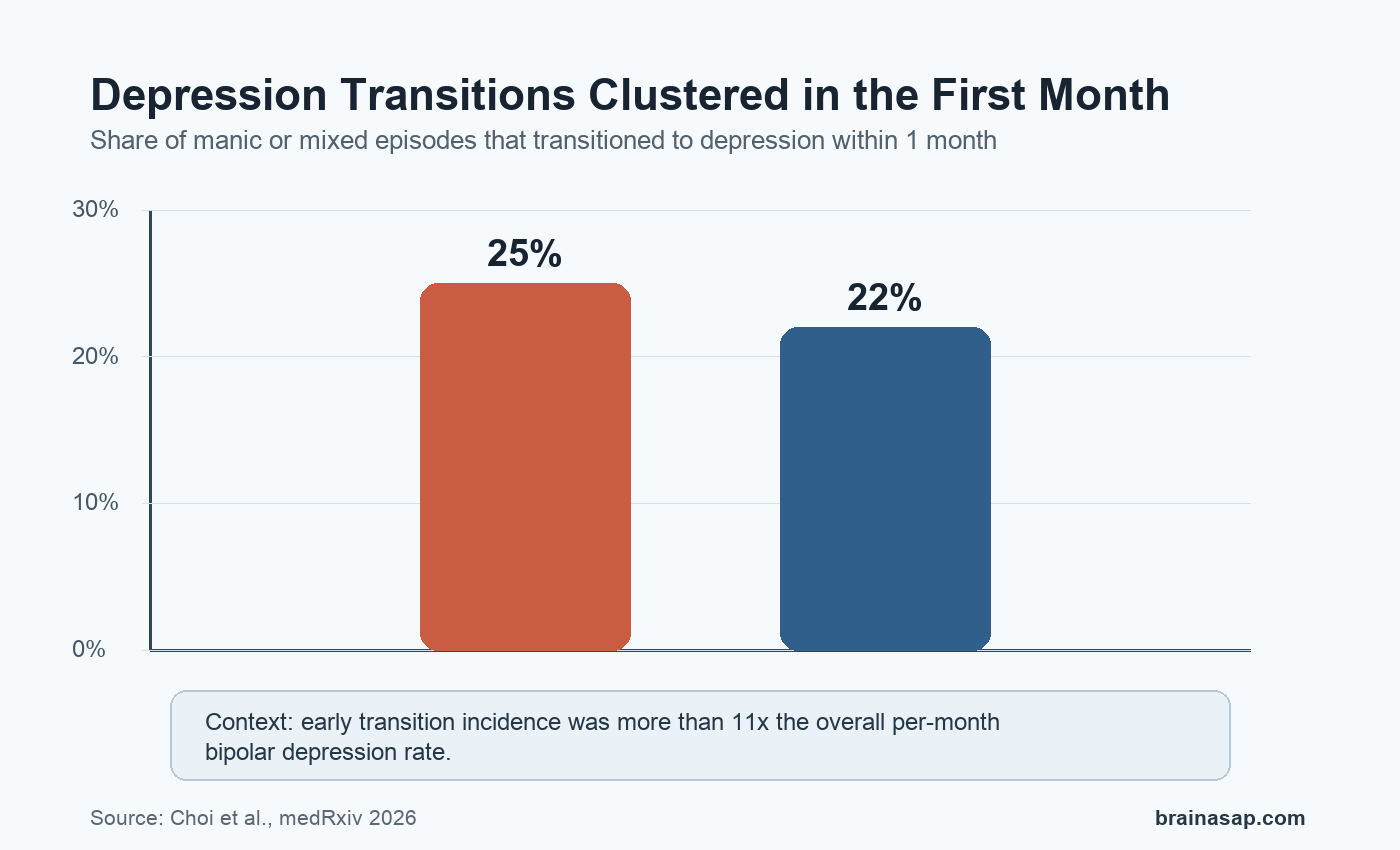
The main result was direct. Within 1 month, 25% of manic episodes and 22% of mixed episodes had transitioned to depression.
Researchers reported that this early transition incidence was more than 11 times higher than the overall per-month bipolar depression rate. By 6 months, the transition rate had mostly plateaued.
The analysis treated transition time as the interval between a recorded manic or mixed episode and the next recorded depressive episode. That makes the result clinically practical: the paper is not only counting lifetime bipolar episodes, but asking when clinicians should expect depression to appear after an elevated or mixed state.
Previous Fast Transitions Predicted Another Fast Transition
The strongest predictor was a patient’s own prior pattern. A previous short transition time was associated with a higher chance of another short transition after mania or a mixed episode.
- Post-mania pattern: Prior short transition time was associated with a relative risk of 3.08 for another transition to depression within 1 month.
- Post-mixed pattern: Prior short transition time was associated with a relative risk of 2.52.
- Clinical meaning: A recent or historical fast swing into depression may identify patients who need closer follow-up soon after mania or mixed symptoms improve.
Episode severity also mattered. Each 1-point increase in Clinical Global Impression-Severity (CGI-S), a clinician-rated illness-severity scale, was associated with higher short-transition risk after both manic and mixed episodes.
Hospitalized Episodes Had Higher Short-Transition Risk
Hospitalization for the manic or mixed episode was another risk marker. For post-mania transitions, hospitalization was associated with a relative risk of 1.22. For post-mixed transitions, the association was stronger at relative risk 1.71.
That does not mean hospitalization caused the transition. Hospital admission is also a marker of more severe, disruptive, or clinically complex episodes.
Still, the result gives clinicians a practical signal: patients leaving a hospital-associated manic or mixed episode may be entering a high-risk depression window, especially in the first month.
Lithium Was Associated With Longer Transition Time
The medication analysis focused on drugs prescribed during hospital-associated manic or mixed episodes. Several medication groups were associated with longer transition time to depression.
- Lithium: Lithium was associated with lower short-transition risk after mania (RR 0.75) and after mixed episodes (RR 0.72).
- Other mood stabilizers: Other mood stabilizers were also associated with lower short-transition risk after both manic and mixed episodes.
- First-generation sedating antihistamines: This class was associated with longer transition time after manic episodes.
- No clear signal: Antipsychotics, antidepressants, and benzodiazepines were not associated with longer transition time in the reported analysis.
The lithium result fits older clinical interest in mania-depression-euthymic interval patterns, where lithium may be especially relevant. The study cannot prove prevention, though, because prescribing was not randomized.
Shorter Transition Time Was Linked to More Depression Hospital Days
Transition timing was not only a descriptive pattern. Shorter time from mania or mixed symptoms to depression was associated with more later depression-related hospital days.
Researchers estimated 16% fewer depression-related hospital days for each month of delay to depression, with a 95% CI from 4% to 25%.
That result supports the clinical importance of timing. A fast transition was not just a calendar detail; it tracked with heavier depression-related hospital burden afterward.
Electronic Records Cannot Prove Lithium Prevention
This was a large naturalistic study, not a prospective trial. Electronic health records can reveal patterns across many patients, but they also bring measurement and confounding problems.
- Observational medication data: Medication associations may reflect prescribing choices, patient severity, clinician judgment, adherence, or unmeasured clinical factors.
- Episode timing depends on records: Mood-episode dates came from clinical documentation, not a trial schedule with standardized assessment visits.
- Preprint status: The source was posted to medRxiv and had not yet completed journal peer review at the time of the scan.
- Database access: NeuroBlu data are available through application and paid access, limiting independent replication by outside groups.
The most supported takeaway is practical and time-specific: depression risk appears especially concentrated in the first month after manic and mixed episodes.
Future prospective studies can test whether targeted monitoring or medication strategies during that early window reduce rapid post-mania or post-mixed depression.
Citation: DOI: 10.64898/2026.06.29.26356830. Choi et al. Transition time from manic and mixed episodes to depression: a retrospective cohort study. medRxiv. 2026.
Study Design: Retrospective cohort study using de-identified U.S. electronic health record data.
Sample Size: 10,437 people with bipolar disorder; 42,314 mood episodes; 90,727 person-years.
Key Statistic: 25% of manic episodes and 22% of mixed episodes transitioned to depression within 1 month.
Caveat: The study was observational and posted as a preprint, so medication associations should not be read as proof of prevention.