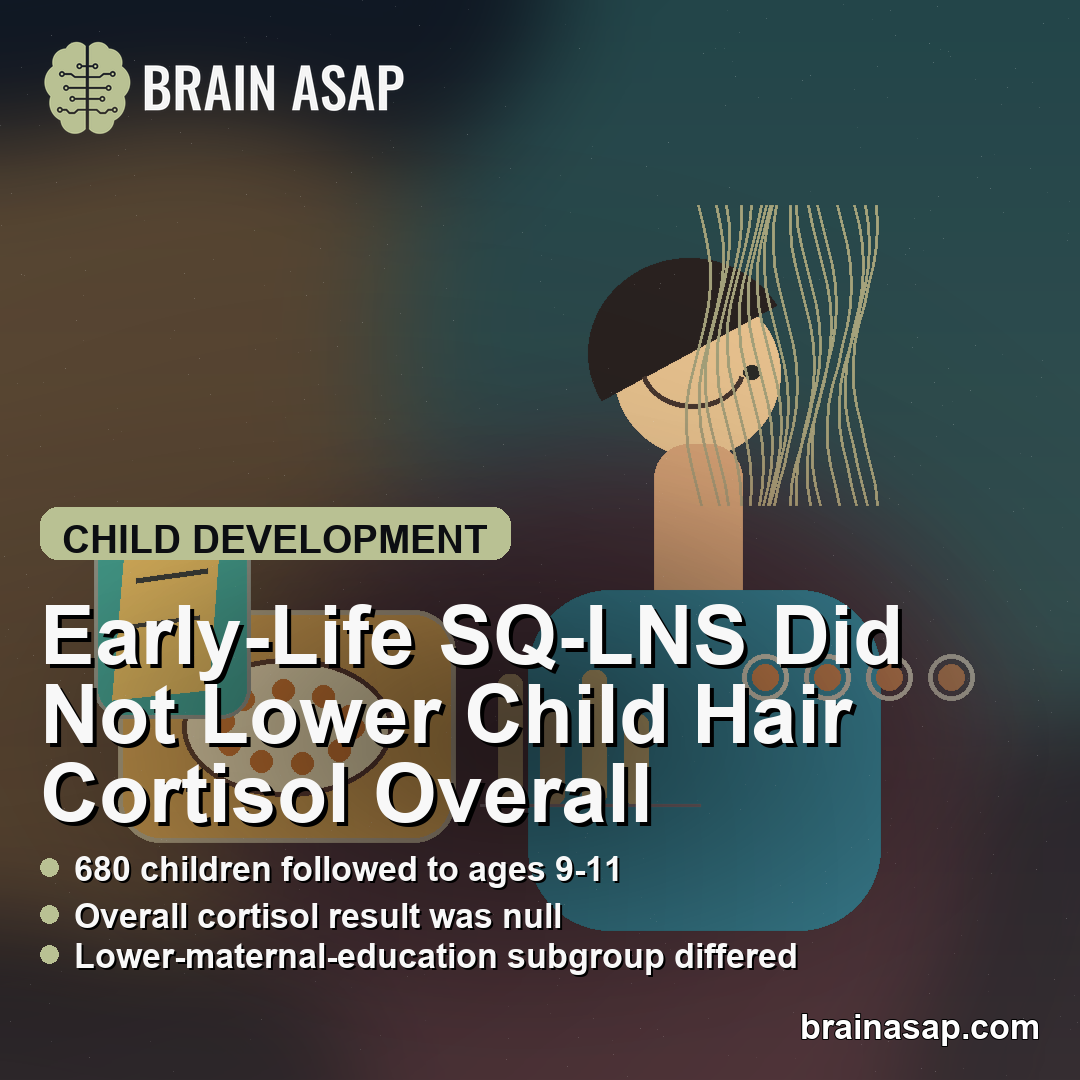
TL;DR: A 2026 randomized follow-up study in Maternal & Child Nutrition found no overall hair-cortisol difference at ages 9-11 after early-life small-quantity lipid-based nutrient supplementation, but children whose mothers had 0-5 years of schooling had lower cortisol if they received SQ-LNS.
Key Findings
- No overall cortisol shift: Usable hair cortisol data from 680 children showed nearly identical medians in the SQ-LNS and non-LNS groups.
- No full-sample effect: Median hair cortisol was 7.4 pg/mg with SQ-LNS versus 7.5 pg/mg without child LNS exposure, with p values above 0.10.
- Education interaction: Maternal education modified the supplementation result, with a reported interaction p value of 0.043.
- Lower-education subgroup: Among children whose mothers had 0-5 years of schooling, median cortisol was 6.3 pg/mg with SQ-LNS versus 7.8 pg/mg in controls.
- No high-education gap: Among children whose mothers had more than 5 years of schooling, cortisol did not differ between groups (p = 0.949).
Source: Maternal & Child Nutrition (2026) | Nti et al.
Small-quantity lipid-based nutrient supplements (SQ-LNS) are fortified pastes designed to improve diet quality during early development.
In this Ghana follow-up, researchers asked whether supplementation during pregnancy, lactation, and toddlerhood left a measurable trace in children’s stress biology years later.
The stress marker was hair cortisol concentration (HCC), a measure that reflects longer-term hypothalamic-pituitary-adrenal (HPA) axis activity rather than a single moment of acute stress.
SQ-LNS Did Not Lower Hair Cortisol in the Full Ghana Follow-Up Sample
The study followed children from the iLiNS-DYAD Ghana randomized trial. Pregnant women had originally been assigned to iron-folic acid, multiple micronutrients, or SQ-LNS; the SQ-LNS group also received child supplementation from 6 to 18 months.
At ages 9-11 years, researchers collected hair samples close to the scalp and assayed cortisol. After excluding two extreme outliers and one child with too little hair, the analysis included 680 children.
- SQ-LNS group: 225 children whose mothers received SQ-LNS during pregnancy and 0-6 months postpartum, and who received child SQ-LNS from 6-18 months.
- Non-LNS controls: 455 children from the iron-folic acid and multiple-micronutrient arms, combined after the two control groups did not differ significantly.
- Main biomarker: Hair cortisol concentration, reported as pg/mg and log-transformed for regression models.
The overall result was close to null. Median HCC was 7.4 pg/mg in the SQ-LNS group and 7.5 pg/mg in the non-LNS group, and adjusted and unadjusted models did not show a significant main effect.
The original hypothesis was straightforward: better early-life nutrition might support HPA-axis regulation and lead to lower cumulative cortisol in late childhood. The full sample did not support that broad claim.
Maternal Education Changed the SQ-LNS Cortisol Pattern
The more specific pattern appeared only after researchers tested prespecified effect modifiers. Maternal education, split at 0-5 years versus more than 5 years of schooling, modified the supplementation result.
The split was concentrated in families with less maternal schooling. In that subgroup, median HCC was 6.3 pg/mg after SQ-LNS exposure versus 7.8 pg/mg in controls, with a subgroup comparison of p = 0.031.
For children whose mothers had more than 5 years of schooling, there was no comparable difference. Cortisol values were essentially unchanged between groups, with p = 0.949.
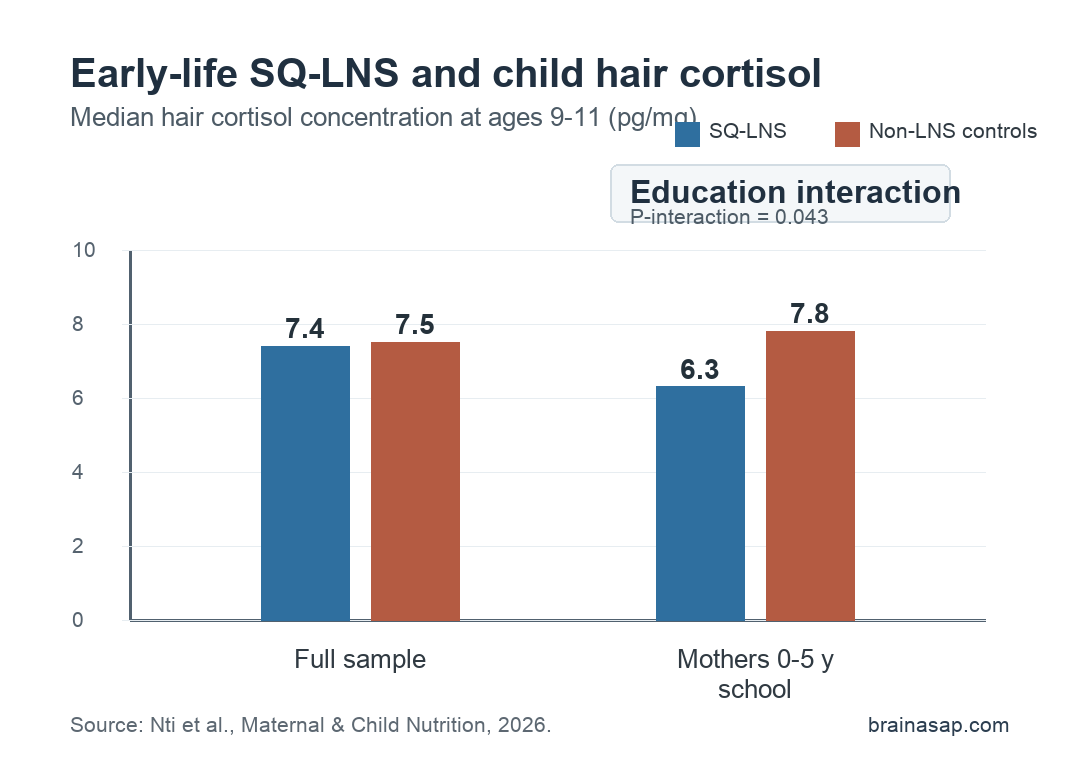
- Interaction test: Maternal education modified the intervention effect on log-transformed HCC, with P-interaction = 0.043.
- Lower-education subgroup: SQ-LNS was associated with lower median cortisol when mothers had 0-5 years of schooling.
- Higher-education subgroup: SQ-LNS was not associated with lower cortisol when mothers had more than 5 years of schooling.
The researchers described this as a cautious finding, not proof of a universal stress-buffering effect. Maternal education was one of six tested effect modifiers, and the other five did not show significant interactions.
Hair Cortisol Measured Longer-Term HPA-Axis Activity
Cortisol can be measured in saliva, blood, urine, or hair, but those sources answer different questions. Saliva and blood can reflect acute timing, daily rhythm, or the stress of collection, while hair offers a longer retrospective window.
In this study, hair was collected from the posterior vertex near the scalp. Samples were washed, ground, extracted in methanol, and analyzed with an enzyme-linked immunosorbent assay validated for hair cortisol.
- Hair sample: About 100-120 strands were collected, with the scalp end marked for analysis.
- Assay method: A 15 mg cleaned hair portion was ground and extracted before cortisol measurement.
- Outcome scale: Cortisol was normalized to hair weight and reported as pg/mg.
The included children had median values within the paper’s cited healthy-child reference range. Those values describe a population-level stress-biology comparison, not a clinical cortisol abnormality.
The biology remains plausible. SQ-LNS contains nutrients relevant to neurodevelopment and stress regulation, including iron, zinc, folate, and omega-3 fatty acids.
The study cannot tell which nutrient, if any, drove the subgroup difference.
The Subgroup Cortisol Result Needs Replication
The main limitation is that the strongest positive result was an interaction finding. Effect-modification tests can identify important vulnerability patterns, but they can also produce chance findings when several subgroups are examined.
The sample also represented a follow-up subset. Of 1217 eligible children, 979 were re-enrolled, 683 provided hair samples, and 680 remained in the analytic sample after exclusions.
- Attrition: Children with HCC values differed from those without HCC values on several baseline characteristics, including maternal age, marital/cohabiting status, parity, and child sex.
- Multiple tests: The maternal-education interaction was prespecified, but the researchers did not correct the effect-modification analyses for multiple comparisons.
- Timing: HPA-axis effects might look different later in puberty, when cortisol concentrations can change with developmental stage.
For now, the cleanest interpretation is specific. Early-life SQ-LNS did not lower hair cortisol across all children in this Ghana follow-up, but it may have lowered cumulative cortisol among children growing up with lower maternal education.
Citation: DOI: 10.1111/mcn.70197. Nti et al. Effect of Small-Quantity Lipid-Based Nutrient Supplementation on Children’s Cortisol Concentration. Maternal & Child Nutrition. 2026;22:e70197.
Study Design: Long-term follow-up of the iLiNS-DYAD Ghana randomized controlled trial.
Sample Size: 680 children with usable hair cortisol data at ages 9-11 years.
Key Statistic: Full-sample median HCC was 7.4 pg/mg with SQ-LNS versus 7.5 pg/mg without LNS; lower-maternal-education subgroup medians were 6.3 versus 7.8 pg/mg.
Caveat: The main positive signal was a subgroup interaction without multiple-comparison correction.