TL;DR: A 2026 study in Signal Transduction and Targeted Therapy engineered a modified inhibitory DREADD receptor called GRANPA so the over-the-counter antihistamine diphenhydramine could switch off targeted brain circuits and reduce seizure activity in mouse models.
Key Findings
- Two added receptor mutations: The lead GRANPA receptor combined hM4Di with S85V and Y416F mutations to improve diphenhydramine activation while keeping low basal activity.
- ~1400-fold potency shift: hM4Di plus S85V and Y416F showed an EC50 of 870 pM for diphenhydramine in the GloSensor assay.
- 37% firing rate: In mouse cortical cultures, 200 nM diphenhydramine reduced weighted mean firing rate in GRANPA-expressing networks to 37% +/- 7% of baseline after 1 hour.
- 35% burst rate: The same culture experiment reduced mean network bursting rate to 35% +/- 7% of baseline.
- Mouse seizure suppression: Hippocampal GRANPA plus diphenhydramine delayed PTZ-induced myoclonic seizures and reduced seizure burden in a chronic epilepsy model.
Source: STTT (2026) | Devenish et al.
GRANPA is not a normal brain receptor. It is an engineered version of the inhibitory muscarinic DREADD hM4Di, designed so a common drug can control cells that have been given the receptor by a viral vector.
Ordinary diphenhydramine does not selectively silence brain circuits by itself. The tested system was a gene-therapy-style switch, where receptor expression supplies targeting and the drug supplies timing.
GRANPA Changed hM4Di So Diphenhydramine Became a Potent Switch
Chemogenetics lets researchers control selected neurons with a drug-like ligand. The challenge for clinical translation has been finding a ligand with useful brain exposure, potency, and tolerability.
Existing hM4Di tools often rely on clozapine-related compounds. Clozapine can activate many receptors and requires monitoring in clinical use, so the researchers looked for a safer activating route.
- Starting receptor: hM4Di, an inhibitory designer muscarinic receptor used to reduce neuronal activity.
- Candidate ligand: Diphenhydramine, a first-generation antihistamine used for allergy, motion sickness, and mild sedation.
- Lead pair: GRANPA plus diphenhydramine, shortened in the paper as a G protein-coupled receptor activated by a non-prescription agent.
The lead receptor added S85V and Y416F to hM4Di. In the GloSensor assay, that two-mutation construct shifted diphenhydramine potency by about 1400-fold, to an EC50 of 870 pM.
A more heavily mutated version reached an EC50 of 78 pM, but those added mutations increased constitutive activity. The researchers chose the two-mutation GRANPA receptor because it kept low baseline activity before diphenhydramine was added.
Cryo-EM and Pharmacology Mapped the Diphenhydramine Binding Site
The structural work used cryo-electron microscopy to solve active-state GRANPA bound to diphenhydramine and a G protein transducer. The overall receptor-focused interpretation reached 3.0 angstrom resolution.
The structure explained why the two selected mutations helped. S85V shifted a key aspartate toward the binding pocket, and Y416F changed the hydrophobic environment around diphenhydramine.
- S85V effect: The mutation interrupted a hydrogen-bond network and allowed D112 to rotate toward diphenhydramine’s amine group.
- Y416F effect: The mutation changed the pocket around the ligand’s aryl groups and helped support activation by diphenhydramine.
- Low unwanted activation: Common neurotransmitters did not notably activate GRANPA below 100 micromolar in the TRUPATH assay.
Diphenhydramine activated GRANPA with about 250x greater potency than it inhibited H1 signaling in the comparison assay. At GRANPA-active concentrations, the assay suggested little H1 blockade.
That pharmacology does not make the system ready for patients. It means the receptor-ligand pair passed several early tests that matter before animal disease models are considered.
Diphenhydramine Suppressed GRANPA-Expressing Neuronal Networks
The next question was whether the engineered receptor could inhibit real neuronal activity. Researchers packaged GRANPA in an AAV9 vector under a CaMKII promoter, which biases expression toward excitatory neurons.
Mouse cortical neurons were grown on multielectrode arrays and transduced with either GRANPA or a control fluorescent-protein vector. Before diphenhydramine was added, GRANPA networks were viable and active, which argued against toxic or tonic receptor effects.
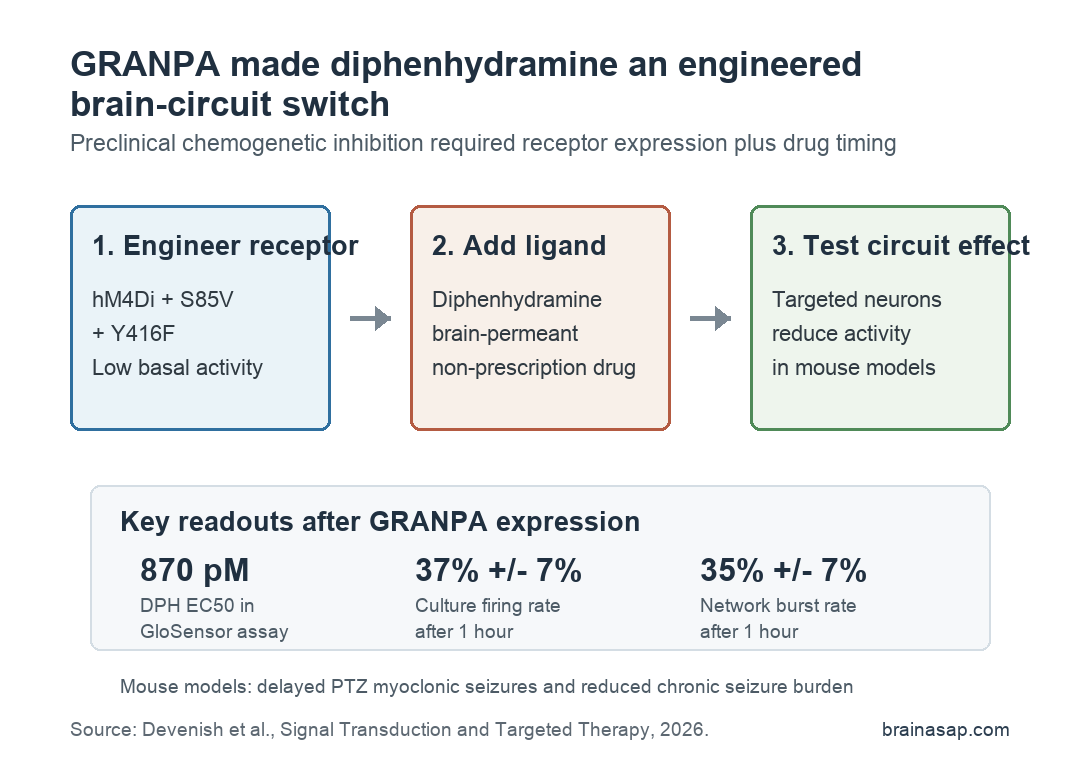
- Culture dose: Diphenhydramine was applied at 200 nM to multielectrode-array cultures.
- Firing rate: Weighted mean firing rate fell to 37% +/- 7% of baseline after 1 hour in GRANPA cultures.
- Network bursts: Mean network bursting rate fell to 35% +/- 7% of baseline.
- Reversibility: After 24 hours, the culture-silencing effect had disappeared, consistent with compensation after prolonged suppression.
Brain-slice experiments supported a synaptic mechanism. In hippocampal slices from GRANPA-injected mice, 1 micromolar diphenhydramine reduced field excitatory postsynaptic potential slope, while control slices did not show the same effect.
Hippocampal GRANPA Reduced Anxiety Measures and Seizure Burden in Mice
The in vivo experiments targeted the hippocampus because it is involved in anxiety-related behavior and temporal-lobe seizure generation. Mice received AAV9-CaMKII-GRANPA or a control vector in the ventral hippocampus.
After intraperitoneal diphenhydramine at 1 mg/kg, GRANPA-expressing mice entered the center of an open field more often than control-vector mice, consistent with reduced anxiety-like avoidance. Total distance traveled did not increase in a way that suggested nonspecific hyperactivity.
The epilepsy experiments were more directly disease-facing. In an acute pentylenetetrazol model, diphenhydramine significantly delayed the first myoclonic seizure in GRANPA-expressing mice.
- Acute model: PTZ seizures were evoked after diphenhydramine treatment, with 12 mice per group in the figure legend.
- Chronic model: A kainate-induced mesial temporal lobe epilepsy model used hippocampal electroencephalography (EEG) to detect spontaneous focal seizures.
- Seizure burden: Diphenhydramine and clozapine reduced total time spent in seizure states over 120-minute post-injection windows in GRANPA-expressing epileptic mice.
The study is still preclinical. It used engineered receptor expression, viral vectors, mouse models, and laboratory dosing, so it should not be read as evidence that non-prescription diphenhydramine treats epilepsy in people.
The proposed translation depends on targeted receptor delivery. A future clinical version would need to show safe expression, durable control, and reliable seizure reduction before a familiar brain-permeant drug could adjust circuit inhibition.
Citation: DOI: 10.1038/s41392-026-02865-4. Devenish et al. Next-generation chemogenetic inhibition using a brain-permeant non-prescription agent. Signal Transduction and Targeted Therapy. 2026;11:259.
Study Design: Receptor-engineering, cryo-EM, cell-culture electrophysiology, hippocampal slice, and mouse seizure-model study.
Sample/Model: HEK-cell pharmacology, mouse neuronal cultures, hippocampal slices, open-field behavior, PTZ seizures, and kainate-induced chronic epilepsy mice.
Key Statistic: Diphenhydramine reduced GRANPA-expressing culture firing to 37% +/- 7% of baseline and network burst rate to 35% +/- 7% after 1 hour.
Caveat: The approach requires engineered receptor expression and remains a preclinical gene-therapy-style strategy, not ordinary diphenhydramine treatment.