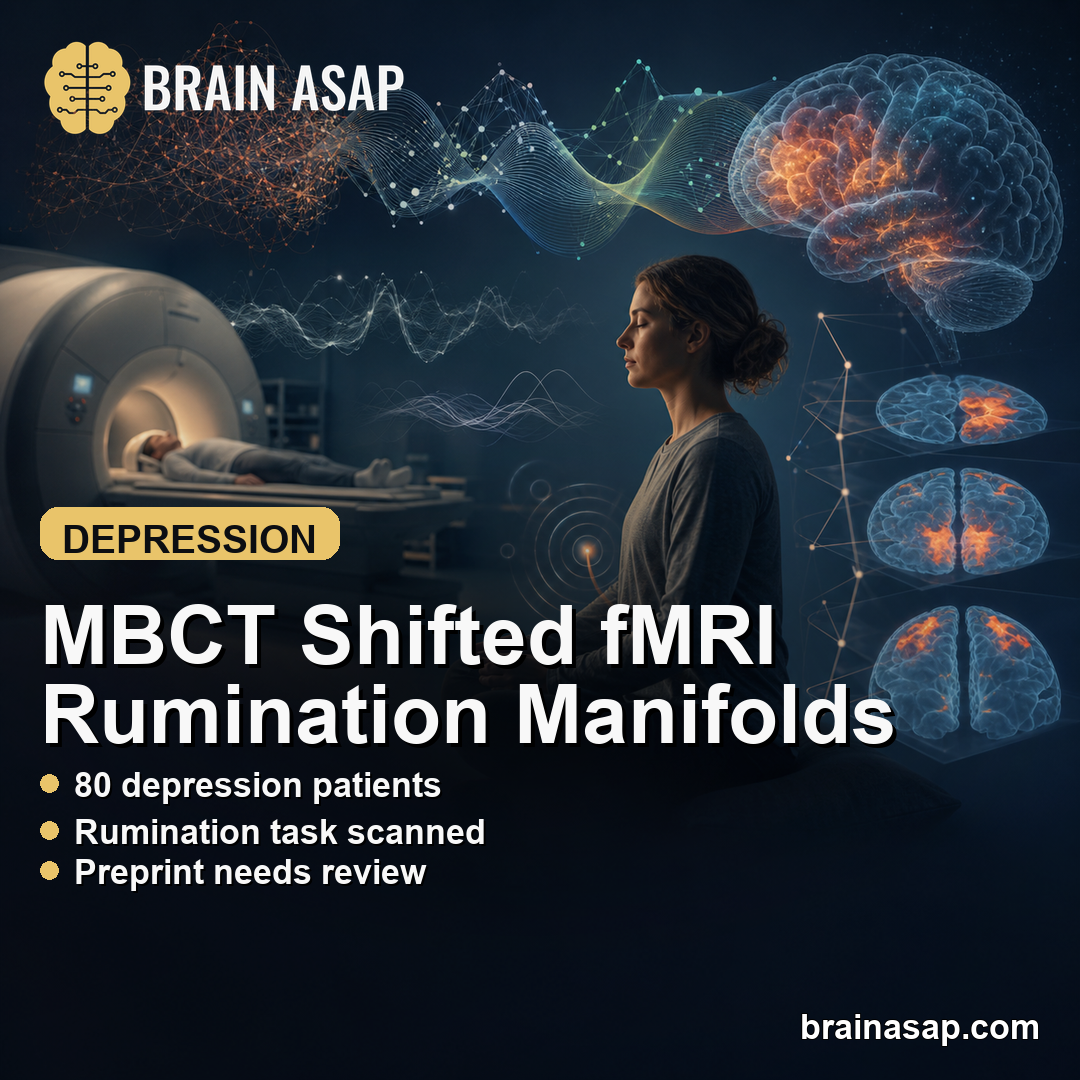
TL;DR: A 2026 medRxiv preprint used functional MRI (fMRI) and complex harmonics decomposition to study mindfulness-based cognitive therapy in 80 people with major depressive disorder, reporting post-treatment changes in whole-brain manifolds during rumination.
Key Findings
- 80-patient trial sample: The preprint analyzed fMRI data from a randomized controlled trial in major depressive disorder.
- MBCT plus TAU: One group received mindfulness-based cognitive therapy plus treatment as usual, while the comparison group received treatment as usual alone.
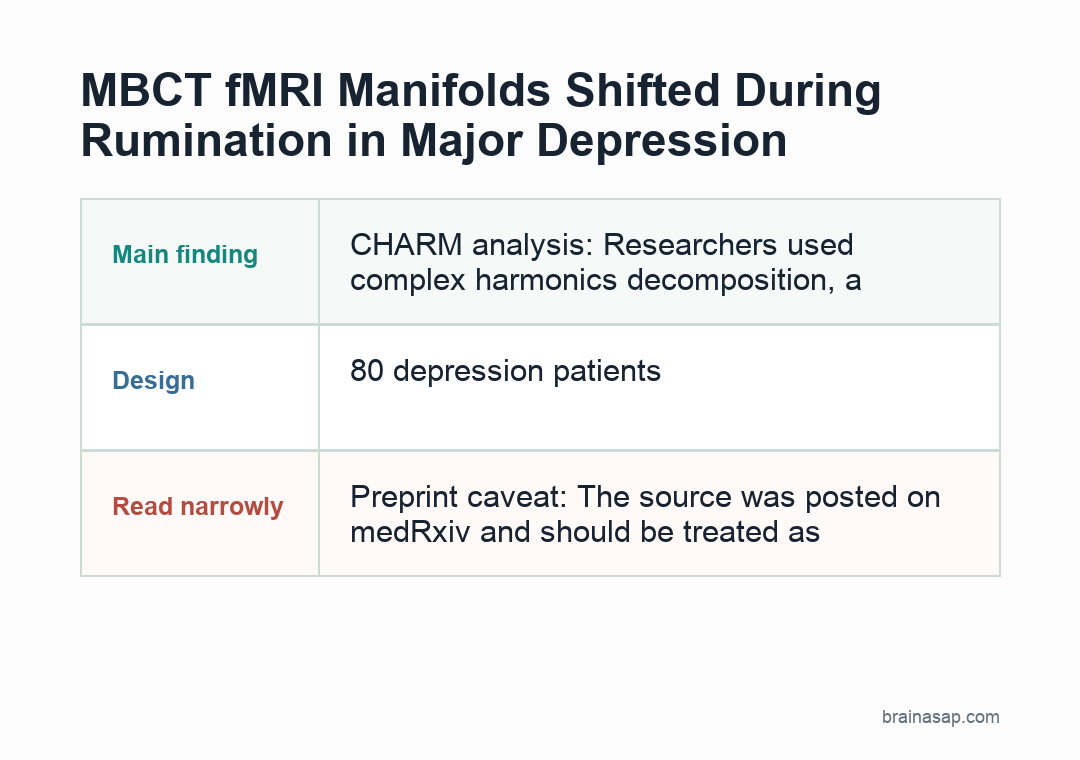
- CHARM analysis: Researchers used complex harmonics decomposition, a method for reducing whole-brain spacetime dynamics into lower-dimensional manifolds.
- Rumination scan state: After MBCT, rumination involved more consistent recruitment of bodily and interoceptive-processing regions across manifolds.
- Preprint caveat: The source was posted on medRxiv and should be treated as non-peer-reviewed until journal review is complete.
Source: medRxiv (2026) | Dagnino et al.
Mindfulness-based cognitive therapy (MBCT) trains people to notice thoughts and body sensations without automatically following them. Rumination is a relevant scan state because depressive rumination is repetitive negative thinking, not simply sadness.
The analysis does not claim that a brain scan can diagnose treatment response. It uses a computational method to describe how distributed brain activity may reorganize during a depression-relevant mental state.
That distinction keeps the preprint in the right lane: brain-mechanism research, not clinical decision support for individual patients in routine care.
MBCT Was Compared With Treatment as Usual in Major Depression
The source describes a randomized controlled trial with 80 patients with major depressive disorder (MDD). Participants received either MBCT plus treatment as usual or treatment as usual alone.
The imaging question is tied to an intervention contrast, not a simple cross-sectional difference between depressed and non-depressed groups. The preprint focuses on rumination because it is a treatment target for MBCT and a relapse-risk process in depression models.
- Condition studied: Major depressive disorder.
- Intervention group: MBCT plus treatment as usual.
- Comparison group: Treatment as usual alone.
- Imaging method: fMRI, which measures blood-oxygen-level-dependent activity related to brain function.
The source page did not provide full clinical-outcome tables in the extracted text. The imaging findings should therefore be treated as mechanistic brain-dynamics evidence rather than proof that MBCT outperformed usual care on depression symptoms.
The trial-registration and ethics statements on the source page support human-subjects oversight, but they do not replace a full peer-reviewed methods section. The safest source use is the imaging hypothesis, sample structure, and reported manifold interpretation.
CHARM Reduced Whole-Brain Dynamics Into Manifolds
The central method was complex harmonics decomposition (CHARM). The preprint describes CHARM as a way to uncover low-dimensional manifolds in spacetime brain dynamics, including both local and non-local interactions.
In plainer terms, the method tries to compress complex fMRI activity into organized patterns that can be compared across brain states. The authors report that CHARM identified distributed spatiotemporal manifolds and outperformed traditional dimensionality-reduction techniques.
- Whole-brain focus: The method looked beyond isolated regions to distributed activity patterns.
- Spacetime framing: The analysis considered how brain activity was organized across space and time.
- Comparison claim: The preprint reports better state separation than traditional dimensionality-reduction methods.
The method-heavy framing should be kept separate from clinical interpretation. A more sensitive brain-dynamics method can reveal patterns, but it does not automatically show that those patterns are causal or ready for treatment decisions.
CHARM is also a model choice. Replication with other fMRI cohorts, other rumination tasks, and more conventional analysis pipelines would help show whether the same MBCT-linked organization appears outside this dataset.
Rumination After MBCT Recruited Interoceptive Regions
During rumination after MBCT, the preprint reports consistent recruitment of regions involved in bodily and interoceptive processing. Interoception refers to sensing internal bodily states, such as heartbeat, breathing, or visceral body cues.
The reported pattern was not just a list of isolated regions. The authors described bodily and interoceptive-processing regions as integrated within distributed whole-brain manifolds.
- Rumination context: The scan state was tied to depressive repetitive thinking.
- Interoceptive processing: The finding involved body-state processing regions, not only classic cognitive-control areas.
- Distributed integration: The source described those regions as part of whole-brain manifold organization.
The source also linked latent brain-configuration changes with clinical and behavioral improvements, and it reported greater flexibility within the reduced manifold space. Those claims need the full statistical record for precise effect-size interpretation.
The interoception emphasis is also clinically coherent for mindfulness training. Breath, posture, heartbeat, and other body-state cues are common anchors during mindfulness practice, so stronger integration of bodily-processing regions is a plausible imaging target to test in later datasets.
Greater Brain Flexibility May Relate to Less Sticky Rumination
The preprint interprets greater flexibility in reduced brain-state space as a possible neural correlate of less “sticky” ruminative thinking after mindfulness training. That interpretation fits the treatment logic of MBCT, which trains people to notice thoughts without becoming trapped in them.
Still, the finding should be framed carefully. The source is a preprint, the extracted text does not include full numeric effect sizes, and complex-manifold methods are not yet routine clinical biomarkers.
- Preprint status: medRxiv posts are not certified by peer review.
- Sample size: The imaging analysis included 80 people with MDD.
- Method novelty: CHARM needs independent replication in other depression and mindfulness datasets.
- Clinical boundary: The result describes brain dynamics, not a stand-alone treatment-response test.
The measured claim is narrow: after MBCT, rumination-related fMRI dynamics appeared more flexible and more integrated with bodily-processing networks in this preprint sample.
Citation: DOI: 10.64898/2026.06.26.26356643. Dagnino et al. Complex harmonic manifolds in mindfulness-based cognitive therapy for major depressive disorder. medRxiv. 2026.
Study Design: Preprint analysis of fMRI data from a randomized controlled trial of MBCT plus treatment as usual versus treatment as usual alone.
Sample Size: 80 patients with major depressive disorder.
Key Statistic: The extracted source reported N = 80 and described post-MBCT manifold changes during rumination, but did not provide full numeric effect sizes in the source markdown.
Caveat: medRxiv preprints are not peer reviewed, and the imaging method needs independent replication before clinical use.