TL;DR: A 2026 randomized active-control study in European Journal of Sport Science found that one 45-minute slackline practice session improved eyes-open slackline balance and increased resting-state electroencephalography (EEG) beta power in healthy slackline-naive adults, while eyes-closed balance and tibial somatosensory evoked potentials did not show the same selective change.
Key Findings
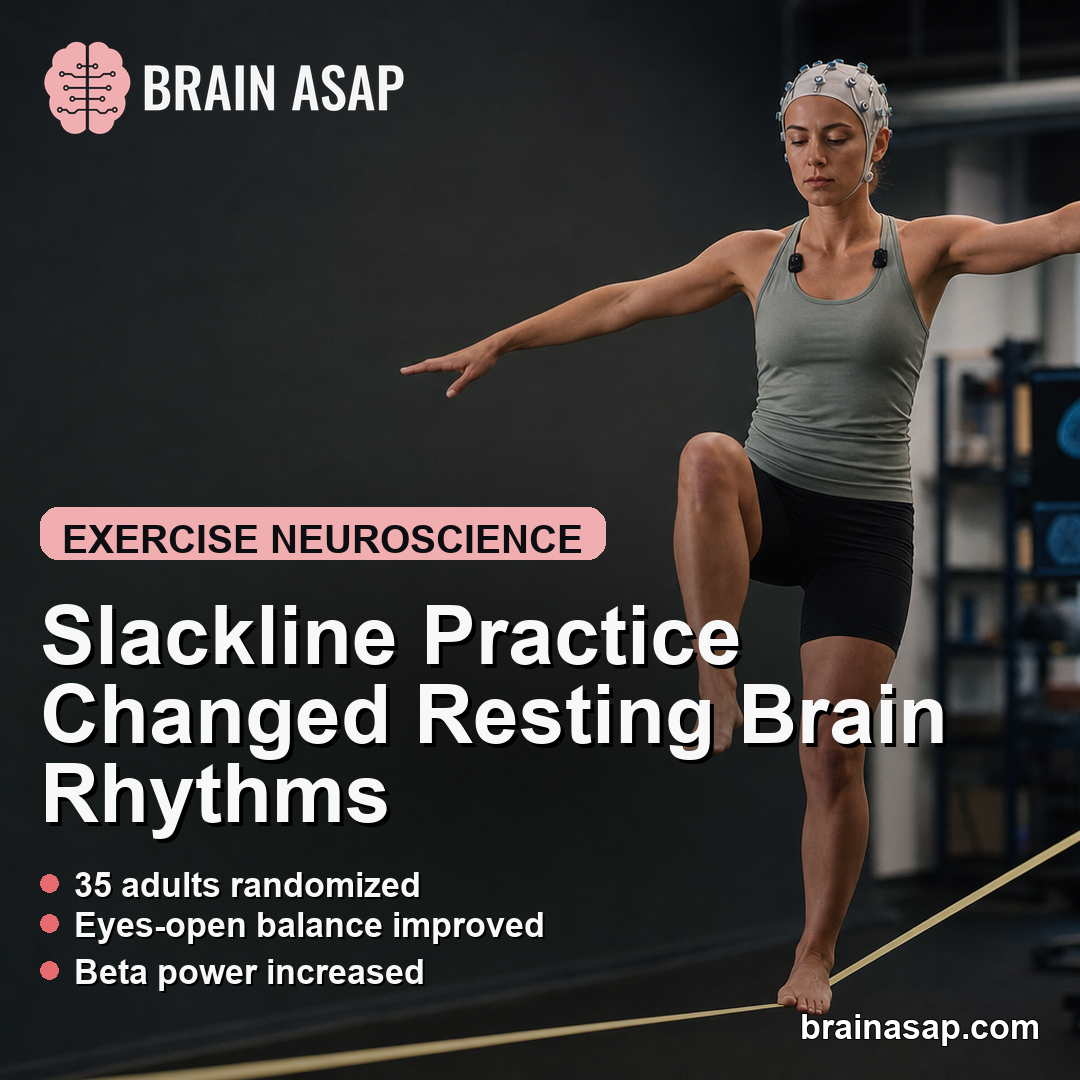
- 35-person randomized sample: Researchers analyzed 19 adults assigned to slackline training and 16 assigned to a time-matched active-control routine.
- Single-session design: The intervention group completed about 45 minutes of supervised slackline balance exercises; the control group completed the same exercise sequence with the slackline placed on the ground.
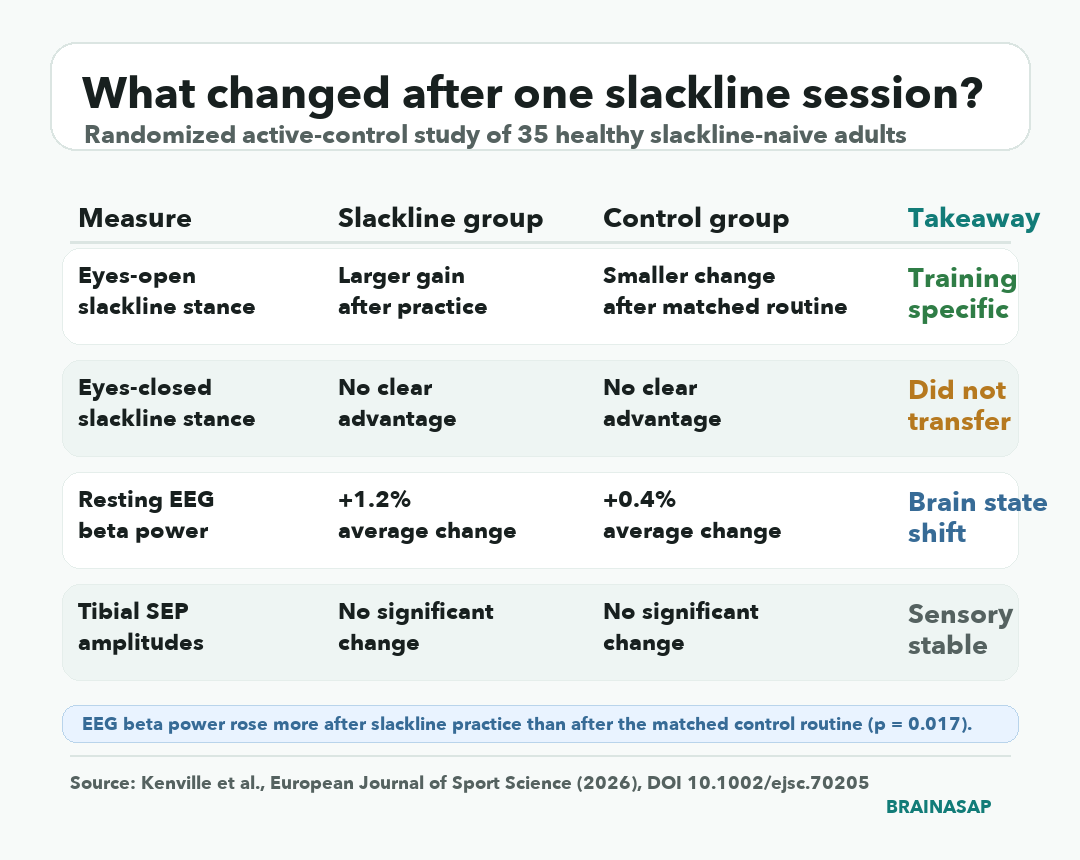
- Task-specific balance gain: The slackline group improved more than controls on the eyes-open slackline stance task, but not on the eyes-closed slackline task.
- Resting beta power increased: EEG beta power rose more after slackline practice than after the control routine (1.2% vs. 0.4%; p = 0.017).
- Sensory-evoked potentials were stable: Tibial-nerve SEP amplitudes did not significantly change in either group, suggesting the short session did not measurably shift that early somatosensory readout.
Source: European Journal of Sport Science (2026) | Kenville et al.
Slackline training is an unstable, visually guided motor-learning task that requires beginners to correct balance errors continuously.
The new study asks a narrow question: can one short exposure to slackline practice change both performance and resting brain rhythms?
The pattern was selective. The behavioral gain was real, but it was specific to the practiced eyes-open task. The EEG signal also changed, while the sensory-evoked potential measure did not.
Researchers Compared Slackline Practice With a Matched Control Routine
The final sample included 35 healthy slackline-naive adults. After exclusions for unusable recordings or behavioral outliers, 19 participants were in the intervention group and 16 were in the control group.
Everyone completed the same broad test sequence before and after the behavioral protocol:
- Balance testing: Single-leg slackline stance with eyes open and eyes closed, tested on dominant and non-dominant legs.
- Resting EEG: A 5-minute resting-state recording used to estimate theta, alpha, and beta power after aperiodic correction.
- Tibial SEP recording: Somatosensory evoked potentials measured cortical responses after tibial-nerve stimulation.
The intervention group practiced on a 4-meter slackline mounted 55 cm above the ground. The active-control group performed the same sequence of balance exercises, but with the line placed directly on the ground to reduce dynamic balance demands.
The control condition makes the comparison stricter. The study did not compare slackline practice with sitting still. It compared slackline practice with a similarly timed, similarly structured motor routine with less instability.
Eyes-Open Slackline Balance Improved, But Eyes-Closed Transfer Did Not
The clearest behavioral result was task-specific improvement. Participants who trained on the slackline improved more than controls on the eyes-open slackline stance task.
The same was not true for the eyes-closed version. The authors interpret that as a context-specific learning pattern rather than a general balance upgrade.
The task design helps explain that split. During training, participants practiced with visual input.
Removing vision changes the weighting of visual, vestibular, and somatosensory information, so a beginner can learn a visually guided balance strategy without immediately gaining the same control when vision is removed.
So the finding should not be translated as “one slackline session improves balance.” A cleaner translation is: one slackline session improved the practiced eyes-open slackline task in this small healthy-adult sample.
Resting EEG Beta Power Rose More After Slackline Training
The EEG finding focused on resting-state spectral power. Across frequency bands, the key interaction was group by frequency band, meaning the intervention and control groups did not show the same pattern across theta, alpha, and beta.
The post-hoc comparison was most specific for beta power. The slackline group showed a larger beta-power increase than the control group: 1.2% versus 0.4%, with p = 0.017.
Beta rhythms are often discussed in relation to sensorimotor state, movement preparation, motor learning, and stabilization of the current motor set. In this study, the authors frame the beta increase as a possible resting-state trace of acute sensorimotor network change after error-heavy balance practice.
Beta power was not a simple performance meter. Within the slackline group, beta-power changes did not significantly correlate with individual eyes-open balance gains.
The EEG result may say something about neural state after practice, but it did not explain why one participant improved more than another.
Tibial Somatosensory Evoked Potentials Did Not Move
The study also tested whether the short practice session changed early sensory-pathway responses from the tibial nerve. Those responses were measured as short-latency somatosensory evoked potentials.
Here, the SEP finding was negative: SEP amplitudes did not significantly change in either group.
That negative result still narrows the claim. It suggests that one session was enough to alter a resting EEG rhythm and the practiced task, but not enough to shift the tibial SEP measure used here.
The authors note that SEP sensitivity depends on the task, practice dose, and measurement parameters. A longer training program might show a different pattern, but this experiment does not support a claim that a single session measurably changed early tibial somatosensory processing.
One Slackline Session Did Not Prove General Balance Adaptation
This study is valuable because it keeps the behavioral and brain measures separate. The same session produced a clear practiced-task gain, a larger resting beta-power increase, and no SEP amplitude change.
That combination points toward an acute sensorimotor network response rather than a broad upgrade in balance capacity.
The limitations are also concrete:
- Small healthy-adult sample: The final analysis included 35 people, all slackline-naive and apparently healthy.
- Acute exposure: The study tested one session, not weeks of training or retention after days away from practice.
- Task-specific transfer: Improvement appeared in the practiced eyes-open slackline condition, not the eyes-closed condition.
- Brain-behavior mismatch: Beta power changed at the group level, but individual beta changes did not track individual performance gains.
The narrow interpretation is that one demanding balance session quickly changed beginner performance on the practiced task and left a detectable resting beta-power signal. That is different from proving durable balance adaptation or a general neural-training benefit.
Citation: DOI: 10.1002/ejsc.70205. Kenville et al. A Single Session of Slackline Training Induces Rapid, Task-Specific Balance Improvements and Elevated Resting-State Beta Band Power. European Journal of Sport Science. 2026.
Study Design: Randomized active-control pre-post study combining slackline-specific balance testing, resting-state EEG, and tibial-nerve SEP recordings.
Sample Size: 35 healthy slackline-naive adults after exclusions: 19 in the slackline intervention group and 16 in the active control group.
Key Statistic: Resting EEG beta power increased more in the slackline group than the control group (1.2% vs. 0.4%; p = 0.017).
Caveat: The study tested a single session in a small healthy-adult sample; beta-power change did not significantly correlate with individual balance gains.