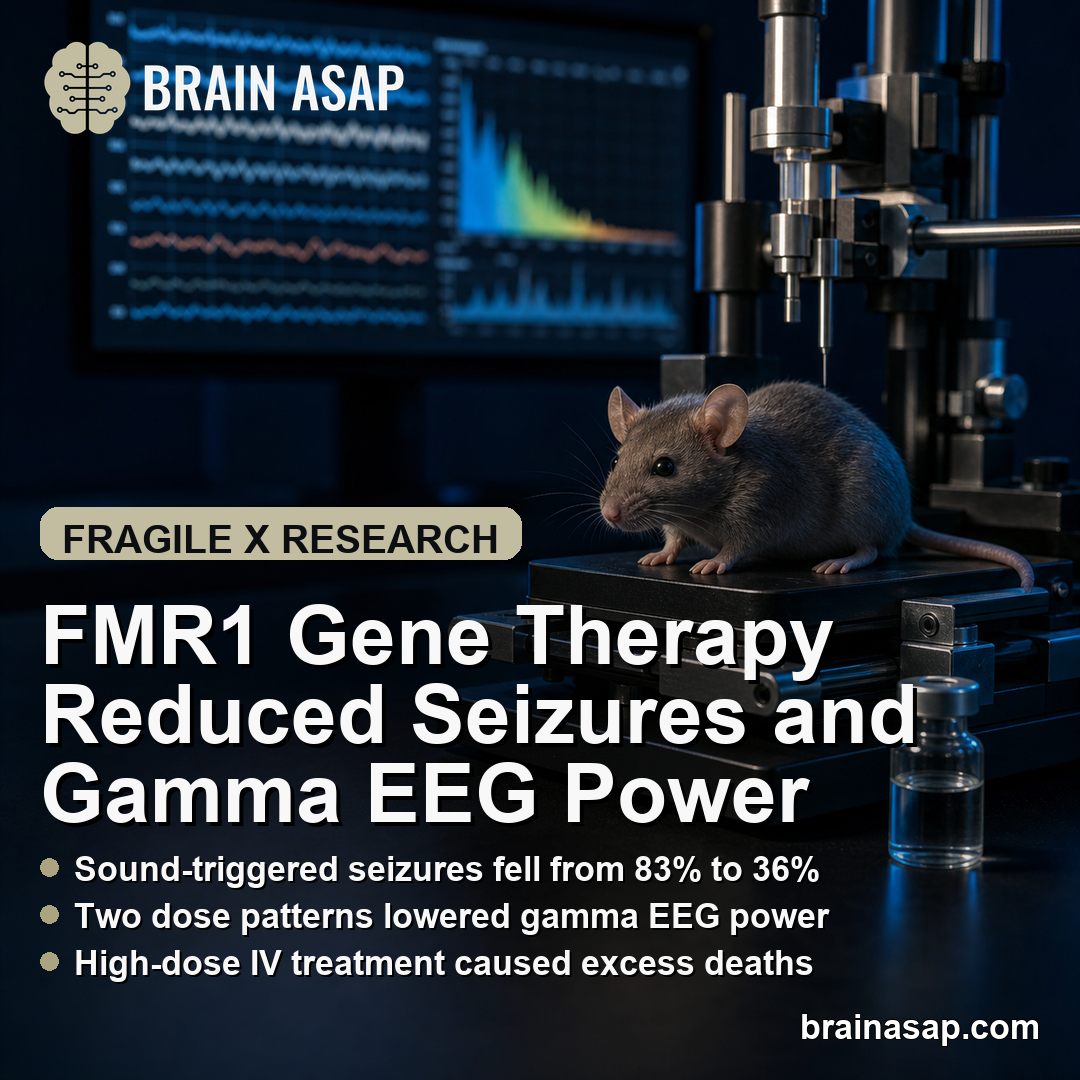
TL;DR: A 2026 mouse study in Gene Therapy used an adeno-associated virus 9 (AAV9) vector to deliver human FMR1 and reduced sound-triggered seizures, excessive digging, and gamma-frequency electroencephalography (EEG) power in selected dose and route groups. The outcomes came from separate experiments, and high-dose intravenous treatment without immunosuppression caused excess deaths.
Key Findings
- Adolescent seizure susceptibility decreased: Four weeks after dual intracerebroventricular and intravenous AAV/CAG treatment, 4 of 11 Fmr1 knockout mice had sound-triggered seizures, compared with 10 of 12 vehicle-treated mice.
- Gamma EEG power responded to two dosing patterns: High-dose delivery into the brain’s ventricles and a low-dose combined route reduced excessive gamma power; three other regimens did not.
- Digging improved, but several behavioral tests were inconclusive: Intravenous treatment produced the clearest reduction in excessive digging, while open-field activity was not rescued and three other assays lacked a knockout-versus-control difference.
- Route changed where the vector was expressed: Ventricular delivery favored cortex and hippocampus, while intravenous delivery produced more expression in midbrain, cerebellum, and liver.
- The highest intravenous dose raised a safety concern: A dose of 1 × 10¹⁴ vector genomes per kilogram caused excess mortality without immunosuppression.
Source: Lacher et al., Gene Therapy (2026).
Fragile X syndrome is usually caused by a CGG-repeat expansion that silences the FMR1 gene, leaving too little fragile X messenger ribonucleoprotein (FMRP), a protein involved in RNA regulation and synaptic activity. Current treatment manages symptoms rather than replacing the missing protein.
Researchers packaged the protein-coding portion of human FMR1 into AAV9, a viral gene-delivery vector, and tested different promoters, doses, ages, and routes in Fmr1 knockout mice. Most efficacy experiments used male mice, and each outcome came from a separate cohort.
Dual-Route FMR1 Gene Therapy Reduced Sound-Triggered Seizures
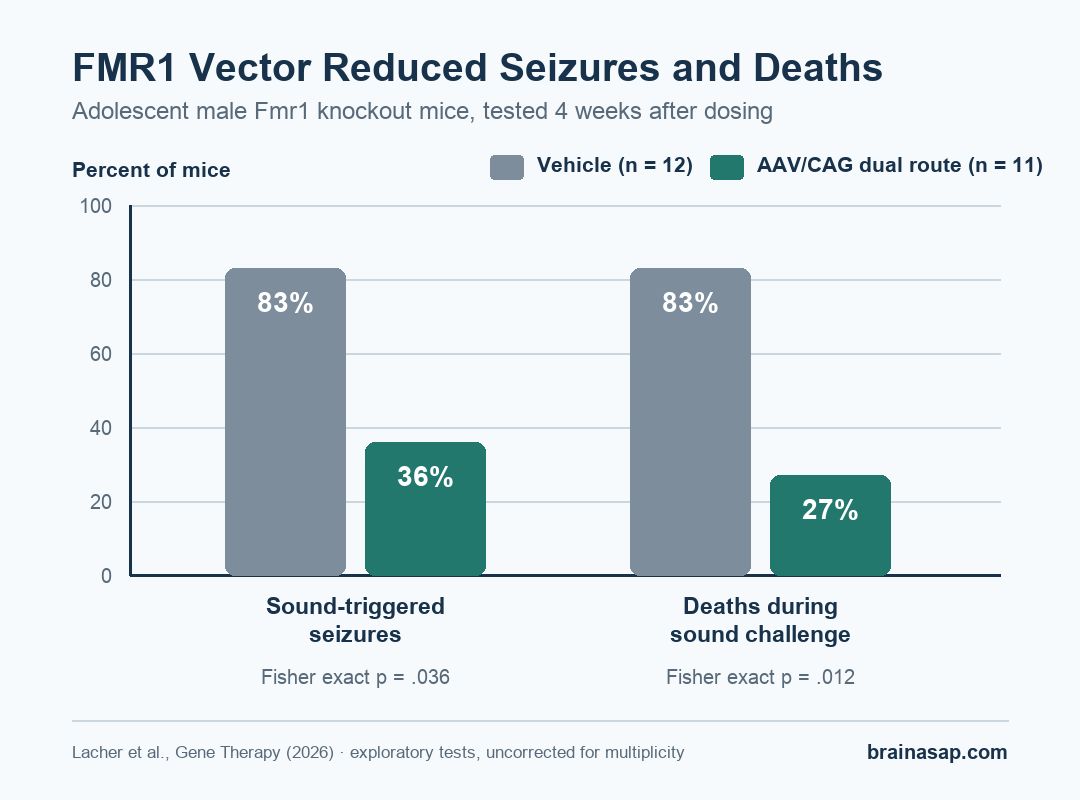
One experiment treated five-week-old male Fmr1 knockout mice and tested them four weeks later. The selected AAV/CAG vector was delivered both into the brain’s ventricles, called intracerebroventricular (ICV) dosing, and through the bloodstream, called intravenous (IV) dosing.
Sound exposure triggered a seizure in 10 of 12 vehicle-treated mice (83%) and 4 of 11 AAV/CAG-treated mice (36%). Death occurred in 10 of 12 vehicle mice and 3 of 11 treated mice, with Fisher exact p values of .036 and .012.
The overall four-group test for seizure score was not statistically significant (p = .09), although the post-hoc comparison between vehicle and AAV/CAG was significant (p = .038). The methods also label the seizure and death Fisher tests as exploratory and state that they were not corrected for multiple comparisons.
A separate neonatal experiment delivered vectors by ICV injection on postnatal days 1–3. The lower-expressing AAV/CAG-WPREdel version reduced seizures from 8/16 to 1/11 and deaths from 7/16 to 0/11, while higher-expressing AAV/CAG did not.
Two Dose Patterns Lowered Excess Gamma EEG Power
Researchers next used a 32-channel skull-surface multielectrode array to approximate human scalp EEG. Six- to seven-week-old mice received one of five AAV/CAG regimens, and usable groups contained 7–9 treated mice, along with 16 vehicle-treated knockout mice and 15 wild-type controls.
Vehicle-treated knockout mice had higher absolute 30–55 Hz gamma power than wild-type mice (p < .001). Gamma power was reduced after high-dose ICV treatment and after combined low-dose ICV plus low-dose IV treatment. High-dose IV alone and the other two combined-dose patterns did not differ significantly from knockout vehicle controls.
ICV dosing produced more vector, human FMR1 messenger RNA, and FMRP in cortex and hippocampus; IV dosing produced relatively more in midbrain, cerebellum, and liver. The two effective EEG regimens yielded similar cortical FMRP levels, while ineffective regimens produced lower or substantially higher levels.
That pattern supports careful dose finding, but it does not establish a universal therapeutic window. Vector copies and FMR1 messenger RNA were measured in one half of the cohort and FMRP in the other, preventing direct pairing with each mouse’s EEG result.
IV FMR1 Delivery Reduced Digging but Not Open-Field Activity
In a littermate study, male mice were treated at postnatal days 21–24 and tested four to five weeks later. Vehicle-treated Fmr1 knockout mice spent more time digging after their nesting material was removed, a laboratory measure of repetitive responding to environmental change.
AAV/CAG reduced digging overall, with the clearest effect after IV treatment in the mid-dose and immunosuppressed high-dose groups. ICV results were weaker, and behavioral comparison groups generally contained 7–14 mice.
Open-field activity and time in the center remained abnormal after treatment. Nest building, social preference, water-maze performance, and digging in a later cohort could not show rescue because knockout and wild-type controls did not differ at baseline.
These inconsistent baselines are important because Fmr1 knockout behavior varies across laboratories, breeding strategies, and housing conditions. An effect in one digging cohort cannot be generalized to learning, social behavior, or the daily functioning of people with Fragile X syndrome.
High-Dose IV Mortality and Mouse Variability Limit Translation
At 1 × 10¹⁴ vector genomes/kg IV, mortality increased four to six weeks after dosing without immunosuppression. Anti-CD20 antibody plus four weeks of rapamycin improved survival, but the experiment did not identify whether AAV9, human FMRP, or another factor caused the reaction.
Mid-dose IV treatment produced liver FMRP levels averaging 3.8 times those of untreated wild-type mice. Histology found mild liver-cell degeneration in one of three high-dose mice and no prominent heart damage, so the small tissue sample did not fully explain the deaths.
Several other limits narrow the result:
- Model: The mice lack Fmr1, while most people with Fragile X syndrome have a silenced expanded gene and may retain trace FMRP.
- Population: Most efficacy studies used male mice, and some cohorts used purchased animals rather than littermate controls.
- Outcomes: The experiments did not test hallmark molecular outcomes such as altered mGluR-dependent protein synthesis, and several behavioral assays had no baseline phenotype.
- Conflicts: Forge Biologics funded the work through a research contract, and five study authors reported being co-inventors on an FMR1 gene-therapy patent application.
Human FMR1 delivery changed selected seizure, behavior, and EEG outcomes in mice after brain development had begun. It did not establish human safety or efficacy; mortality makes route, tissue distribution, immune management, and dose essential before clinical testing.
Citation: DOI: 10.1038/s41434-026-00630-4. Lacher et al. FMR1 gene therapy restores translationally relevant phenotypes in a mouse model for fragile X syndrome. Gene Therapy. 2026.
Study Design: Multi-cohort preclinical AAV9 gene-replacement study testing neonatal through young-adult dosing, ICV and IV delivery, biodistribution, sound-triggered seizures, behavior, and skull-surface EEG.
Sample/Model: Fmr1 knockout mice; efficacy groups generally contained 7–16 usable mice and were predominantly male.
Key Statistic: In adolescent mice, dual-route AAV/CAG reduced sound-triggered seizures from 10/12 to 4/11 and challenge deaths from 10/12 to 3/11.
Caveat: Benefits depended on age, route, dose, and assay; high-dose IV treatment caused excess mortality without immunosuppression, and no humans were treated.