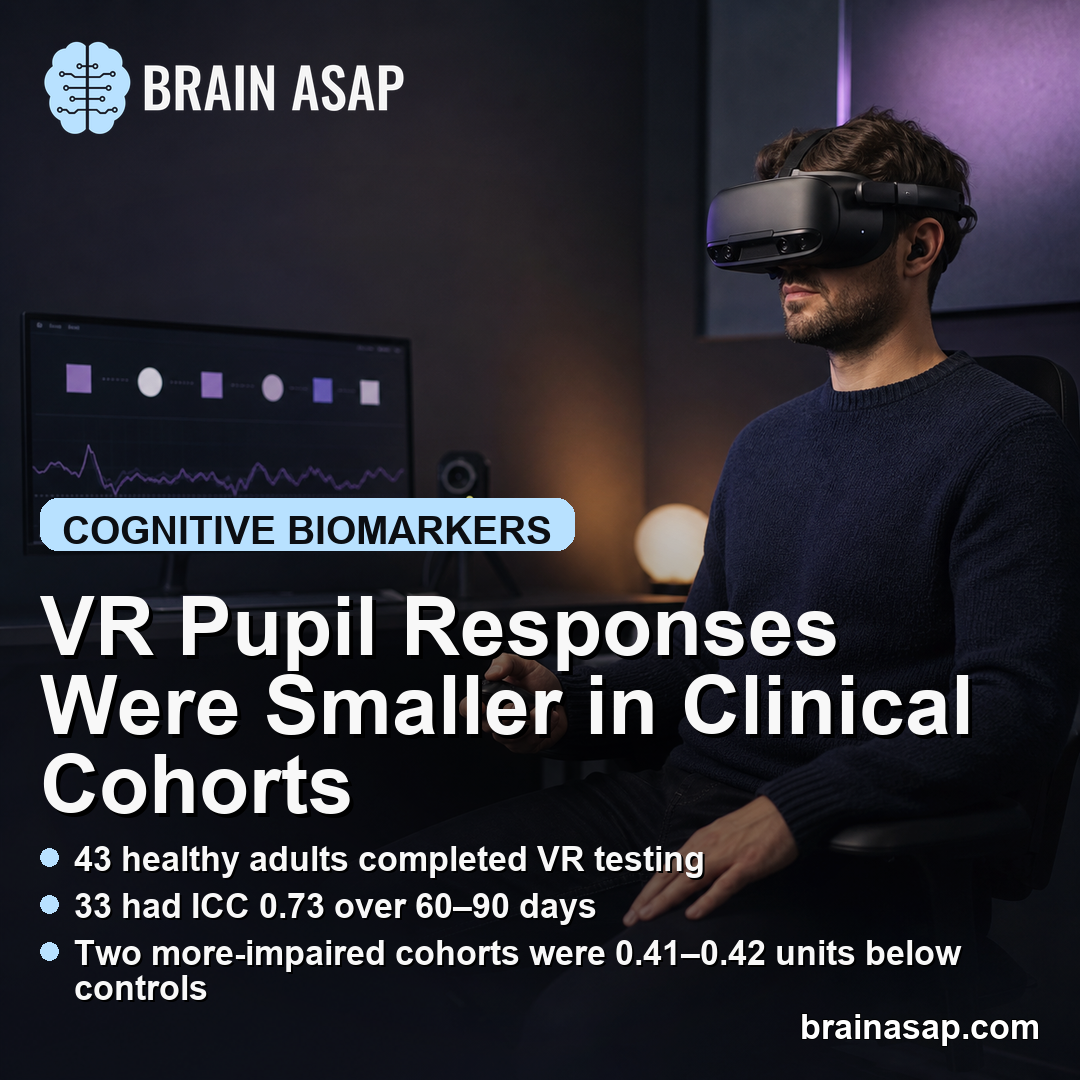
TL;DR: A 2026 medRxiv preprint found that pupil dilation measured inside a virtual reality (VR) headset increased as working-memory load rose in healthy adults, was reproducible 60–90 days later in 33 returnees, and was smaller under the highest load in cognitively impaired patient cohorts than in 81 healthy controls.
Key Findings
- Forty-three healthy adults completed the first test: Standardized pupil size increased at every step from fixation through the 0-back, 1-back, and 2-back working-memory conditions.
- Thirty-three returned after 60–90 days: The 2-back-minus-0-back pupil response had an intraclass correlation coefficient of 0.73 (95% CI, 0.53–0.86), a moderate-to-good result depending on the reliability guideline.
- The clinical comparison included 170 people: Eighty-one healthy controls were compared with 89 patients from three heterogeneous psychiatric, cognitive-complaint, and memory-clinic cohorts.
- High-load differences were largest in the more impaired cohorts: At 2-back, standardized pupil responses were about 0.42 and 0.41 units lower than in healthy controls for the older inpatient and memory-clinic groups.
- This was not a diagnostic-accuracy study: The preprint reported no sensitivity, specificity, area under the curve, or screening cutoff, and patients were assessed only once.
Source: Brendler et al., medRxiv (2026 preprint).
Pupillometry measures changes in pupil diameter. Pupils respond to light, but they also dilate as cognitive effort and arousal increase, making the measurement a possible physiological complement to questionnaires and performance tests.
Researchers tested whether a portable VR headset could capture that response during an n-back working-memory task. Participants watched letters and responded when the current letter matched a target rule: no memory comparison in 0-back, one item back in 1-back, and two items back in 2-back.
VR Pupil Dilation Increased From Fixation Through 2-Back
The technical-validation group included 43 healthy adults aged 21–65 years; their mean age was 31.6, and 27 were women. An HTC VIVE Pro Eye headset recorded pupil diameter at 120 Hz while participants completed fixation, 0-back, 1-back, and 2-back blocks.
Researchers removed values outside a biologically plausible 2–8 mm range, interpolated brief blink gaps, and standardized each participant’s pupil series. The resulting values are within-person standardized units, not raw millimeters.
Mean pupil size increased from −0.405 during fixation to −0.040 in 0-back, 0.291 in 1-back, and 0.923 in 2-back. Every adjacent increase was statistically significant, and the overall load coefficient was 0.43 standardized units (SE, 0.02; p<.001).
Reaction time slowed as the task became harder, although the 1-back-to-2-back difference was not significant; accuracy also declined with higher load. These behavioral results support that the task became more demanding, but they do not prove pupil size is a better screening measure than performance.
Pupil-Response Differences Repeated After 60–90 Days
All 43 healthy participants were invited back, and 33 completed the second session. Researchers calculated the difference between each person’s 2-back and 0-back pupil response, then compared that value across visits.
The Pearson correlation was r=0.74 (95% CI, 0.53–0.86), while the Spearman rank correlation was 0.80. The intraclass correlation coefficient, which tests absolute agreement rather than only whether people keep the same rank, was 0.73 (95% CI, 0.53–0.86).
An ICC of 0.73 is moderate under one common guideline and good under another. The interval allows a value near 0.53, and 10 of the original 43 participants did not complete retesting, so repeatability needs confirmation in a larger independent sample.
High-Load Pupil Responses Were Smaller in More Impaired Cohorts
Clinical validation compared 81 healthy controls with 89 patients. The patient sample combined three groups rather than one diagnosis:
- BeCOME (n=53): Mostly higher-functioning outpatients with mild affective symptoms.
- Older depression and cognitive complaints (n=23): Inpatients aged 60 or older, many with major depression and neurological or cognitive concerns.
- Memory Clinic (n=13): Patients with memory complaints and early neurodegenerative disease, including seven with mild cognitive impairment and five with dementia; diagnoses could overlap.
The 81-person control group included the original 43-person technical sample and 16 healthy older adults. The patient and control counts therefore describe the clinical comparison; they should not be added to 43 as if every participant were unique.
A mixed-effects model found a cognitive-load-by-group interaction (p<.001). Under the highest 2-back load, pupil response was lower than in healthy controls by 0.13 standardized units in BeCOME, 0.42 in the older inpatient group, and 0.41 in the Memory Clinic group.
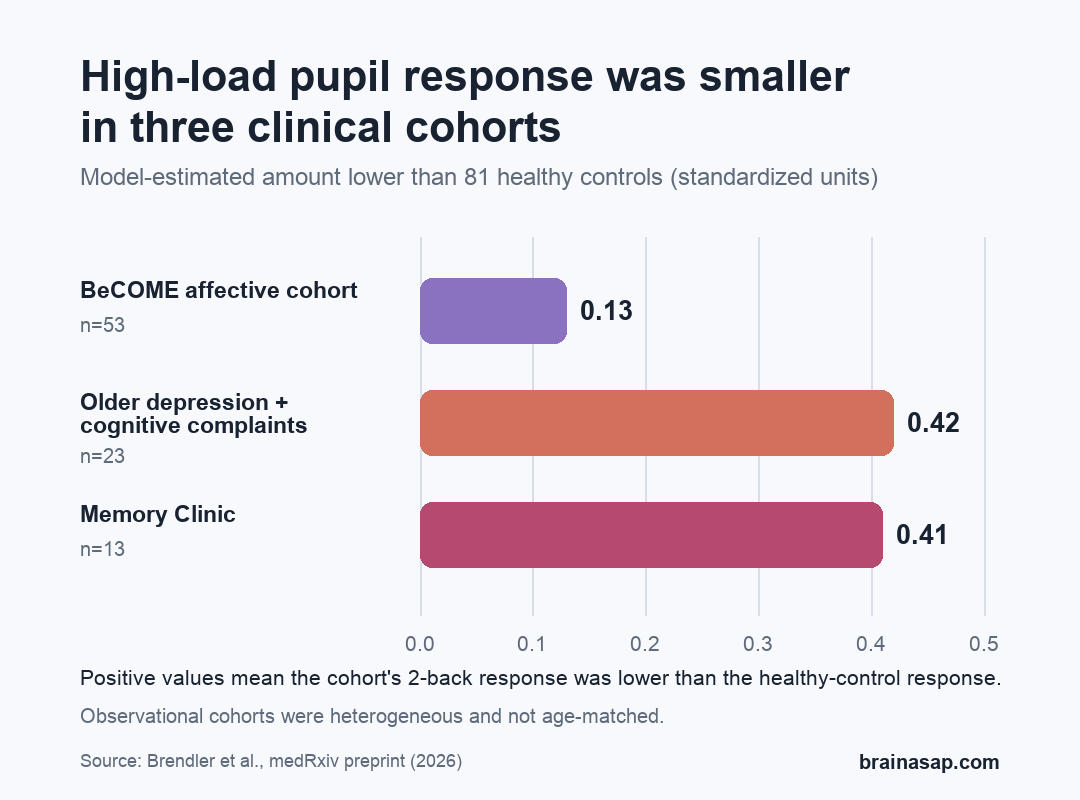
The older inpatient and Memory Clinic groups did not differ from each other at 2-back (p=.999). This similarity is compatible with a shared high-load response pattern, but it does not show that pupillometry can identify a specific disease.
Age and Cohort Differences Complicate the Clinical Comparison
Average age was 37.1 years in healthy controls and 35.8 in BeCOME, compared with 65.9 in the older inpatient group and 74.1 in the Memory Clinic group. An age-by-group-by-load interaction was significant (p=.014), so age and clinical status were both related to the response pattern.
Researchers noted that older healthy participants resembled younger healthy controls more than older patients. Still, the cohorts were not randomized or matched, and statistical adjustment cannot fully separate age, diagnosis, medication, fatigue, education, vision, and other group differences.
Procedures also differed slightly because BeCOME participants completed a six-minute fixation period and eye calibration before the n-back task, which could contribute to their lower overall pupil values. Diagnoses overlapped within the patient cohorts, limiting disease-specific interpretation.
No Diagnostic Cutoff or Longitudinal Patient Test Was Included
The experiment establishes three early properties: pupil dilation followed working-memory load, the healthy response repeated reasonably well, and clinical cohorts differed at high load. It did not test diagnostic sensitivity, specificity, an area under the curve, or a cutoff for classifying cognitive impairment.
Patients completed one session, so the data do not show whether pupil response changes as cognition worsens or improves. The task examined working memory only, while clinical cognitive impairment can also involve attention, language, executive function, memory storage, and visuospatial ability.
People with ocular disease were excluded, and the VR protocol may be unsuitable for some people with migraine, epilepsy, or other light-sensitive conditions. No participant reported motion sickness or procedural discomfort, but the samples were too small and selected to establish broad safety or accessibility.
The work is a non-peer-reviewed preprint funded by Germany’s GoBio programme. Victor I. Spoormaker reported paid consulting for Roche, Sony, and Boehringer Ingelheim and co-founded biomentric UG.
Mobile VR pupillometry now has a credible early validation result, not a ready clinical screen. Independent studies need larger, diagnosis-specific cohorts, matched controls, repeated patient measurements, and prespecified diagnostic thresholds before the method can guide clinical decisions.
Citation: DOI: 10.64898/2026.07.15.26358187. Brendler et al. Initial Technical and Clinical Validation of Mobile Pupillometry with Virtual Reality: A Digital Biomarker for Screening Cognitive Function and Impairment. medRxiv. 2026.
Study Design: Technical construct-validation and 60–90-day test-retest study in healthy adults, followed by an observational cross-sectional comparison of three clinical cohorts with healthy controls.
Sample Size: 43 healthy adults in the initial test, 33 healthy retest participants, and a clinical comparison of 81 healthy controls with 89 patients across three cohorts.
Key Statistic: At 2-back, standardized pupil response was 0.42 units lower in the older inpatient cohort and 0.41 units lower in the Memory Clinic cohort than in healthy controls.
Caveat: The preprint used small, heterogeneous, non-randomized cohorts and reported no diagnostic-accuracy threshold or longitudinal patient validation.