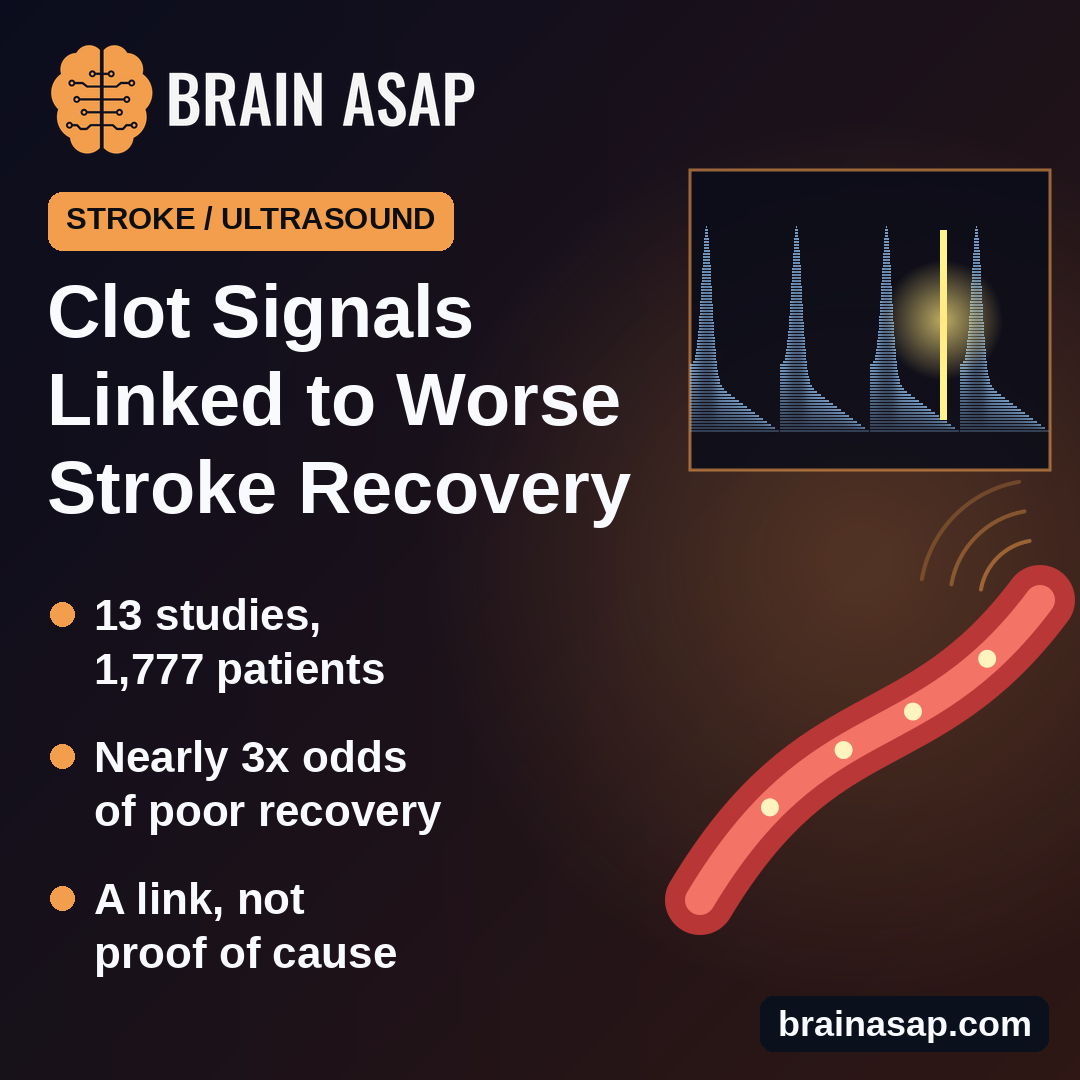
TL;DR: Stroke patients whose brain arteries showed tiny traveling clots on an ultrasound scan had nearly 3 times the odds of poor recovery than those without, across 13 studies. The signals may mark a more unstable stroke rather than cause the worse outcome.
Key Findings
- 13 studies, 1,777 patients: About 1 in 5 (361) had the clot signals.
- Worse recovery: 2.85 times the odds of ending up dependent or dying.
- Consistent results: No meaningful differences between studies.
- Seen at every follow-up: At discharge, 14 days and 90 days.
Source: Frontiers in Neurology (2026) | Qiao et al.
After an ischemic stroke, doctors can listen to blood flow in the brain’s arteries with a transcranial Doppler ultrasound, a probe held against the side of the head. Sometimes the scan picks up brief, bright blips: tiny bits of clot or plaque passing through.
These “microembolic signals” suggest that the source of the stroke is still active. But do they predict how well a person recovers? A team in China pooled the studies to find out.
Listening for Tiny Clots
The review included 13 cohort studies with 1,777 people who had an acute ischemic stroke, from China, the US, Europe and elsewhere. Each was monitored for 30 to 60 minutes, usually within a day or two of the stroke.
- Signal group: 361 patients (20%) with at least one microembolic signal.
- No-signal group: 1,416 patients without them.
Poor recovery meant a modified Rankin Scale score of 3 to 6: needing help with daily life, being bedbound, or dying.
Nearly 3 Times the Odds of Poor Recovery
The signal group had 2.85 times the odds of poor recovery (95% CI 2.16 to 3.75). The studies agreed closely with each other, and removing any single study kept the result between 2.60 and 3.00.
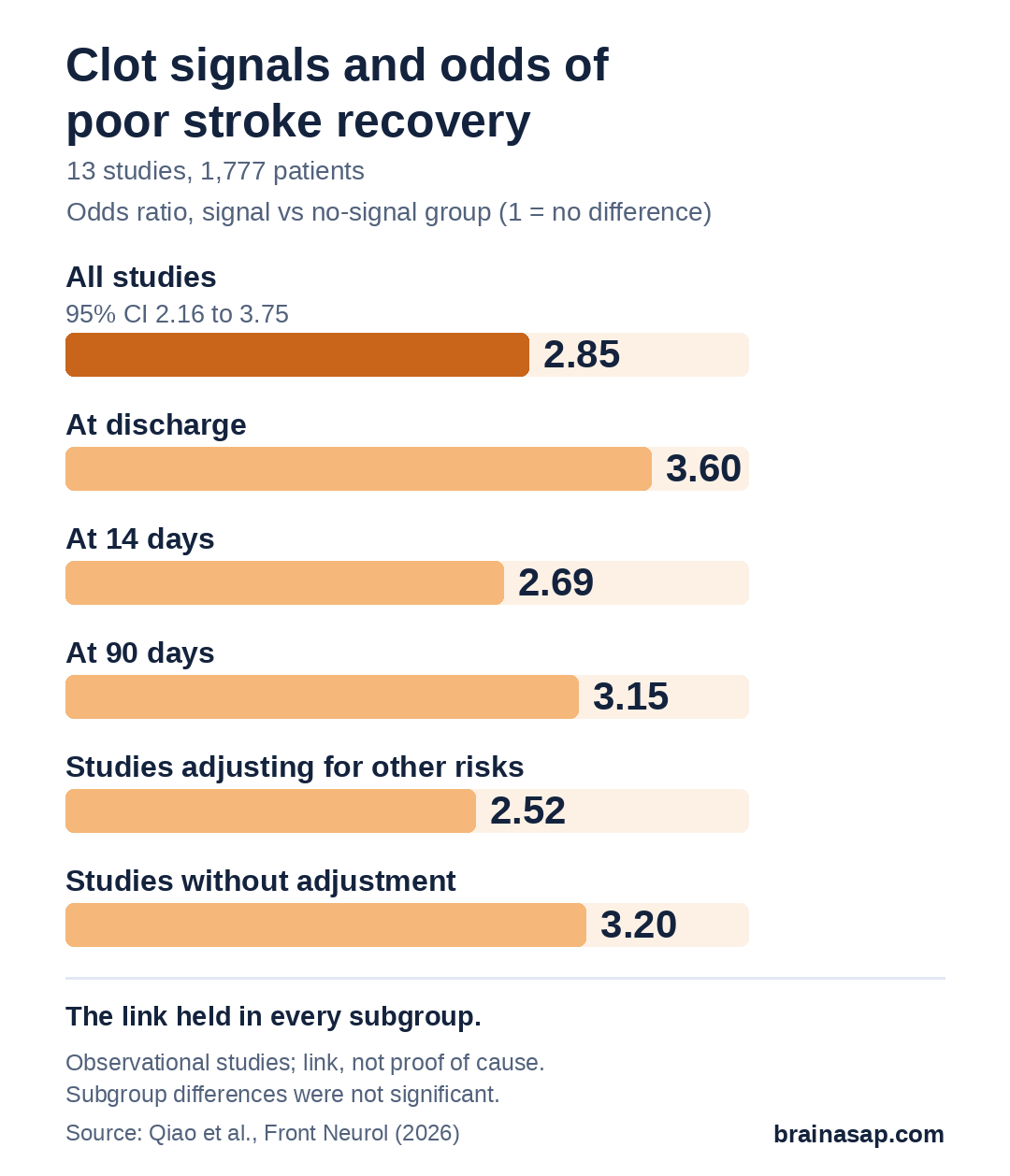
The link held across subgroups: older and younger patients, studies with more or fewer men, patients who did or did not have a clot-removal procedure, and short or longer monitoring. It was a bit smaller in studies that adjusted for other risk factors (2.52) than in those that did not (3.20), but the difference was not significant.
A Warning Sign, Not Necessarily a Cause
The authors offer two explanations that may both be true:
- Ongoing damage: Repeated tiny clots could cause new small strokes and slow recovery.
- A marker of severity: The signals may simply flag an unstable plaque, heart source or larger stroke.
Observational data cannot tell these apart.
Gaps in the Evidence
- Adjustment varied: Six studies reported only unadjusted results.
- 6 of 13 studies were from China, with different monitoring methods and timing.
- No added value tested: The review could not show the signals predict better than stroke severity and imaging already do.
Could a Quick Scan Improve Stroke Care?
Transcranial Doppler is cheap, bedside and noninvasive, so a signal that flags higher risk is appealing. The question for future studies is whether finding these signals should change treatment, such as more aggressive clot prevention, and whether that improves recovery.
Citation: DOI: 10.3389/fneur.2026.1911457. Qiao J, Zhang Z, Feng Y, Wang Y. Microembolic signals in transcranial Doppler and the functional outcome of patients with acute ischemic stroke: a meta-analysis. Front Neurol. 2026.
Study Design: Systematic review and random-effects meta-analysis of cohort studies (PROSPERO CRD420261425262).
Sample Size: 13 cohort studies, 1,777 patients (361 with microembolic signals).
Key Statistic: OR 2.85 (95% CI 2.16 to 3.75) for poor functional outcome; I² = 0%.
Caveat: Observational; several unadjusted estimates; added value beyond established predictors unproven.