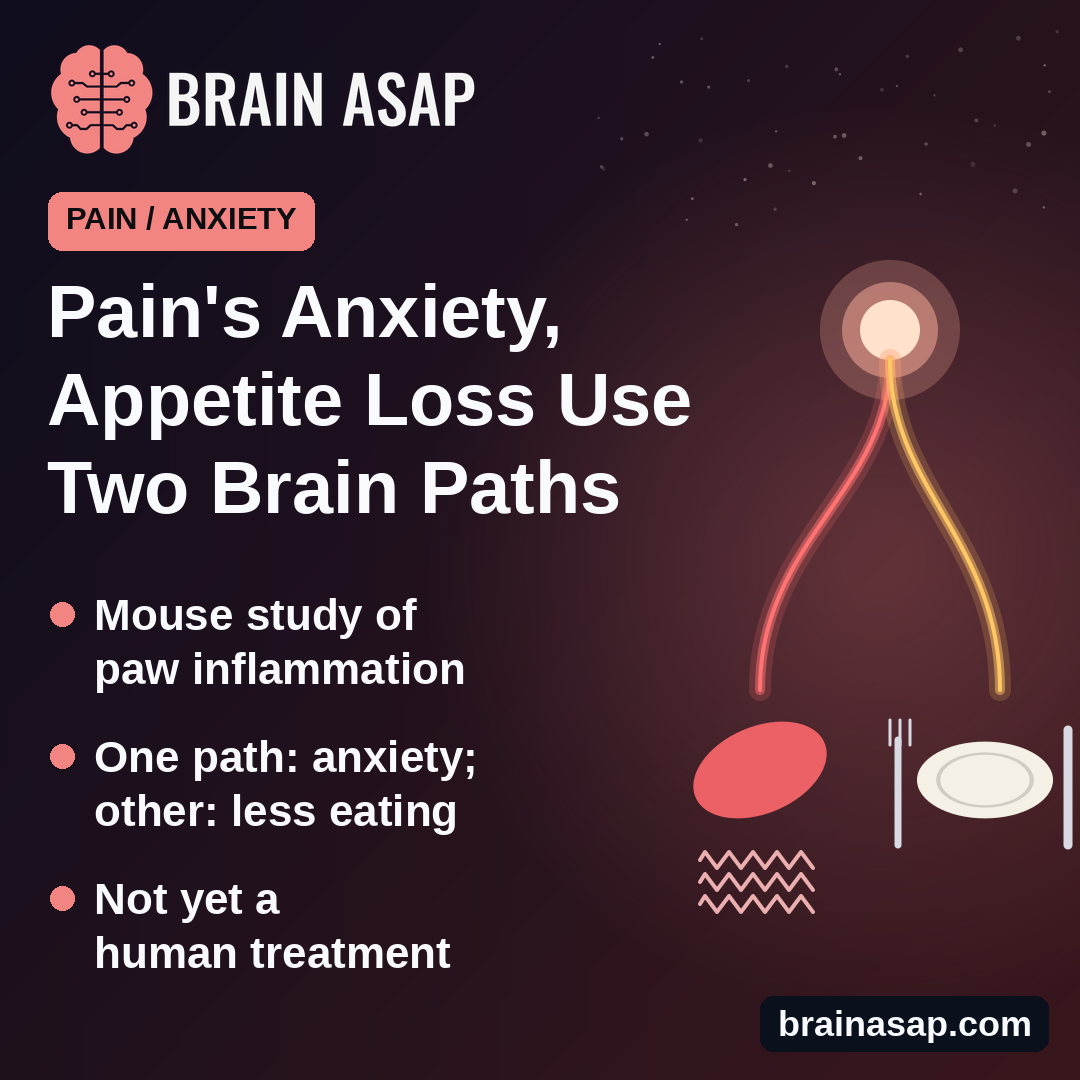
TL;DR: In mice with a painful, inflamed paw, two separate sets of neurons in a pain-and-emotion brain area seemed to drive different side effects. One set, wired to the amygdala, controlled anxiety-like behavior, while the other, wired to a reward hub, controlled loss of appetite.
Key Findings
- Pain brought anxiety and poor appetite: Mice with paw inflammation avoided open spaces, ate less and gained less weight.
- Amygdala path: Switching it on raised anxiety-like behavior; quieting it lowered it. Eating did not change.
- Reward-hub path: Switching it on cut eating; quieting it raised eating. Anxiety did not change.
- Mostly different neurons: Tracer dyes showed the two paths come from largely separate cells.
- Male mice only: No human data.
Source: Frontiers in Pharmacology (2026) | Yu et al.
Chronic pain rarely travels alone. Many people living with it also struggle with anxiety, and some lose interest in food.
Researchers in China asked whether the same brain cells drive both problems, or whether each has its own wiring. Their mouse study points to two separate routes out of one brain region.
A Brain Hub for the Feeling of Pain
The anterior cingulate cortex sits deep in the front of the brain. It handles the unpleasant, emotional side of pain rather than where it hurts. It sends signals to many areas, including two that matter here:
- Amygdala: A small almond-shaped region central to fear and anxiety
- Nucleus accumbens: A reward hub involved in motivation and eating
The team focused on the cingulate’s main excitatory neurons and the paths they send to each target.
Paw Pain Made Mice Anxious and Less Hungry
Male mice got an injection that inflamed one hind paw for days. Compared with 12 mice given a saltwater injection, the 12 mice with inflamed paws:
- Felt more pain: Pulled the paw away at lighter touch
- Avoided open spaces: Spent less time in exposed areas of two standard anxiety tests, while moving just as much
- Ate less: Lower food intake and less weight gain over 10 days
The cingulate cortex was more active in mice with pain, and calming the whole area with a designer-drug technique reduced both anxiety-like behavior and appetite loss.
Two Paths, Two Different Jobs
Next the researchers used light-controlled and drug-controlled switches to turn each path on or off separately.
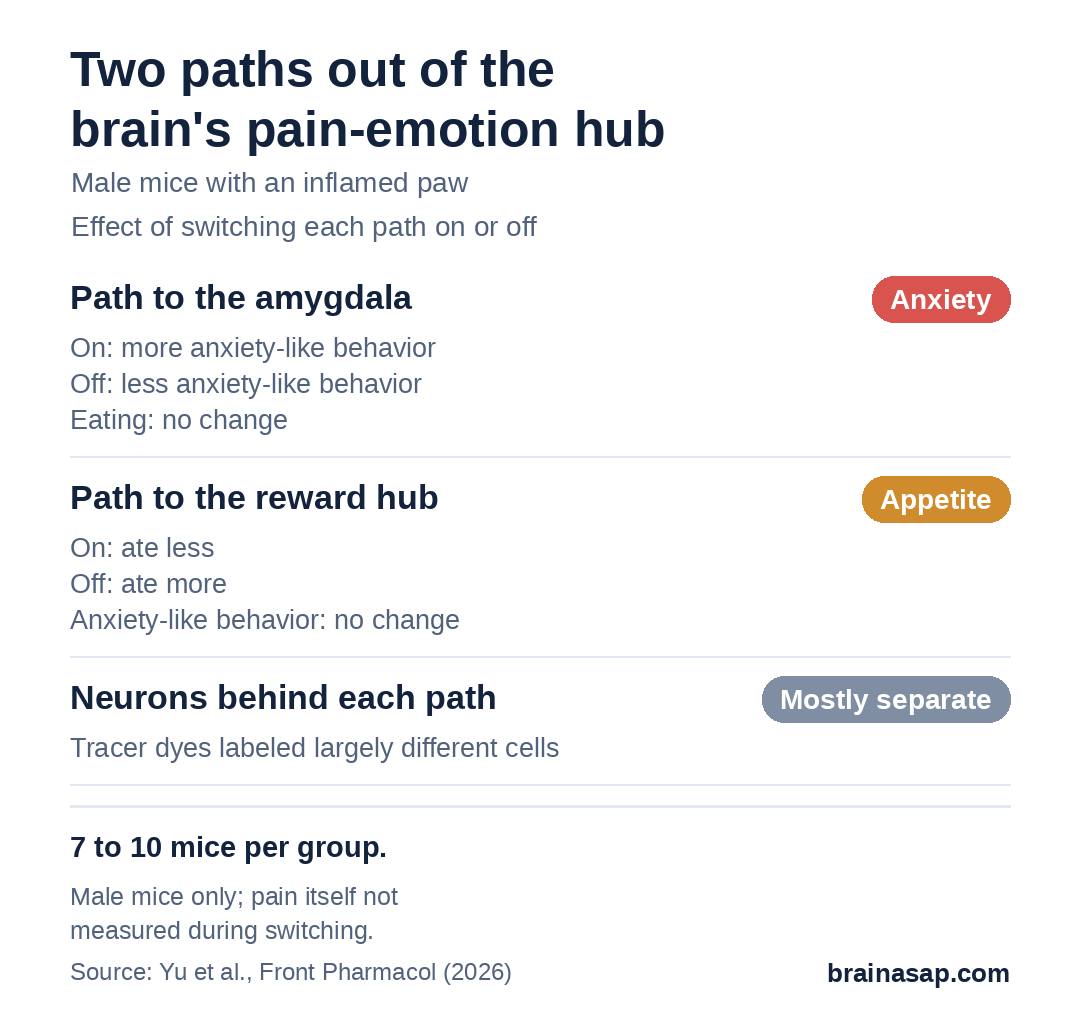
Tracer dyes injected into each target lit up mostly separate groups of cingulate neurons, so the two jobs seem to belong to different cells.
Pain Rewired Each Group Differently
Recordings from brain slices showed that inflammation changed the two groups in different ways:
- Amygdala-bound neurons: Fired more readily and received stronger excitatory input
- Reward-hub-bound neurons: Firing unchanged, but excitatory input grew stronger while inhibitory input grew weaker
Both shifts tilt the balance toward excitation, but by different routes. That could matter if future drugs aim at one problem without touching the other.
Mouse Wiring, Not a Treatment
- Male mice only: Pain and anxiety often differ by sex
- Small groups: 5 to 12 mice per test; recordings used 9 to 14 cells from 3 to 7 mice
- No pain measures during switching: The study cannot say whether the paths also change pain itself
- Whole-region activity only: Live calcium recordings did not separate the two neuron groups
- Anxiety-like behavior: Avoiding open spaces in mice is a stand-in, not the same as human anxiety
- Short-term model: Paw inflammation lasting days, not years of chronic pain
Could Pain’s Side Effects Be Treated One at a Time?
If the same split holds in people, it may one day be possible to target pain-related anxiety or appetite loss on its own. The next step is to test both paths in female mice, measure pain during the experiments, and see whether brain imaging in people with chronic pain shows a similar split.
Citation: DOI: 10.3389/fphar.2026.1897103. Yu J, Han H, You Y, et al. Distinct CaMKII neurons in anterior cingulate cortex regulate anxiety-like behavior and appetite suppression in a model of inflammatory pain. Front Pharmacol. 2026;17:1897103.
Study Design: Mouse circuit study using an inflammatory pain model, optogenetic and chemogenetic manipulation, tracing and slice electrophysiology.
Sample Size: Male C57BL/6 mice; 12 per group for pain behavior, 7 to 10 per group for circuit tests.
Key Statistic: Quieting the reward-hub path increased food intake in mice with pain (p = 0.0069); quieting the amygdala path increased open-arm time (p = 0.0017) without changing food intake.
Caveat: Male mice only; no pain readouts during circuit manipulation; no human data.