
TL;DR: In a phase III trial of 34 children with a rare inherited energy disorder, the drug dichloroacetate did not improve parent-rated movement problems more than placebo over 4 months. It did lower a harmful blood acid, lactate, and was well tolerated.
Key Findings
- Main goal missed: Movement scores did not differ from placebo (p = 0.51).
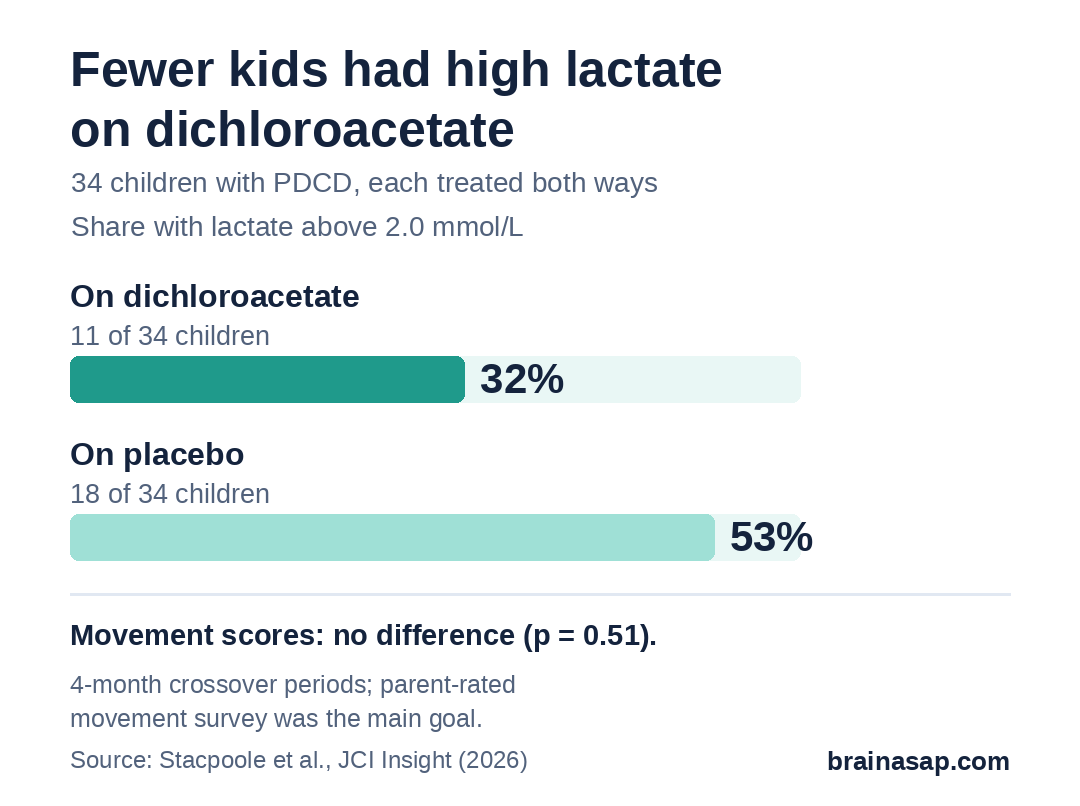
- Lactate fell: About 20% lower on the drug; high levels in 32% vs 53% on placebo.
- Well tolerated: Side effects similar to placebo; one mild nerve problem in the extension.
- Longer-term signals: Movement scores improved over years of open-label use, and survival beat a historical group, but neither had a placebo comparison.
Source: JCI Insight (2026) | Stacpoole et al.
Pyruvate dehydrogenase complex deficiency, or PDCD, is a rare genetic disease in which cells cannot fully turn sugar into energy. Children often have weak muscles, movement problems, seizures and developmental delays, and many die young. There is no FDA-approved drug for it.
A drug called dichloroacetate, or DCA, has been studied for decades as a way to push the stuck energy step forward. This was its largest controlled test in PDCD so far.
Each Child Took Both the Drug and a Placebo
The trial enrolled 34 children at several centers, average age about 5 (range under 1 to 17). Each child took DCA by mouth for 4 months and a look-alike placebo for 4 months, in random order, with a 1-month break between. Neither families nor staff knew which came first.
The dose was set by a gene test. Children whose bodies clear DCA quickly got twice the dose of those who clear it slowly.
The main outcome was a daily parent survey of 5 movement problems: weakness, poor coordination, floppy muscles, stiffness and involuntary movements, scored from 0 to 20.
Movement Scores Did Not Beat Placebo
Scores improved slightly on both treatments: by 0.49 points on DCA and 0.79 points on placebo. The difference was not meaningful (95% CI −0.60 to 1.19; p = 0.51).
Many children started with low scores, leaving little room to improve. Among the 15 with more severe problems at the start, scores leaned toward improvement on DCA, but not significantly (p = 0.066).
Blood Lactate Dropped on the Drug
Lactate is an acid that builds up when cells cannot use sugar properly, and very high levels can be dangerous. Compared with placebo, DCA lowered lactate by about 0.48 mmol/L, or roughly 20% (p = 0.006).
Side effects were reported by 74% of children on DCA and 79% on placebo. Nerve damage, a known DCA concern, did not occur in the blinded phase. One mild case appeared after 18 months in a 17-year-old during open-label use.
Promising Long-Term Signs Lack a Fair Comparison
After the blinded phase, 32 children kept taking DCA, some for 3 years. Across all 34 children, the last recorded movement scores were better than at the start (p = 0.002), especially in children with more severe symptoms. For 9 children, that final score was still from the blinded phase. Survival was also better than in 28 matched untreated children from an earlier natural history study (p = 0.027).
These results are encouraging but harder to trust. There was no placebo group in the extension, children naturally change as they grow, and the historical group differed in age at onset and other care.
- Rare disease, small trial: 34 children.
- Primary endpoint missed: The main movement measure did not beat placebo.
- Company involvement: Funded in part by Saol Therapeutics, which has filed for FDA approval.
- Parent-rated outcome: Movement scores came from daily caregiver surveys.
A Lactate-Lowering Option Still Short of Proof
For families living with PDCD, DCA appears safe at gene-guided doses and reliably lowers lactate. Whether it improves movement or extends life still needs proof from a longer controlled study.
The key open question is whether children with more severe movement problems benefit when DCA is compared with placebo over a year or more.
Citation: DOI: 10.1172/jci.insight.200149. Stacpoole PW, Abdenur JE, Bedoyan JK, et al. Phase III trial of sodium dichloroacetate for pyruvate dehydrogenase complex deficiency in children. JCI Insight. 2026;11(18):e200149.
Study Design: Multicenter randomized double-blind placebo-controlled crossover phase III trial with open-label extension and historical-control survival comparison.
Sample Size: 34 children randomized; 32 entered the open-label extension.
Key Statistic: Movement score difference vs placebo 0.29 points (95% CI −0.60 to 1.19; p = 0.512); lactate −0.48 mmol/L (p = 0.006).
Caveat: Primary endpoint missed; long-term and survival results lack concurrent controls; partly industry funded.