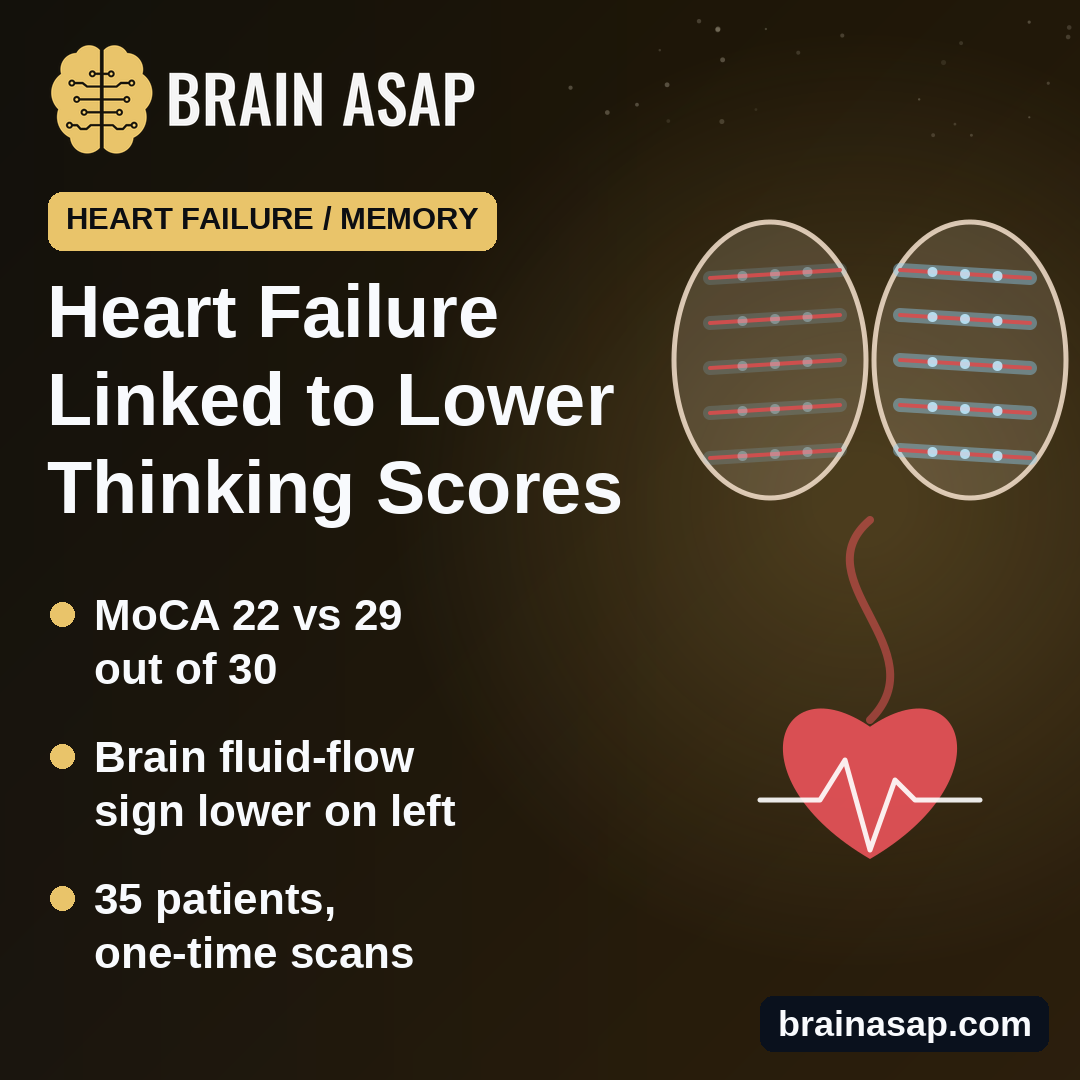
TL;DR: People with a common type of heart failure scored lower on thinking tests than healthy people of similar age, and an MRI sign of the brain’s fluid-clearing system was lower on the left side of their brains. Lower values of that sign went with lower thinking scores.
Key Findings
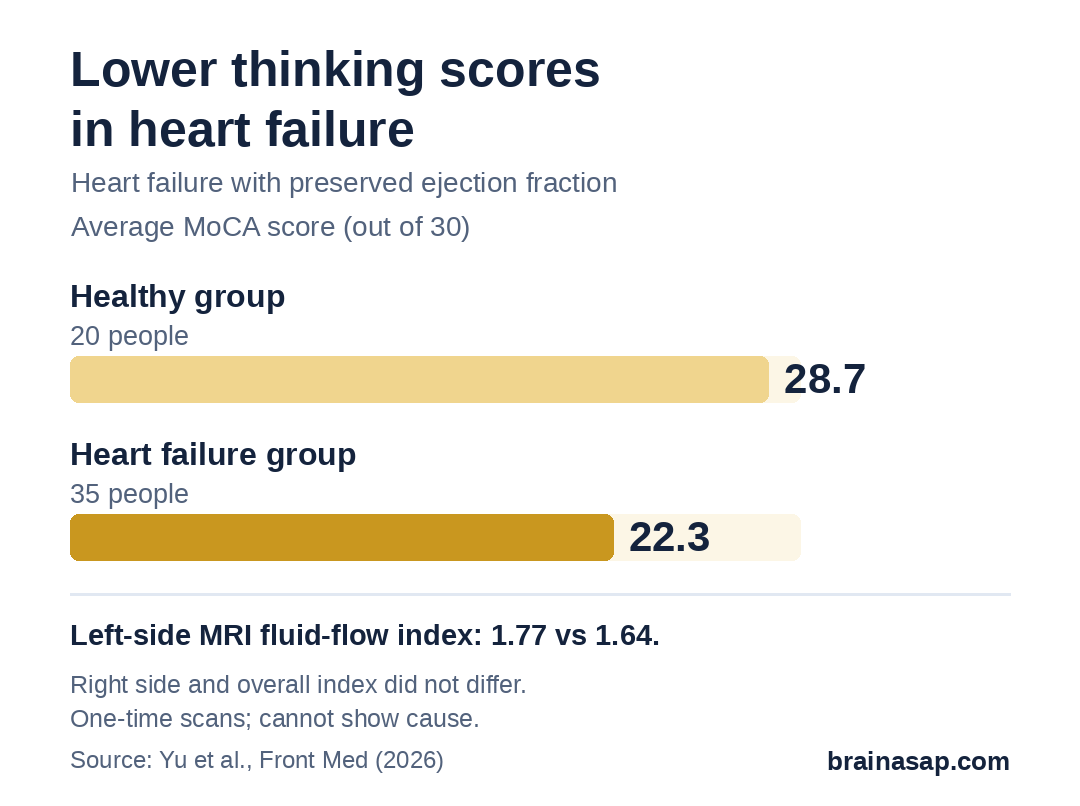
- Lower thinking scores: Average MoCA 22.3 in heart failure vs 28.7 in healthy people (out of 30).
- Memory hit hardest: Delayed recall, attention, language and planning were all lower; naming and orientation were not.
- Left side only: MRI fluid-flow index 1.64 vs 1.77 on the left (p = 0.04); right side no different.
- Linked to thinking: Lower left-side index went with lower test and memory scores after adjusting for age, sex and education.
- Small snapshot: 35 patients and 20 healthy people, one scan each.
Source: Frontiers in Medicine (2026) | Yu et al.
Heart failure is usually thought of as a pump problem. But many people with it also notice trouble with memory and focus. Why the brain suffers when the heart struggles is still not clear.
Researchers in Jinan, China, checked whether the brain’s waste-clearing fluid system might be part of the story.
A Common Heart Failure With a Normal-Looking Pump
The study focused on heart failure with preserved ejection fraction, often called HFpEF. In this type, the heart squeezes out a normal share of blood with each beat (over 50% here), but it is stiff and does not fill well. It is common in older adults and people with high blood pressure.
The team compared two groups at a hospital in Shandong Province:
- Heart failure group: 35 people with HFpEF and no dementia, stroke or major brain lesions.
- Healthy group: 20 people without major heart or brain disease.
The groups were similar in age (median 64 vs 58, not a significant difference), sex, education, weight, cholesterol, blood sugar, blood pressure history and smoking.
Thinking Scores Were Clearly Lower
On the Montreal Cognitive Assessment (MoCA), a 30-point screening test, the heart failure group averaged 22.3 compared with 28.7 for the healthy group. A score under 26 is often used as a sign of possible thinking problems. The MMSE, another screening test, showed the same pattern.
Delayed recall of words showed one of the biggest gaps. Attention, language, abstract thinking and visual planning were also lower, while naming objects and knowing the date and place were not.
An MRI Sign of Brain Fluid Flow Dipped on the Left
The brain clears waste partly through fluid moving along spaces around small blood vessels, sometimes called the glymphatic system. A special MRI method, DTI-ALPS, estimates how easily water moves along those spaces. A lower index is read as less fluid movement.
On the left side of the brain, the index averaged 1.64 in the heart failure group and 1.77 in the healthy group (p = 0.04). The right side and the overall average did not differ.
After adjusting for age, sex and education, a lower left-side index was linked to lower MoCA, MMSE and memory scores. The adjusted models explained only a modest share of the differences between people.
One Scan Cannot Show Cause
- Snapshot study: Cannot tell whether fluid changes came first or caused thinking problems.
- Small groups: 35 patients and 20 controls; right-side changes may have been missed.
- Indirect measure: DTI-ALPS estimates water movement; it does not track fluid flow directly.
- Borderline result: The left-side group difference was just under the usual cutoff (p = 0.04).
- One hospital: Patients in China; results may differ elsewhere.
Brain Checks May Belong in Heart Failure Care
The clear takeaway is the thinking gap: people with HFpEF scored well below healthy peers, which supports routine memory screening in heart failure clinics. The brain-fluid finding is an early clue, not an explanation.
The next question is whether this MRI sign drops before thinking declines when people with HFpEF are followed over several years.
Citation: DOI: 10.3389/fmed.2026.1811109. Yu T, Duan C, Sun M, Liu Y, Yuan Y. Brain perivascular diffusion and cognitive impairment in heart failure with preserved ejection fraction. Front Med. 2026;13:1811109.
Study Design: Cross-sectional MRI and cognitive testing study, single center.
Sample Size: 35 patients with HFpEF and 20 healthy controls.
Key Statistic: MoCA 22.34 ± 3.38 vs 28.70 ± 1.69 (p < 0.01); left DTI-ALPS 1.64 ± 0.24 vs 1.77 ± 0.21 (p = 0.04).
Caveat: Cross-sectional, small sample; DTI-ALPS is an indirect imaging marker.