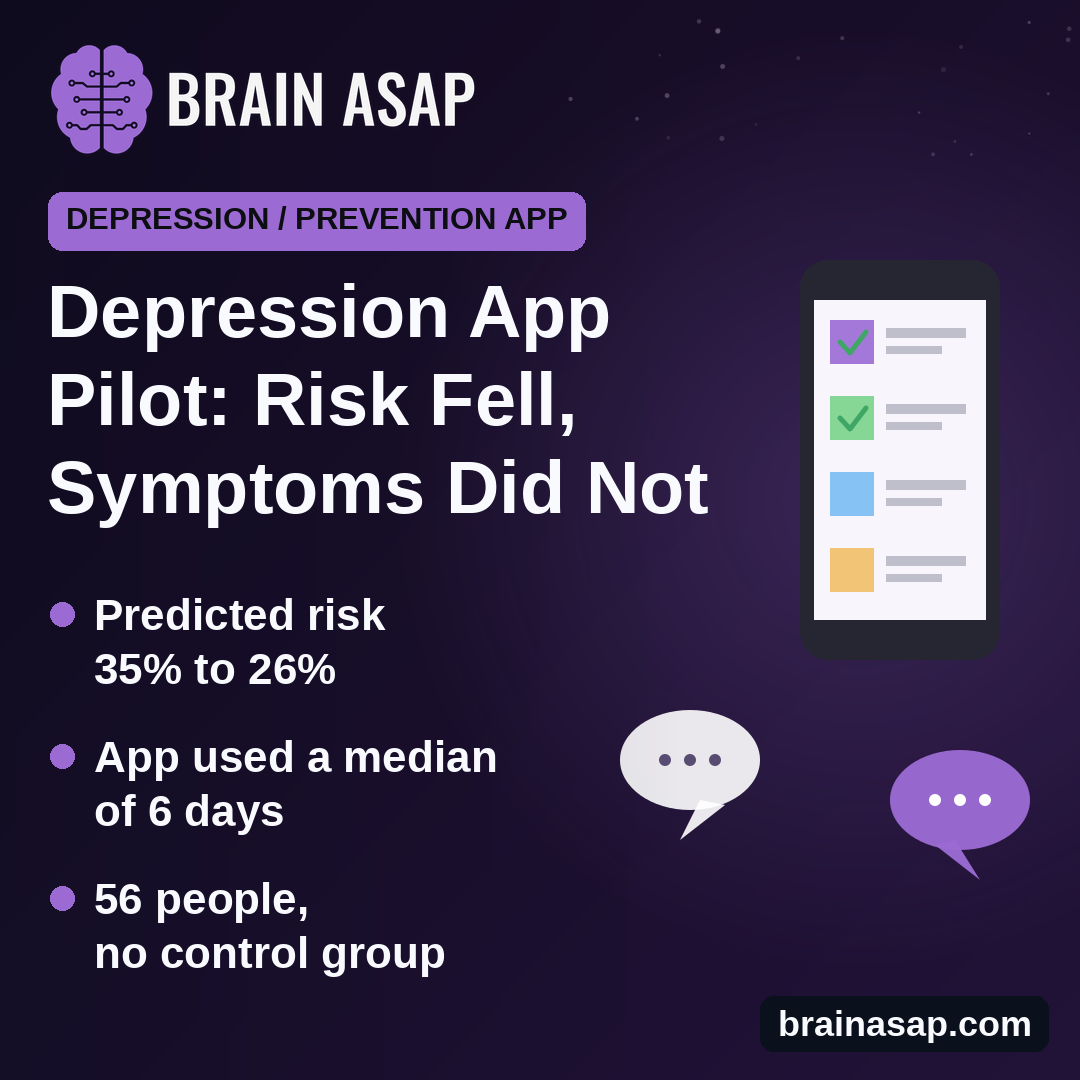
TL;DR: In a small Spanish pilot, adults at high risk of depression got a personalized prevention plan from their family doctor plus an app. After 3 months their predicted depression risk and anxiety scores fell, but depression symptoms did not, most people barely used the app, and there was no comparison group.
Key Findings
- 56 at-risk adults, 6 doctors: 47 (84%) finished the 3-month check.
- Low app use: Median of 6 days of use in 3 months.
- Predicted risk fell: Chance of major depression in the next year dropped from 35% to 26%.
- Anxiety and mood quality of life improved; depression symptoms did not change.
- Liked by users: Patients and doctors were satisfied and suggested changes.
Source: PLOS One (2026) | Moreno-Peral et al.
Most depression care starts after someone is already ill. But family doctors often see people who are struggling before depression sets in. Could a quick conversation plus a phone app help those people stay well?
A Spanish research network tested an early version of such a program, called e-predictD, in family practices.
A Risk Score, a 15-Minute Talk and an App
The program builds on an earlier doctor-led approach that had already shown it could prevent some depression. This version added technology:
- Risk calculator: A validated tool estimated each person’s chance of major depression in the next 12 months.
- Personal plan: Software suggested modules such as exercise, sleep, social contact, problem-solving and changing unhelpful thoughts.
- Doctor visit: A 15-minute talk to pick which modules to work on.
- App: Lessons and tracking for 3 months, with updates to the doctor.
Six family doctors in six Spanish cities enrolled 56 adults without current depression but at moderate-to-high risk. Most were women (73%), average age 40, and many already had anxiety symptoms.
People Barely Used the App
The median person used the app on just 6 days over 3 months, with a range from 1 to 30 days for the middle half. In interviews, people blamed hard log-ins, phone changes, lack of time, and feeling overwhelmed by content, questions and notifications. The most worked-on module was changing unhelpful thoughts.
Risk and Anxiety Went Down, Depression Symptoms Did Not
After 3 months, the average predicted chance of major depression in the next year fell from 34.5% to 26.2%. Anxiety scores dropped by about 2 points on a 21-point scale, and mental quality of life rose by about 6.5 points.
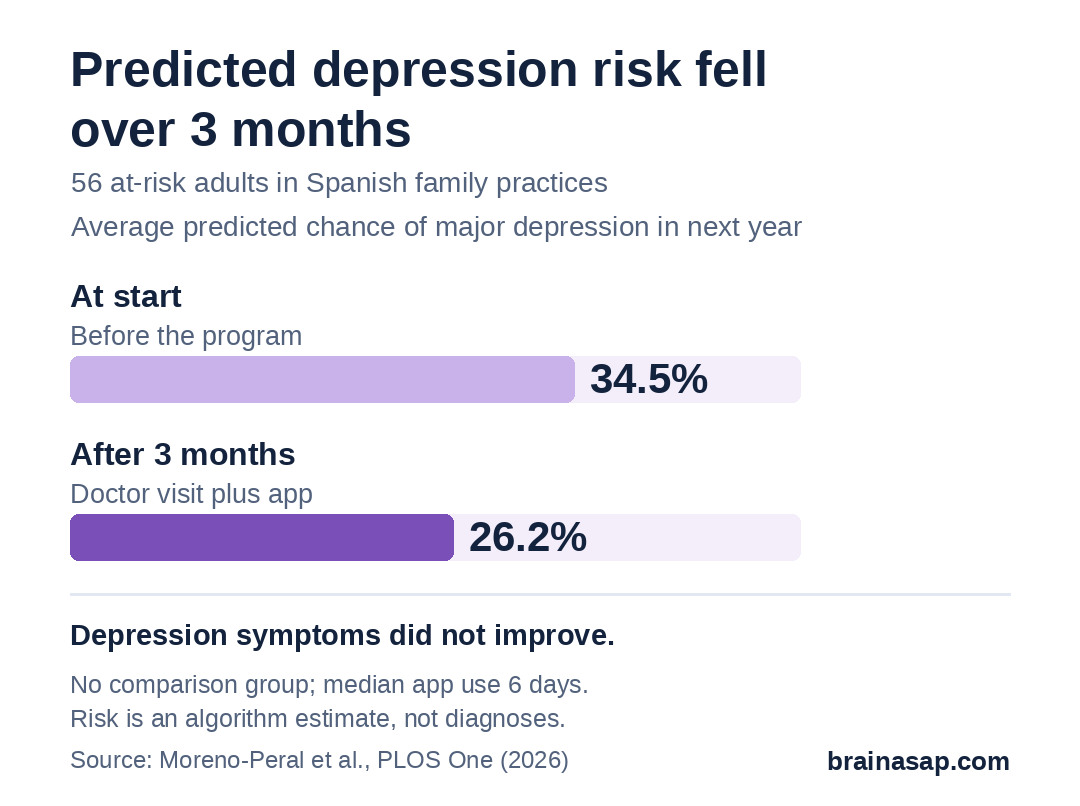
Depression symptom scores, however, did not improve and edged up slightly (8.8 to 9.6 on a 27-point scale, not significant). Physical quality of life did not change.
No Comparison Group
- Uncontrolled: Without a comparison group, improvements may reflect natural recovery or regression to the mean.
- Small sample: 56 people, mostly educated women aged 18 to 55.
- Motivated doctors: Volunteering family doctors may not represent typical practices.
- Beta app: An early version with known usability problems.
The App Needs to Be Easier Before a Real Trial
The findings suggest people and doctors like the idea of a personalized prevention plan, but the app has to be simpler and less demanding before it can be fairly tested. Whether e-predictD actually prevents depression can only be answered by a randomized trial.
Citation: DOI: 10.1371/journal.pone.0355675. Moreno-Peral P, Campos-Paíno H, Rodríguez-Morejón A, et al. Toward personalized interventions for preventing depression in primary care: qualitative and quantitative findings from the e-predictD pilot study. PLoS One. 2026.
Study Design: Uncontrolled mixed-methods pilot study in primary care.
Sample Size: 56 patients and 6 family doctors; 47 completed 3-month follow-up; 43 patients interviewed.
Key Statistic: Predicted 12-month depression risk 0.345 to 0.262 (difference −0.082, p = 0.048); PHQ-9 change +0.87 (p = 0.50).
Caveat: No control group; low app engagement; small, selected sample.