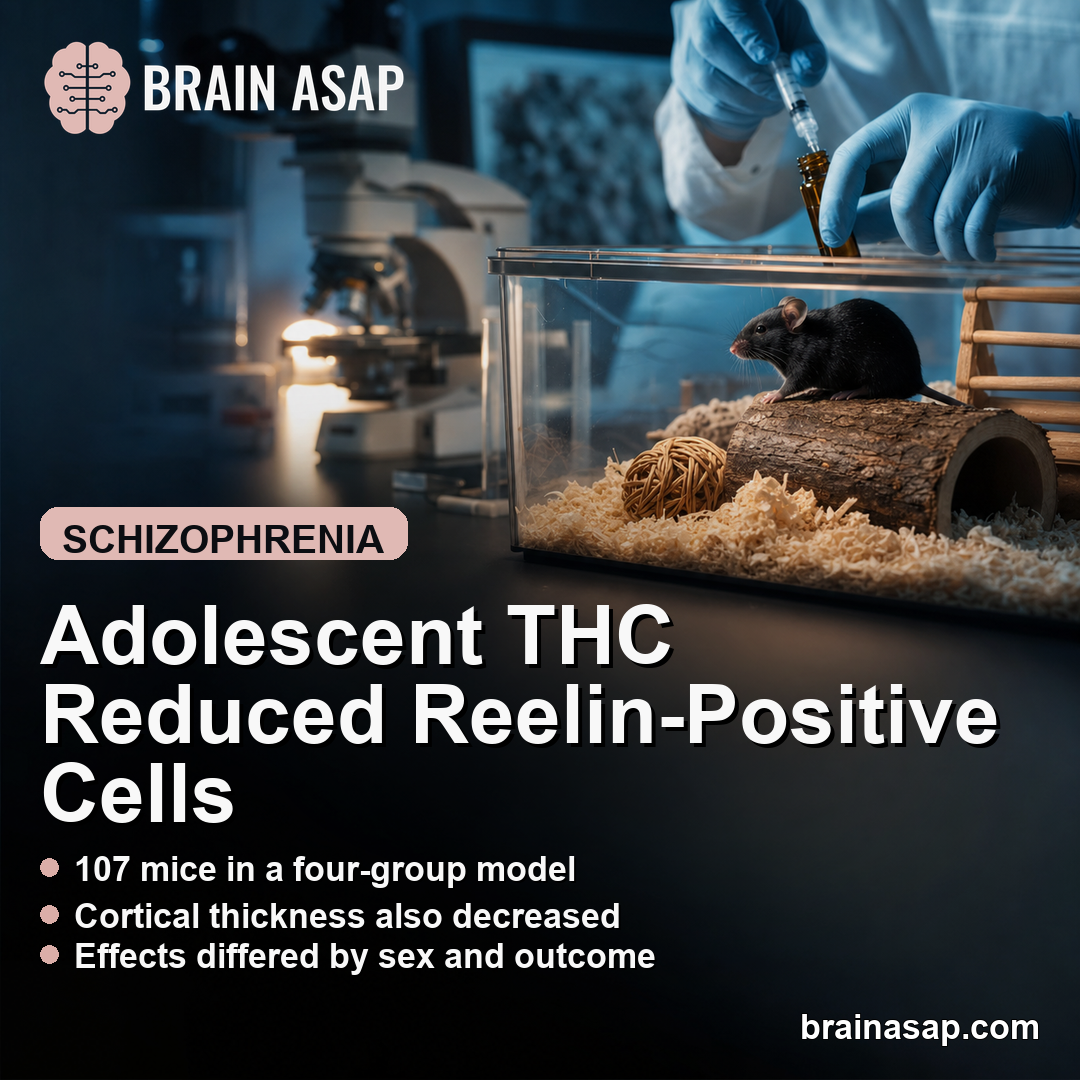
TL;DR: A 2026 mouse study in Translational Psychiatry reported that six days of adolescent THC exposure reduced Reelin-positive cell density in the female prefrontal cortex and cortical thickness across sexes. Prenatal immune activation did not consistently magnify the effects, and the short-term animal experiment does not show that cannabis causes schizophrenia in people.
Key Findings
- Four exposure groups: Researchers tested 107 mice after prenatal saline or immune activation and adolescent vehicle or THC, allowing each exposure and their combination to be compared.
- THC-led structural changes: THC had a main effect on somatosensory cortical thickness (p < .001), while the combined-exposure comparison with prenatal immune activation alone was only a trend for total thickness.
- Female Reelin-positive cells: THC alone and combined exposure each reduced Reelin-positive cell density in the female prelimbic prefrontal cortex versus controls (both p < .01).
- Selective two-hit effects: Combined exposure altered grooming, social novelty, dominance, and spine density in specific comparisons, but it did not produce uniform worsening across behavior, brain structure, or Reelin measurements.
Source: Martín-Cuevas et al., Translational Psychiatry (2026).
Reelin is an extracellular protein that helps organize brain development, neuronal positioning, and synaptic structure. Altered Reelin expression has been reported in schizophrenia, but an association does not establish that Reelin causes the disorder or can serve as a clinical biomarker.
Researchers examined Reelin within a “dual-hit” model. The first exposure activated the maternal immune system during pregnancy; the second exposed offspring to delta-9-tetrahydrocannabinol (THC), the main psychoactive component of cannabis, during adolescence.
The central question was whether those developmental exposures would interact. The answer depended on the outcome: some combined-exposure effects appeared, but THC or prenatal immune activation alone explained several of the clearest changes.
The Experiment Separated Prenatal Immune Activation From Adolescent THC
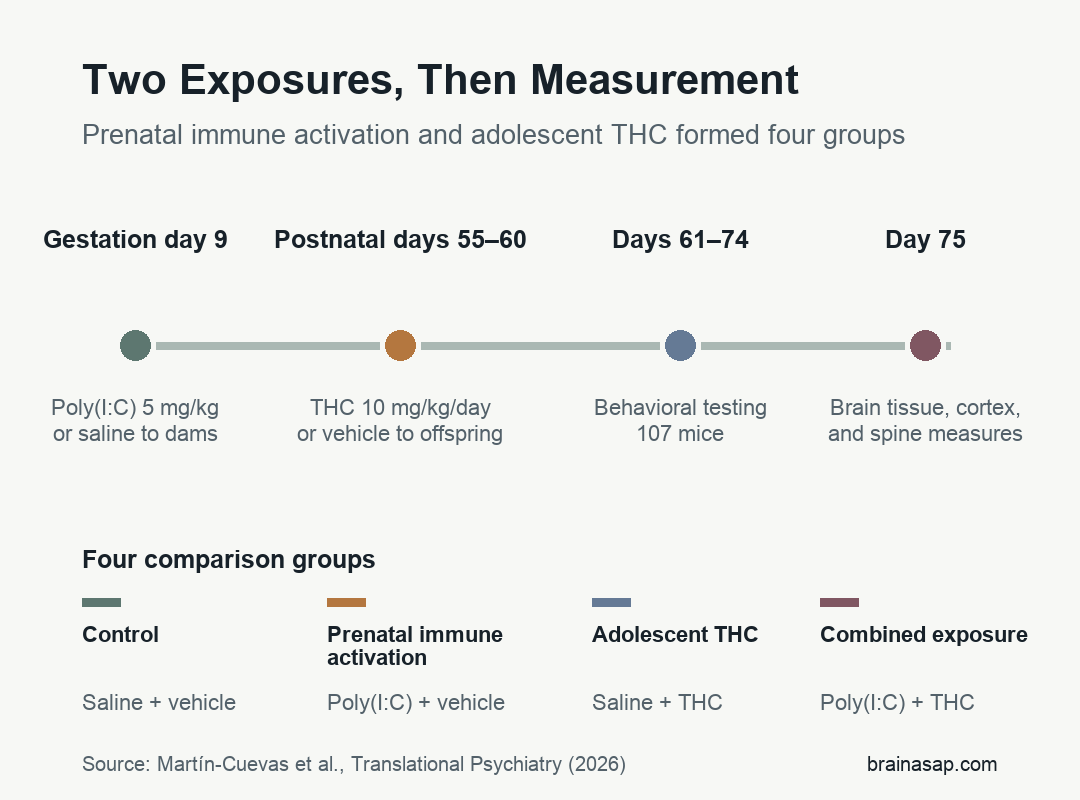
Pregnant C57BL/6J mice received either saline or 5 mg/kg polyinosinic-polycytidylic acid (Poly(I:C)) on gestational day 9. Poly(I:C) mimics a viral immune challenge without infecting the animals.
Male and female offspring then received vehicle or 10 mg/kg THC once daily for six days, from postnatal days 55 through 60. The four groups were:
- Control: Prenatal saline plus adolescent vehicle.
- Prenatal immune activation: Prenatal Poly(I:C) plus adolescent vehicle.
- Adolescent THC: Prenatal saline plus adolescent THC.
- Combined exposure: Prenatal Poly(I:C) plus adolescent THC.
Behavioral testing ran from postnatal days 61 through 74 in 107 mice. Group sizes were 14–15 males and 12–14 females. Researchers measured locomotion, repetitive grooming, social behavior, recognition memory, sensorimotor gating, motor performance, and heat sensitivity.
On day 75, smaller subsets contributed prefrontal tissue, cortical measurements, dendritic-spine counts, proteomics, and Reelin-pathway assays. Those molecular and structural analyses used different denominators, ranging from three to 16 mice per group.
THC Accounted for Several Cortical and Locomotor Changes
THC had main effects on open-field distance and velocity across the three-factor analysis (both p < .001). Pairwise patterns were clearer in males, while females showed a general reduction without significant pairwise differences.
Locomotion requires a narrow interpretation. Open-field testing occurred only 24 hours after the last THC injection, so reduced movement may include residual short-term drug effects rather than a lasting neurodevelopmental change.
Somatosensory cortical thickness also showed a THC main effect (F(1,33) = 15.33, p < .001). THC-only mice had thinner cortex than controls and the prenatal-immune-activation group.
Combined-exposure mice showed a similar direction, but their total-thickness comparison with prenatal immune activation alone did not reach significance (p = .058). Layer IV was thinner after combined exposure than after prenatal immune activation alone (p < .05).
Those results make THC the clearer driver of cortical thinning in this experiment. They do not demonstrate a uniform additive effect from combining the two exposures.
Combined Exposure Changed Specific Social and Repetitive Behaviors
Male combined-exposure mice spent more time grooming than controls (p < .01) and prenatal-immune-activation-only males (p < .05). Grooming-event frequency and grooming sequence did not differ significantly, so the result concerned duration rather than a broad change in grooming organization.
In the social-novelty phase, combined-exposure mice had a lower memory index than controls (p < .001), THC-only mice (p < .01), and prenatal-immune-activation-only mice (p < .05). The analysis showed independent main effects of both exposures rather than a significant interaction.
Male combined-exposure mice also won fewer tube-test contests than controls and THC-only males. Females followed a different pattern: THC-only females had fewer wins than the prenatal-immune-activation group.
Several expected outcomes remained unchanged. Anxiety-like open-field measures, prepulse inhibition, heat sensitivity, and Y-maze performance did not differ significantly. Female object-recognition impairment appeared after prenatal immune activation alone, not after combined exposure.
Reelin Results Depended on Sex and Measurement Method
Proteomics identified 375 altered proteins in combined-exposure males and 447 in females relative to same-sex controls. Of those, 113 overlapped between sexes. Pathway analysis highlighted Reelin signaling along with synaptic, immune, and cytoskeletal pathways.
Targeted assays showed a more nuanced pattern: in female prelimbic cortex, THC-only and combined-exposure groups each had fewer Reelin-positive cells than controls (both p < .01). The infralimbic pattern was weaker and included a significant reduction after prenatal immune activation alone.
With only three mice per group and sex, Western blots showed lower full-length Reelin in THC-only males than in combined-exposure males, but no simple significant treatment-versus-control reduction across groups. Female reductions were trends rather than significant pairwise findings.
Disabled homolog 1 (Dab1), a protein involved in Reelin signaling, increased in combined-exposure females versus controls and prenatal-immune-activation-only females. These results support altered pathway regulation, but not one uniform direction of Reelin protein change.
Reelin was not experimentally restored or blocked, so the analyses cannot show that Reelin changes caused the behavioral or structural outcomes.
Spine Loss Did Not Show Added THC Harm in Every Brain Region
Combined-exposure mice had lower dendritic-spine density in the hippocampal CA1 region than controls (p < .05). In the prefrontal cortex, both prenatal immune activation alone and combined exposure reduced spine density versus controls (both p < .01).
No reported combined-versus-prenatal-only comparison established that THC added further prefrontal spine loss. The result is therefore consistent with prenatal immune activation contributing strongly to that outcome.
Main limitations: This was a short-term mouse experiment, behavioral testing began one day after THC exposure ended, and molecular samples were small. The main manuscript did not report litter-level denominators for the offspring groups, focused molecular work on the prefrontal cortex, and tested many outcomes.
The unedited early-access manuscript also contains an internally inconsistent F statistic and p value for one female infralimbic Reelin-cell analysis. Most importantly, mouse dosing cannot establish that adolescent cannabis causes schizophrenia, cortical thinning, or Reelin disruption in humans.
A causal Reelin experiment would need to manipulate the pathway and test whether the behavioral and structural changes are prevented or reversed. Longer follow-up would also be required to separate transient THC effects from changes that persist into later adulthood.
Citation: DOI: 10.1038/s41398-026-04282-1. Martín-Cuevas C et al. Disruption of Reelin signaling in a dual-hit mouse model of schizophrenia: impact of postnatal Δ9-tetrahydrocannabinol exposure in a maternal immune activation model. Translational Psychiatry. 2026. Article in Press.
Study Design: Four-group, three-factor mouse experiment comparing prenatal Poly(I:C) or saline and adolescent THC or vehicle in both sexes.
Sample Size: 107 mice in behavioral testing; molecular and structural subsets ranged from three to 16 mice per group.
Key Statistic: Female prelimbic Reelin-positive cell density was lower after THC alone and combined exposure versus controls (both p < .01); somatosensory cortical thickness showed a THC main effect (p < .001).
Caveat: Short follow-up, small molecular subsets, unreported litter-level denominators, and a mouse model prevent causal or clinical conclusions about cannabis and schizophrenia in people.