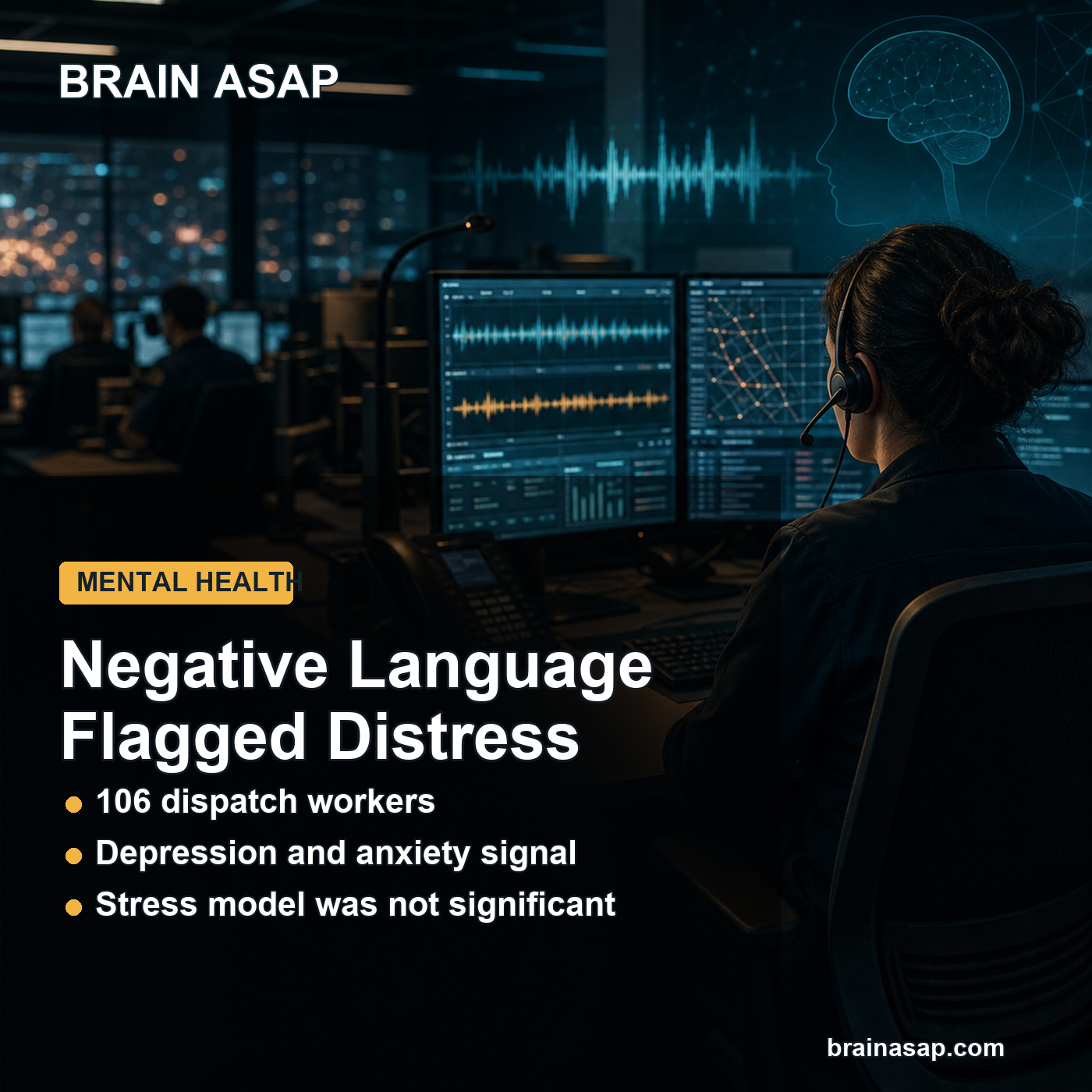
TL;DR: A 2026 study in PLOS One found that emergency call takers and dispatchers who used more negatively valenced words when describing a stressful work event reported higher depression and anxiety symptoms, while arousal-related language did not predict distress.
Key Findings
- 106 emergency communications workers described a stressful work-related event and completed the DASS-21, a depression, anxiety, and stress questionnaire.
- Researchers scored each narrative for negative valence, positive valence, high arousal, and low arousal using a dictionary-based natural language processing method.
- Depression model: Negative-valence language predicted higher depression symptoms in the regression model, with the full model explaining 12% of depression-score variation.
- Anxiety model: The same negative-valence marker predicted higher anxiety symptoms, and that model also explained 12% of anxiety-score variation.
- Stress boundary: Stress symptoms were not significantly predicted by the language markers, and the study does not validate the method as a clinical screening test.
Among emergency communications workers describing difficult calls or radio traffic, greater use of negatively valenced words was associated with higher depression and anxiety symptoms, even though all participants wrote about stressful material.
The strongest marker was not how intense the words sounded. It was whether the words leaned toward negative emotional meaning.
Emergency Dispatch Narratives Were Scored for Emotional Tone
Emergency call takers and dispatchers occupy a demanding mental-health position. They hear urgent, threatening, and sometimes traumatic events unfold through callers and field responders, but they often have less formal recognition than police, firefighters, or emergency medical services.
The study focused on full-time employees in a large metropolitan police department. After exclusions for missing or extremely short open-ended responses, the final sample included 106 participants: 51.89% call takers, 42.45% dispatchers, and 5.66% workers with another or mixed role.
Participants averaged 34.59 years of age and had worked in the field for an average of 72.95 months. Most identified as female, and the sample was drawn from one department, which matters for how far the findings can travel.
Each participant answered a prompt asking them to describe a high-stress situation they had experienced while working as a call taker or dispatcher. Responses averaged 122.51 words, with a median of 87.50 words.
Researchers then paired those narratives with Depression, Anxiety, and Stress Scale scores. The DASS-21 measures symptoms over the previous week across three related but separate subscales:
- Depression: low mood, loss of interest, and related emotional symptoms.
- Anxiety: anxious arousal and fear-related symptoms.
- Stress: tension, irritability, and difficulty relaxing.
Negative-Valence Words Predicted Depression and Anxiety
The language analysis used affective word norms from Warriner et al., a database of roughly 14,000 English words rated for emotional valence and arousal. Words were grouped into high arousal, low arousal, positive valence, and negative valence dictionaries.
For each written response, researchers calculated the percentage of words falling into each category. That percentage approach helps reduce the risk that longer narratives automatically look more emotionally loaded just because they contain more words.
The main regression results were specific:
- Depression model: The overall model was significant, F(4, 101) = 3.45, p = 0.01, R2 = 0.12. Negative-valence language significantly predicted higher depression scores.
- Anxiety model: The overall model was significant, F(4, 101) = 3.87, p = 0.01, R2 = 0.12. Negative-valence language significantly predicted higher anxiety scores.
- Stress model: The overall model was not significant, F(4, 101) = 1.30, p = 0.28, R2 = 0.05.
Positive-valence and arousal-related words did not significantly predict depression, anxiety, or stress in the main models. The association was specific to negative-valence word use rather than emotional language generally.
Instead, the result points to one marker: greater negative emotional word use in a stressful-event narrative was associated with higher depression and anxiety symptom burden.
Moderate-Symptom Groups Used More Negative-Valence Language
The follow-up comparison translated the regression result into a more concrete contrast. Based on corrected DASS-21 cutoffs, 25.47% of participants reported moderate to extremely severe depression symptoms, 31.13% reported moderate to extremely severe anxiety, and 20.76% reported moderate to extremely severe stress.
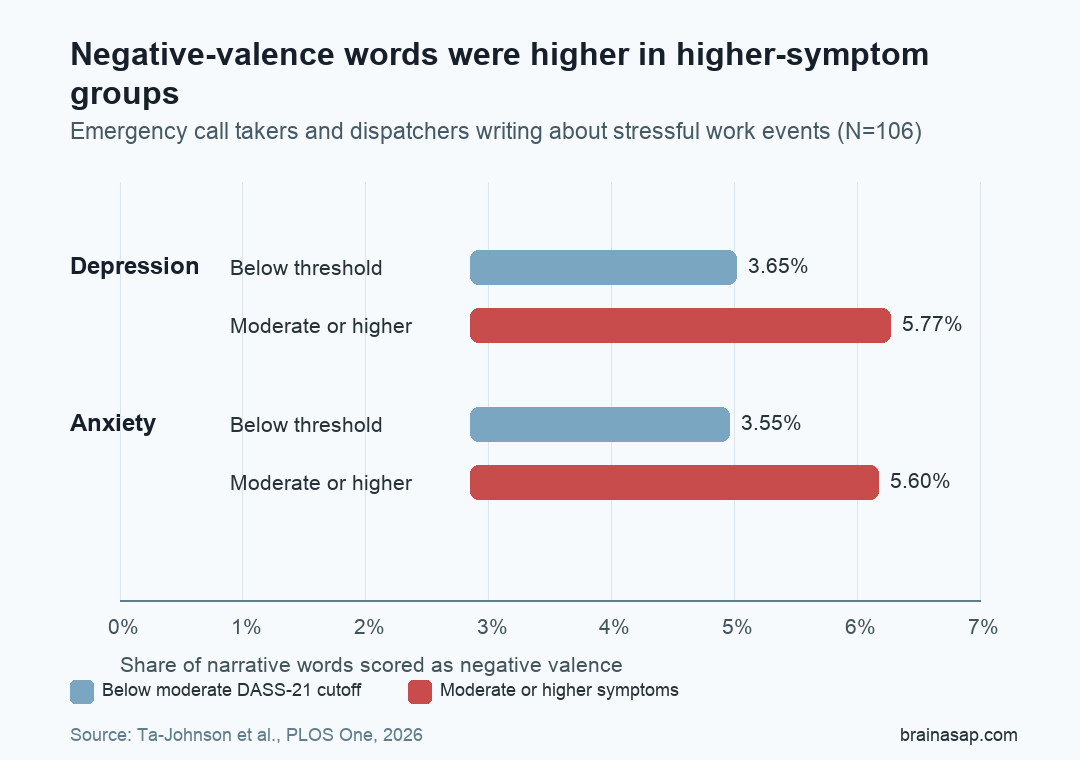
Participants at or above the moderate depression threshold used more negative-valence words than those below threshold: 5.77% versus 3.65% of narrative words. The difference remained significant after the study’s false-discovery-rate adjustment.
The anxiety comparison was similar. Participants at or above the moderate anxiety threshold used 5.60% negative-valence words, compared with 3.55% among participants below threshold.
These are not diagnostic cutoffs for language. They are group-level differences in a research sample. Still, the direction is practical: negative emotional wording separated workers with higher depression and anxiety symptoms from those below those symptom thresholds.
Arousal Language Did Not Track Stress Symptoms
The null stress result is one of the paper’s useful boundaries. A reader might expect high-arousal words, such as words tied to alarm, urgency, or intensity, to track stress symptoms in emergency communications work. That did not happen in this sample.
The study offers a plausible reason. Participants were asked to recall a stressful work event, not to report in-the-moment emotion during a shift. Written recall may capture meaning and appraisal more clearly than immediate physiological intensity.
Several other limits matter before treating language analysis as workplace screening:
- One department: The sample came from a single large metropolitan police department.
- Self-reported symptoms: Depression, anxiety, and stress were measured with DASS-21 scores, not clinician interviews.
- Private narratives: The raw text could not be shared publicly because it contained sensitive occupational and mental-health information.
- Preliminary marker: Negative-valence language needs prospective validation before it can guide individual support decisions.
Language Tools Could Support Earlier Occupational Mental-Health Checks
The most realistic implication is not automated diagnosis. The study supports a more modest idea: language features may help researchers and occupational-health teams understand which emergency communications workers are carrying more depression or anxiety burden.
That distinction matters ethically. Emergency call takers and dispatchers already work under intense surveillance and performance pressure in many agencies. A language-based tool would need strong privacy protections, voluntary use, transparent limits, and a support pathway that does not punish workers for distress signals.
Used carefully, though, the finding could help move wellness work beyond after-the-fact crisis response. A short written narrative may contain measurable emotional information that complements symptom questionnaires, especially in a workforce where distress can build through repeated exposure to other people’s emergencies.
The clearest takeaway is specific: in this 106-person emergency communications sample, negative-valence language was associated with higher depression and anxiety symptoms, while positive-valence and arousal markers did not carry the same signal.
Citation: DOI: 10.1371/journal.pone.0350551. Ta-Johnson et al. Linguistic markers of emotional reactivity and their association with anxiety, depression, and stress among emergency call takers and dispatchers. PLOS One. 2026;21(7):e0350551.
Study Design: Cross-sectional occupational mental-health study using open-ended stressful-event narratives and dictionary-based natural language processing.
Sample Size: 106 full-time emergency call takers, dispatchers, or mixed-role emergency communications workers.
Key Statistic: Negative-valence language predicted depression and anxiety symptoms; both full models had R2 = 0.12.
Caveat: The sample came from one department, symptoms were self-reported, and the language marker is not validated as an individual screening tool.