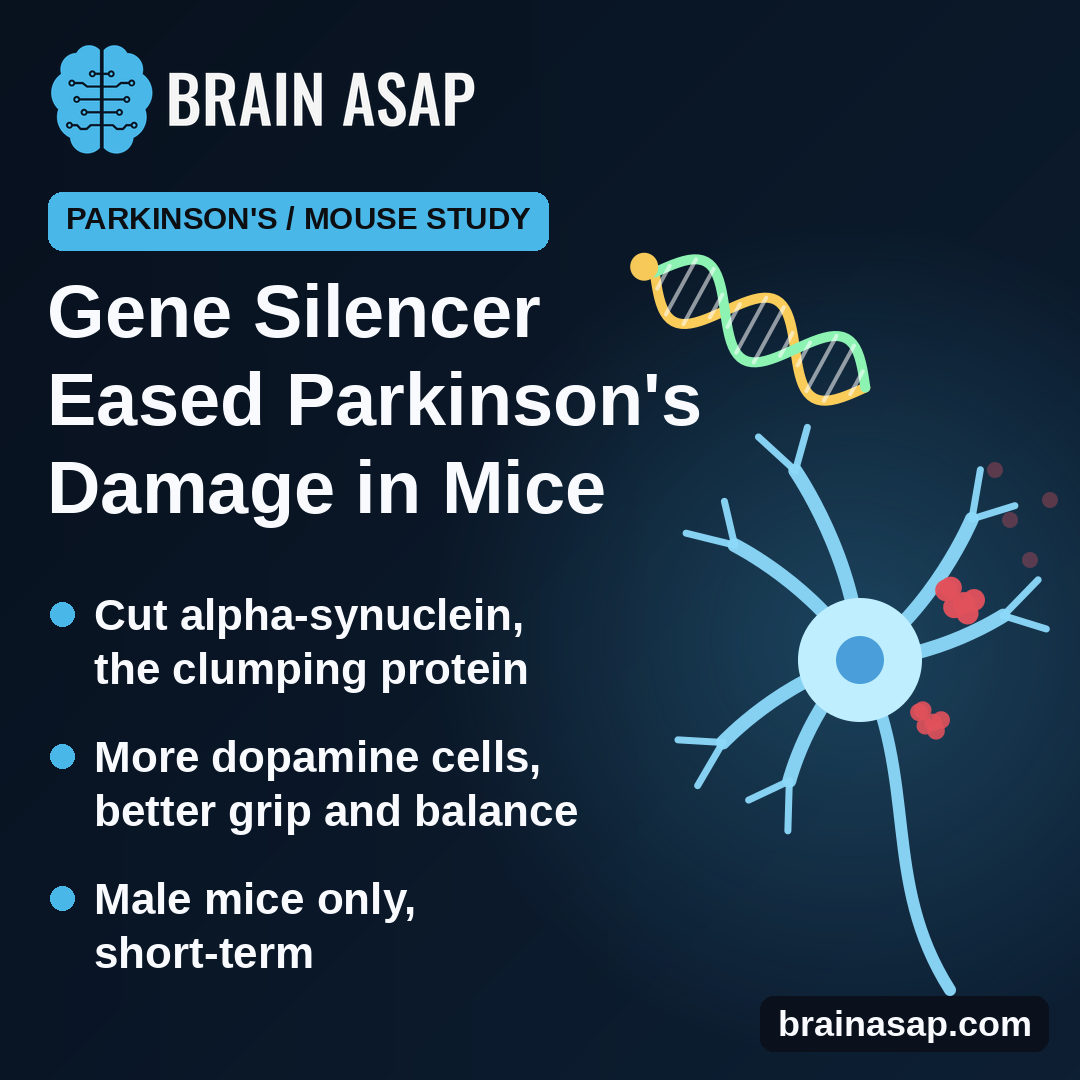
TL;DR: In mice, a new type of gene-silencing molecule lowered levels of alpha-synuclein, the protein that clumps in Parkinson’s. Mice given it kept more dopamine-making brain cells and did better on grip and balance tests than untreated mice with the same disease model.
Key Findings
- Two silencing molecules tested: Both cut alpha-synuclein in the brain region hit by Parkinson’s.
- Better movement: Treated mice had stronger grip and stayed longer on a spinning rod.
- More dopamine cells kept: Staining showed less loss in two Parkinson’s-like mouse models.
- Less clumping: Fewer harmful protein clumps in cells and mice.
- Male mice only: Groups of about 5 to 12 animals per test.
Source: Aging Cell (2026) | Wang et al.
Parkinson’s disease slowly kills the brain cells that make dopamine, and a protein called alpha-synuclein sits at the center of the story. It builds up and sticks together in clumps inside those cells. Some families with Parkinson’s carry extra copies of its gene. So an obvious idea is simply to make less of it.
A team in China and Japan tested a newer way to do that in mice.
A Two-Stranded Way to Silence a Gene
The tool is a heteroduplex oligonucleotide, a short, two-stranded piece of genetic material. One strand latches onto the cell’s instructions for making alpha-synuclein so they get destroyed. The second strand carries a cholesterol tag that helps it get into cells. Earlier work suggested this design can be more potent than the single-stranded versions already used in some brain drugs.
The researchers built two versions: one with an RNA partner strand and one with a DNA partner strand. Both were injected into the fluid around the spinal cord.
- Healthy mice: Both versions lowered alpha-synuclein in the brain’s dopamine region within 3 days, and one shot kept working for at least 9 days. Scrambled control versions did nothing.
- Mice carrying a human Parkinson’s gene mutation: Both also lowered the human form of the protein.
Treated Mice Moved Better and Kept More Neurons
To mimic Parkinson’s, the team used a virus to make mice overproduce human alpha-synuclein in the dopamine region. Three weeks later, once the virus was active, mice got four injections over 10 days and were tested a few days after the last dose. A second model seeded clumps by injecting tiny pre-formed protein fibers.
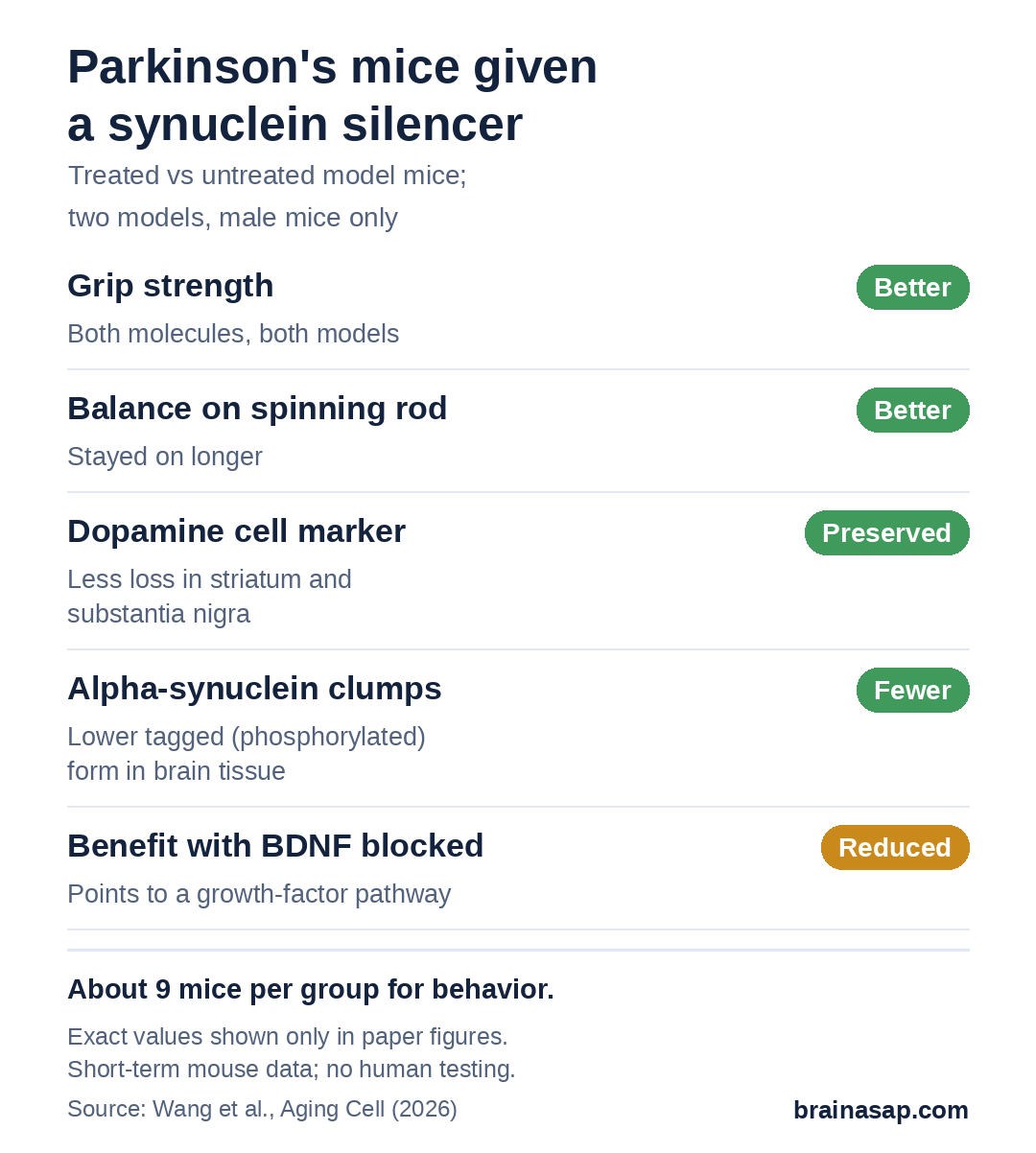
In both models, compared with untreated model mice:
- Grip strength: Improved with both molecules.
- Spinning rod: Mice stayed on longer.
- Dopamine cells: Staining for a key dopamine-making enzyme was largely preserved in the affected brain regions.
- Clumps: Levels of the toxic, tagged form of alpha-synuclein dropped.
A Growth Factor Seems to Do the Protecting
The researchers traced the benefit to BDNF, a natural growth factor that keeps neurons healthy. Too much alpha-synuclein switched BDNF down; the silencing molecules switched it back on. When the team blocked BDNF, the benefit largely disappeared. Boosting BDNF alone also reduced clumping in cells and mice.
Still Far From a Human Treatment
- Mouse models only: Forced overproduction or seeded clumps do not capture how Parkinson’s develops over decades.
- Male mice only: The authors say females need testing.
- Short follow-up: Behavior was tested within days of treatment.
- Small groups: About 9 mice per group for the main behavior tests.
- Safety not studied: Lowering alpha-synuclein long term could carry its own risks.
Next: Longer Tests and Safety
This adds to evidence that turning down alpha-synuclein can protect dopamine cells, at least in mice. The open question is whether this two-stranded design works better or more safely than single-stranded versions, and whether the benefit lasts for months in older animals before anyone tries it in people.
Citation: DOI: 10.1111/acel.70717. Wang X, Ding Y, He L, et al. Inhibition of abnormal elevated α-synuclein ameliorates dopaminergic neuron degeneration in Parkinson’s disease mouse model. Aging Cell. 2026;25:e70717.
Study Design: Preclinical study in cells and male mice (AAV-human SNCA, preformed-fibril and A53T models).
Sample Size: Behavior n = 9 per group (AAV model) and 8 to 12 per group (other experiments); tissue assays n = 4 to 9 per group.
Key Statistic: Both heteroduplex oligonucleotides improved grip strength and rotarod time and preserved TH staining versus untreated model mice (one-way ANOVA; values reported in figures).
Caveat: Mouse models, males only, short-term follow-up; no human data.