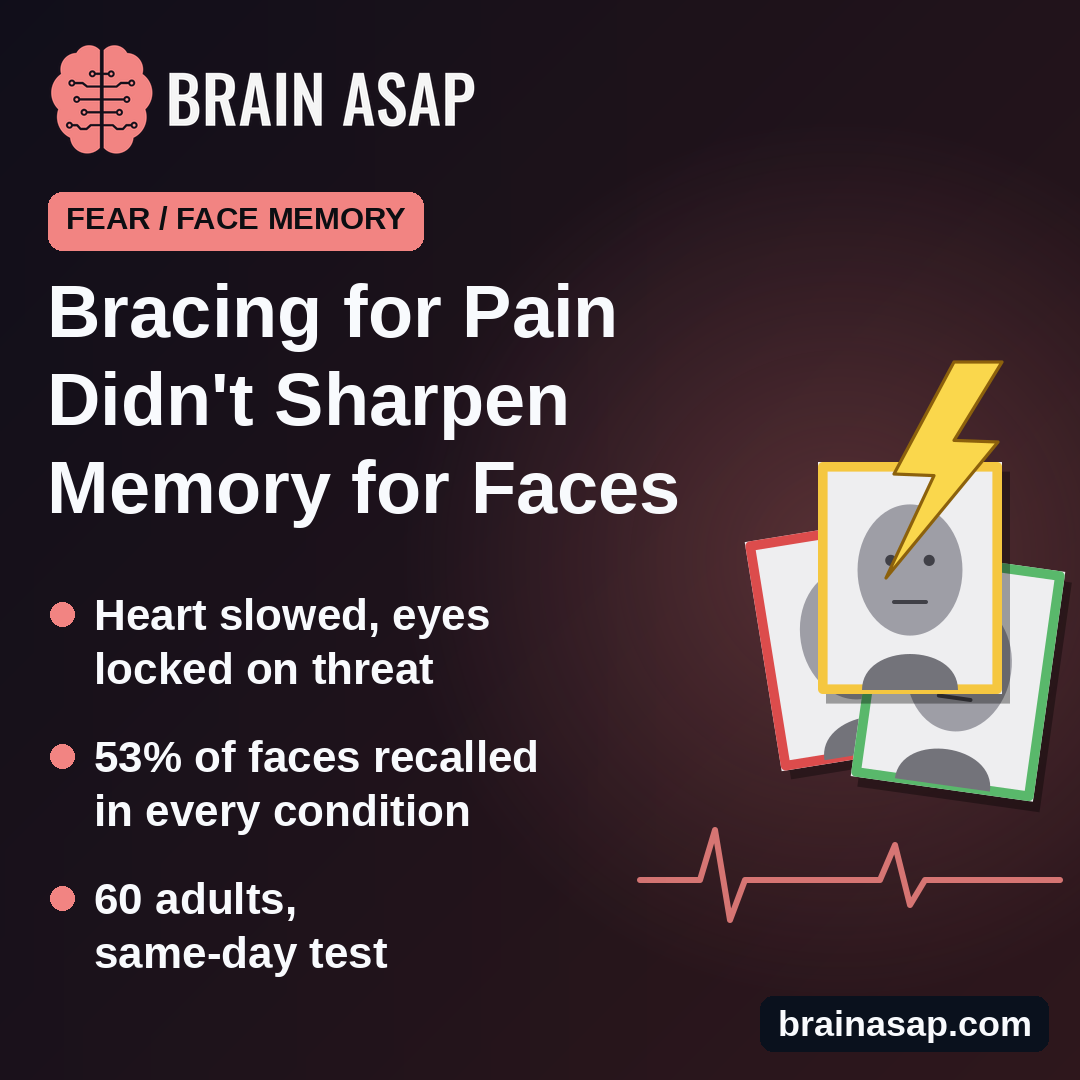
TL;DR: When 60 volunteers braced for a shock they could dodge with a quick button press, their brains and bodies shifted into a focused, alert state. But they remembered faces seen during those moments no better than faces seen when they felt safe.
Key Findings
- 60 adults, 270 trials: Each face came with a certain shock, a shock they could avoid, or no shock.
- Body braced for avoidable threats: Heart slowed, pupils widened, gaze locked to the center.
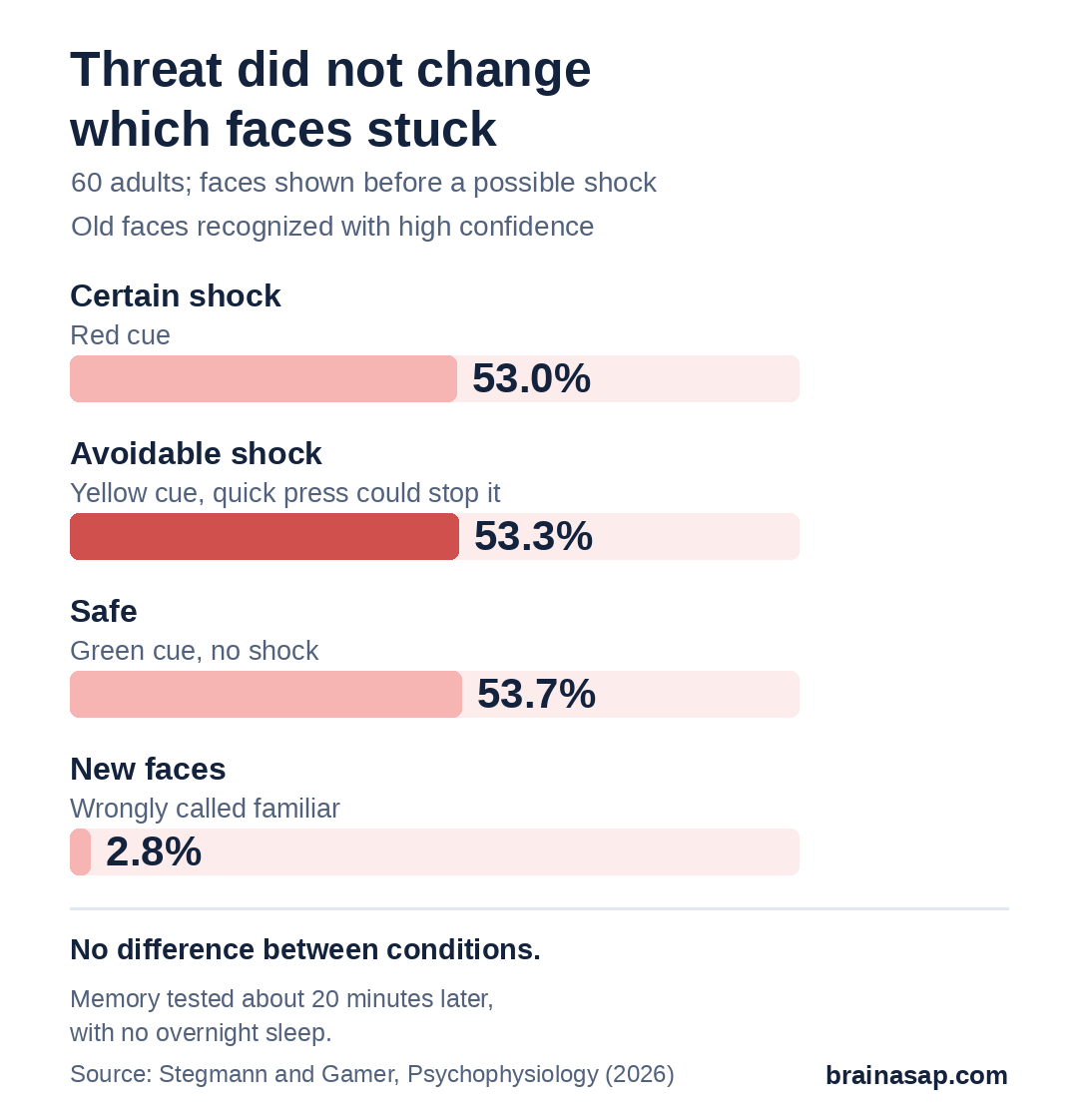
- Memory unchanged: 53.3% of faces recalled under avoidable threat, 53.0% under certain shock and 53.7% when safe.
- Different signals predicted memory: More looking around and lower visual-brain rhythms during viewing.
- Preregistered: Hypotheses and main analyses were set in advance.
Source: Psychophysiology (2026) | Stegmann and Gamer
When danger looms but escape is possible, people often freeze for a split second: the heart slows, the eyes lock on, the body gets ready to bolt. Researchers call this attentive immobility. A natural guess is that this sharp focus would also burn the scene into memory, which matters for understanding how fear memories form in anxiety disorders.
Psychologists at the University of Würzburg in Germany put that guess to a direct test.
Faces, Colored Cues and Mild Shocks
Sixty adults (average age 23, mostly women) sat through 270 trials while the researchers recorded brain waves, heart rate, sweat response, pupil size and eye movements. Each trial started with a colored cross that told them what was coming:
- Red, certain shock: An unpleasant electric pulse to the forearm would arrive no matter what.
- Yellow, avoidable shock: A fast button press when the face turned angry could prevent it. The timing adjusted so people escaped about half the time.
- Green, safe: No shock.
A neutral face then appeared for 6 seconds before turning angry. Participants were not told their memory would be tested. About 20 minutes later, they saw the 90 old faces mixed with 60 new ones and rated how sure they were that they had seen each one.
Bodies Got Ready to Act
The avoidable-shock trials produced the clearest defensive pattern. Compared with safe trials:
- Heart rate slowed more just before the moment to act, a large effect.
- Pupils widened more, a sign of stress arousal.
- Gaze stayed near the center of the face, with longer fixations.
- Alpha brain waves over the back of the head were more suppressed, which usually reflects heightened visual attention.
Memory Did Not Follow
People clearly told old faces from new ones, wrongly claiming only 2.8% of new faces. But recall was nearly identical across conditions, and a statistical test that weighs evidence for no difference strongly favored no effect.
What Did Predict a Remembered Face
Faces that were later remembered had a different signature from the threat response. During viewing, people’s eyes wandered more across those faces, their pupils widened less, and alpha brain rhythms were lower, especially over areas that process faces. These memory signals held in every condition.
In other words, the alert, frozen state seems tuned to action and perception in the moment, not to storing details for later.
Same-Day Testing Is a Big Caveat
- No overnight sleep: Memory was tested about 20 minutes later. Arousal sometimes improves memory only after a night’s sleep.
- Long session: 90 minutes of trials; responses weakened in the final third.
- Healthy young adults: Results may differ in people with anxiety or PTSD.
- Some eye analyses unplanned: The whole-trial gaze results were added after looking at the data.
Would a Night’s Sleep Change the Result?
The study suggests that bracing for an escapable threat sharpens the body and eyes for action without making faces stick any better in the short term. The open question is whether a two-day design, with sleep in between, would reveal a delayed memory boost for faces seen under threat.
Citation: DOI: 10.1111/psyp.70413. Stegmann Y, Gamer M. Electrocortical and physiological correlates of memory and attention during the anticipation of avoidable and inevitable threats. Psychophysiology. 2026;63:e70413.
Study Design: Preregistered within-subject laboratory experiment with EEG, heart rate, pupil, eye-tracking and skin conductance.
Sample Size: 64 completed; 60 analyzed.
Key Statistic: Correct recognition 53.0% (certain shock), 53.3% (avoidable), 53.7% (safe); condition effect p = 0.878, BF10 = 0.06.
Caveat: Same-day memory test without overnight consolidation; healthy young adults only.