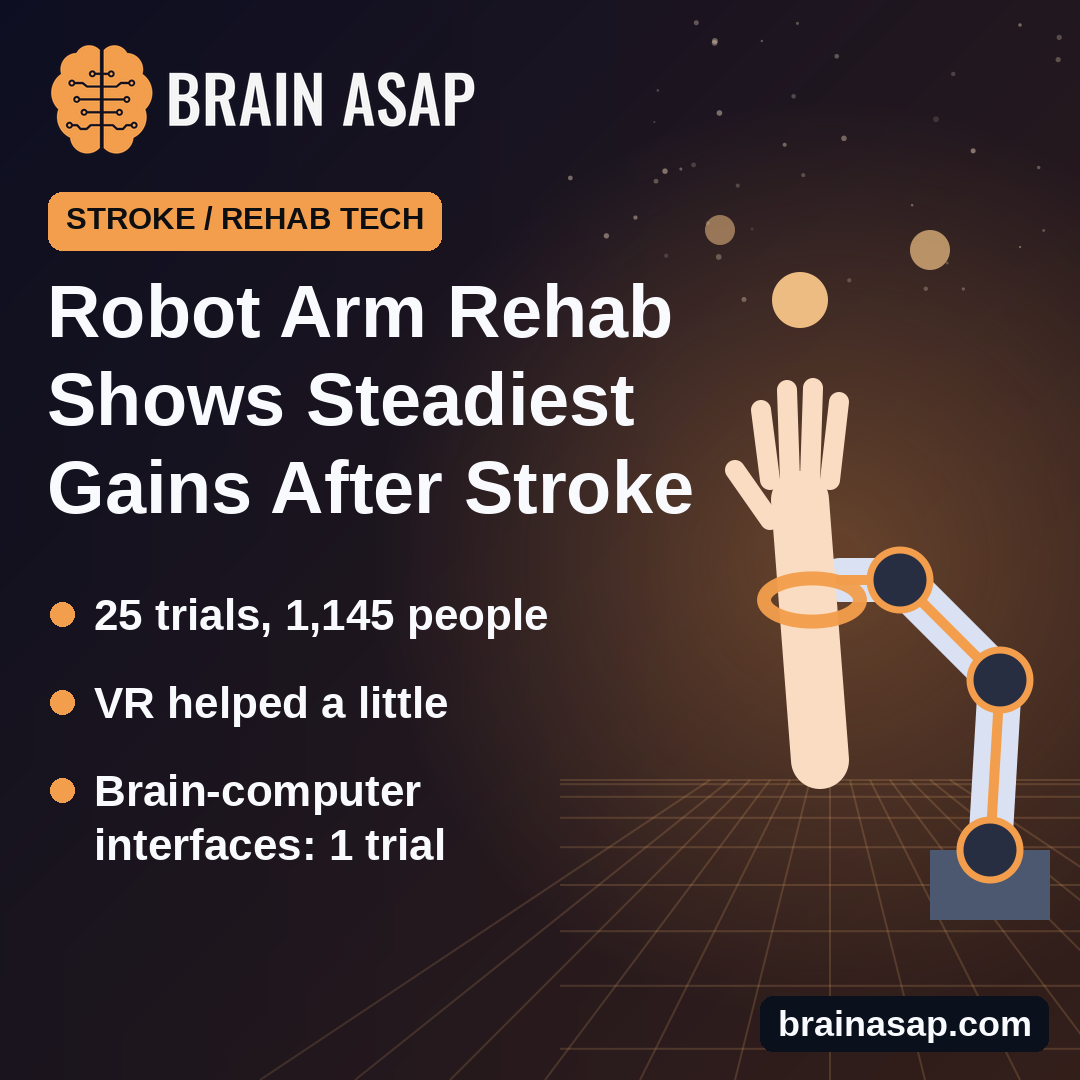
TL;DR: In a review of 25 trials on arm recovery after stroke, robot-assisted training had the most consistent evidence of beating standard physical therapy. Virtual reality helped a little, and brain-computer interfaces had too little data to judge.
Key Findings
- 25 trials, 1,145 stroke survivors: Every tech option was tested only against standard physical therapy.
- Robot training: About 6.5 points better on a 66-point arm-movement scale, in 2 to 3 trials each.
- Top-ranked option rests on 1 trial: Robot plus repetitive exercise, +10 points.
- Virtual reality: +5 points on its own; no clear gain when added to therapy across 10 trials.
- Brain-computer interface: Only 1 usable trial, no clear effect.
Source: Frontiers in Neurology (2026) | Pang et al.
After a stroke, many people can walk again long before their weaker arm and hand work well. Rehab clinics now offer a menu of high-tech options: robots that move the arm, video-game style virtual reality, and brain-computer interfaces that read movement intentions from brain signals.
Almost no trials pit these tools against each other. So a team in China used a network meta-analysis, a method that compares treatments indirectly through a shared comparison, to rank them.
Every Option Was Measured Against Standard Therapy
The researchers found 25 randomized trials with 1,145 stroke survivors, published from 2009 to 2025, mostly from Italy, South Korea, the US, Germany, China and Turkey. In every trial, the comparison group got standard physical therapy (sometimes with a home program or sham treatment).
The tech groups fell into three families:
- Robot training: A device guides or assists arm movements, alone or combined with standard therapy or other exercise.
- Virtual reality: Game-like tasks on a screen or headset, alone or added to therapy.
- Brain-computer interface: A system that detects the intention to move and triggers a device, added to therapy.
The main outcome was the Fugl-Meyer upper extremity score, a 66-point rating of arm and hand movement. Differences of about 5 to 7 points are often cited as the smallest change patients notice.
Robots Came Out Ahead, With Caveats
Compared with standard therapy, the arm-movement score differences were:
- Robot plus repetitive exercise: +10.2 points (95% interval 3.3 to 17.3), but from a single trial.
- Robot alone: +6.5 (0.5 to 12.5), 3 trials.
- Robot plus standard therapy: +6.5 (0.1 to 12.8), 2 trials.
- Virtual reality alone: +5.2 (0.2 to 9.9), 3 trials.
- Virtual reality plus therapy: +2.1 (-1.6 to 5.1), 10 trials, not a clear difference.
- Brain-computer interface plus therapy: +1.3 (-9.1 to 11.3), 1 trial.
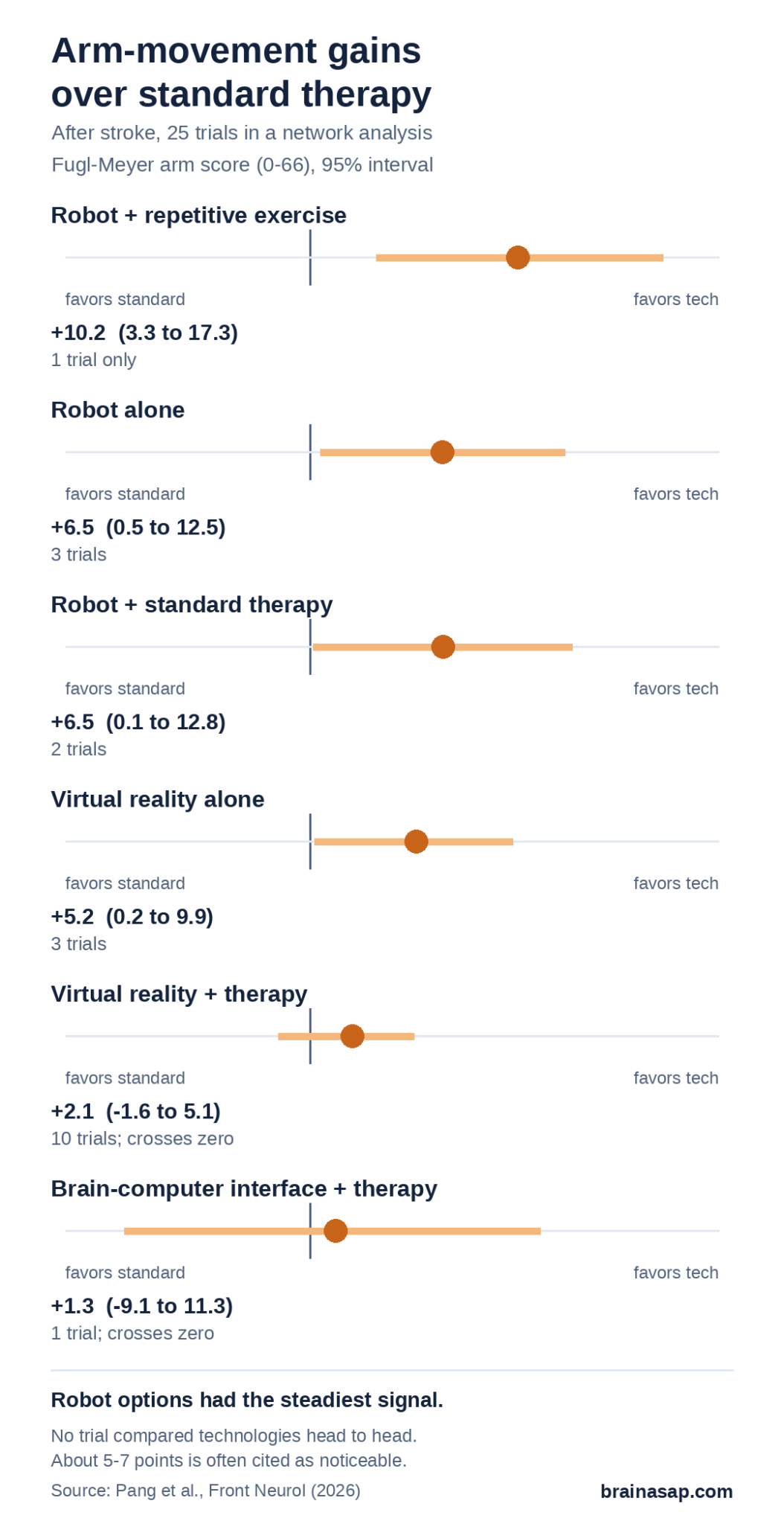
The average robot results were around or above the 5-to-7-point benchmark, but their ranges extended below it. So the gain could be large enough to matter, or quite small.
A Ranking Is Not a Verdict
The review used a ranking score called SUCRA, from 0 to 1; higher scores mean a better average rank. Robot plus repetitive exercise topped it at 0.91. This is not a 91% chance of being the best treatment. The authors stress that this ranking comes from one trial and should only guide future research. They put more weight on robot alone and robot plus therapy, which had more than one supporting trial.
For daily-living skills, robot plus therapy also ranked highest, but its advantage was not statistically clear.
Why These Rankings Are Shaky
- No head-to-head trials: Robots and VR were never compared directly, only through standard therapy.
- Few trials per option: Five of the nine tech options rested on one trial each.
- Very different patients: Starting arm scores ranged from about 8 to 52 of 66.
- Uneven comparison groups: Standard therapy varied from structured sessions to home exercise or sham.
- Stroke stage often missing: Early and late recovery could not be separated.
- 4 of 25 trials at high risk of bias: Removing them did not change the rankings.
Brain-Computer Interfaces Remain an Open Question
Only one brain-computer interface trial had usable data. A larger 300-person trial could not be included because it reported results in a format the analysis could not combine. The authors call the approach investigational for now.
For someone choosing arm rehab after stroke, robot-assisted training has the most consistent backing among these technologies, though the likely gain is modest and uncertain. The question the field still needs answered is direct: in the same trial, with the same therapy time, does a robot beat virtual reality or a brain-computer interface?
Citation: DOI: 10.3389/fneur.2026.1882841. Pang R, Hu Z, Luo C, Liu Z, Zhang S. Comparative efficacy of virtual reality, robotics, and brain-computer interface interventions for upper limb rehabilitation after stroke: a systematic review and network meta-analysis. Front Neurol. 2026.
Study Design: Systematic review and Bayesian random-effects network meta-analysis of randomized controlled trials (PROSPERO CRD420251180631).
Sample Size: 25 RCTs, 1,145 stroke survivors; 23 trials in the main arm-movement analysis.
Key Statistic: Robot alone +6.46 Fugl-Meyer points (95% CrI 0.50 to 12.49); robot plus therapy +6.49 (0.13 to 12.84) versus standard therapy.
Caveat: Star-shaped network with no direct comparisons between technologies; many options supported by one trial; varied patients and comparison therapy.