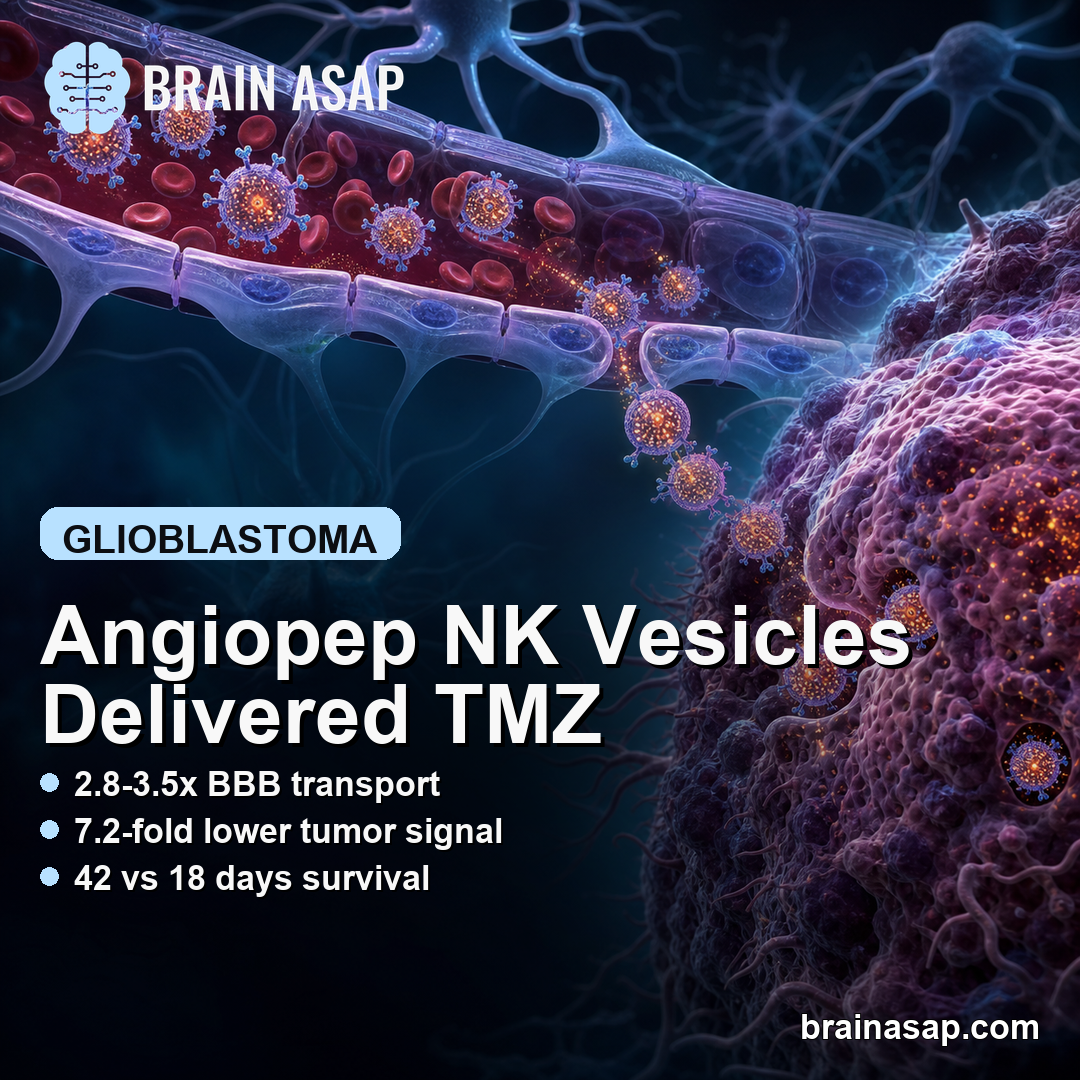
TL;DR: A 2026 study in Journal of Nanobiotechnology found that Angiopep-2-modified natural killer cell extracellular vesicles carried temozolomide across glioblastoma barriers, reduced mouse tumor bioluminescence, and extended median survival in an orthotopic GBM model.
Key Findings
- 2.5-3.2x uptake: Angiopep-2 modification increased glioblastoma-cell uptake of NK extracellular vesicles compared with unmodified NK-EV.
- 2.8-3.5x BBB transport: Ang-NK-EV@TMZ crossed the blood-brain barrier model more efficiently than free temozolomide.
- TMZ resistance targeted: The platform suppressed STING/mTOR/MGMT signaling and increased apoptosis markers including cleaved caspase-3 and gamma-H2AX.
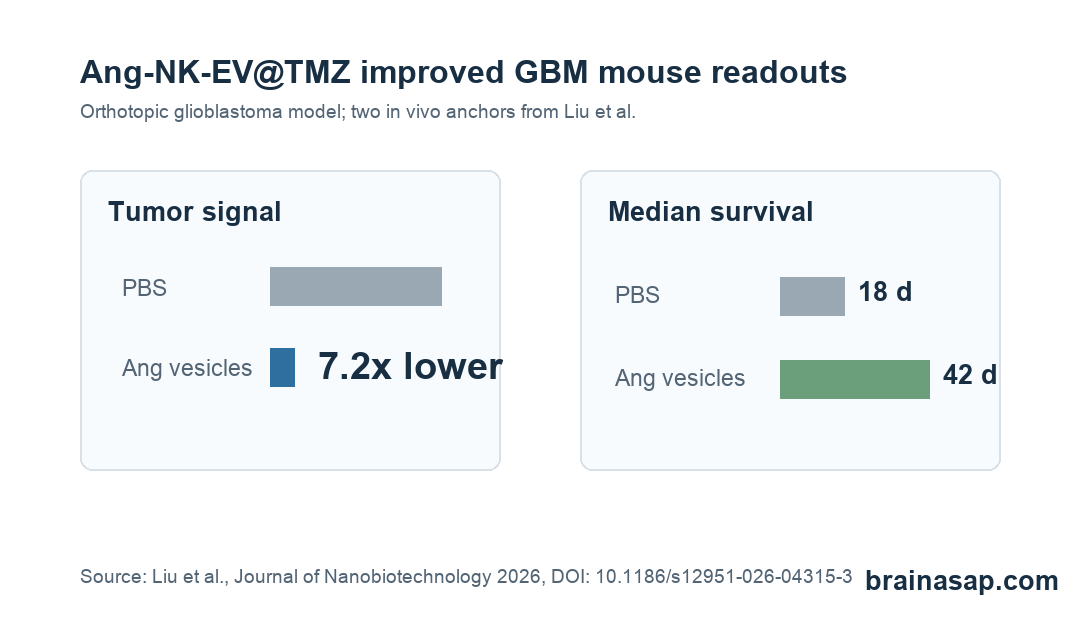
- 7.2-fold lower bioluminescence: Orthotopic GBM mice receiving Ang-NK-EV@TMZ had lower tumor readout than PBS-treated mice.
- 42 vs 18 days: Median survival reached 42 days with Ang-NK-EV@TMZ compared with 18 days for PBS.
Source: Journal of Nanobiotechnology (2026) | Liu et al.
Glioblastoma temozolomide delivery faces two linked problems. The blood-brain barrier limits drug entry, and many tumors resist temozolomide through DNA-repair programs such as MGMT.
This study tested a delivery system built to address both barriers at once: natural killer cell-derived extracellular vesicles loaded with temozolomide and surface-modified with Angiopep-2.
Angiopep-2 Gave NK Extracellular Vesicles a BBB Targeting Route
The researchers prepared NK cell-derived extracellular vesicles (NK-EV) from NK-92 cells, loaded them with temozolomide (TMZ), and added Angiopep-2 to the vesicle surface.
Angiopep-2 targets low-density lipoprotein receptor-related protein 1, or LRP1, which is expressed at the blood-brain barrier and on glioblastoma cells. The design was meant to turn a drug carrier into a dual-targeting system.
- Carrier: NK-cell extracellular vesicles supplied the nanoscale delivery shell and retained NK immune factors such as IFN-gamma and granzyme B.
- Drug payload: Temozolomide was loaded into the vesicles as the chemotherapy component.
- Targeting ligand: Angiopep-2 was added to improve barrier crossing and tumor-cell uptake through LRP1.
Characterization experiments reported spherical vesicles, preserved extracellular-vesicle markers, and retained NK-derived immune proteins. The platform depends on both delivery behavior and immune-modulating cargo.
The model set was deliberately layered. Cell-line assays tested uptake and TMZ-resistant killing, barrier assays tested transport, and orthotopic mouse tumors tested whether the same engineered carrier could act inside the brain-tumor setting.
Ang-NK-EV@TMZ Improved GBM Uptake and Barrier Crossing
The engineered vesicles performed better than simpler comparators in the cell and barrier assays. Angiopep-2 modification increased glioblastoma-cell uptake by 2.5-3.2-fold compared with unmodified NK-EV.
In the blood-brain barrier transcytosis model, Ang-NK-EV@TMZ crossed more efficiently than free temozolomide, with a reported 2.8-3.5-fold improvement.
Those two steps are clinically relevant because a GBM drug carrier has to reach the brain-side compartment and then enter tumor cells. Improving only one step would leave the other barrier intact.
- Barrier entry: The Angiopep-2/LRP1 interaction was used to support transport across a BBB model.
- Tumor uptake: Glioblastoma cells took up more Ang-modified vesicles than unmodified NK-EV.
- Payload delivery: Temozolomide was delivered inside a vesicle system rather than as free drug.
NK Vesicle Temozolomide Targeted MGMT-Linked Resistance
The drug-delivery result was paired with a resistance mechanism. Ang-NK-EV@TMZ suppressed STING/mTOR/MGMT signaling, a pathway set tied to temozolomide resistance in the paper.
MGMT is important because it repairs the DNA damage temozolomide is intended to create. Lower MGMT activity can make glioma cells more vulnerable to the same chemotherapy, which is why the paper treated MGMT-linked biology as a resistance target rather than a background detail.
The study also reported higher apoptosis and DNA-damage markers after treatment, including cleaved caspase-3 and gamma-H2AX. Those findings support a cell-killing mechanism rather than just passive drug accumulation.
- Apoptosis signal: Treated glioma cells showed markers consistent with programmed cell death.
- DNA damage marker: Gamma-H2AX increased, fitting the temozolomide damage-response mechanism.
- Resistance pathway: Suppression of MGMT-linked signaling may explain improved activity against TMZ-resistant glioma cells.
Orthotopic GBM Mice Had Lower Bioluminescence and Longer Survival
The most important test was the brain-tumor mouse model. In orthotopic GBM models, Ang-NK-EV@TMZ accumulated in brain tumors and reduced tumor progression.
The paper reports 7.2-fold lower bioluminescence compared with PBS-treated mice. Median survival was also longer: 42 days with Ang-NK-EV@TMZ versus 18 days with PBS.
The platform also shifted immune readouts. Treatment increased immunogenic cell death markers, including ATP and HMGB1, and pushed macrophages toward M1-like phenotypes.
No significant organ toxicity or hemolysis was reported in the tested models. Those safety readouts are useful, but they remain early-stage animal and cell evidence rather than human tolerability data.
Glioblastoma Nanodelivery Still Needs Human Translation Tests
The evidence supports a preclinical claim: an Angiopep-2 NK-vesicle system improved temozolomide delivery, attacked resistance biology, and slowed orthotopic glioblastoma growth in mice.
The next question is not whether the mouse survival number is encouraging. It is whether this kind of vesicle platform can be manufactured consistently, dosed safely, and tested against human GBM heterogeneity.
- Main strength: The study links delivery, resistance biology, immune modulation, and mouse survival in one platform.
- Main limit: The work remains preclinical, with cell lines, patient-derived material, barrier models, and mouse tumors rather than patients.
- Translation need: Manufacturing, biodistribution, immune effects, and toxicity require larger validation before clinical claims are possible.
For now, the study adds a concrete delivery strategy to the glioblastoma field: pair BBB targeting with a chemotherapy payload and immune-active vesicle cargo, then test whether all three pieces improve the same tumor model.
Citation: DOI: 10.1186/s12951-026-04315-3. Liu et al. Overcoming blood-brain barrier and chemoresistance in glioblastoma by Angiopep-2-modified NK cell-derived extracellular vesicles for targeted delivery of temozolomide. Journal of Nanobiotechnology. 2026.
Study Design: Preclinical glioblastoma drug-delivery study using cell assays, BBB models, patient-derived material, and orthotopic mouse models.
Sample/Model: Human glioma cell lines, TMZ-resistant glioma cells, BBB transcytosis models, and orthotopic GBM mice.
Key Statistic: Ang-NK-EV@TMZ produced 7.2-fold lower tumor bioluminescence versus PBS and extended median survival from 18 to 42 days in the mouse model.
Caveat: The findings are preclinical and do not yet show safety, dosing, or effectiveness in human glioblastoma patients.