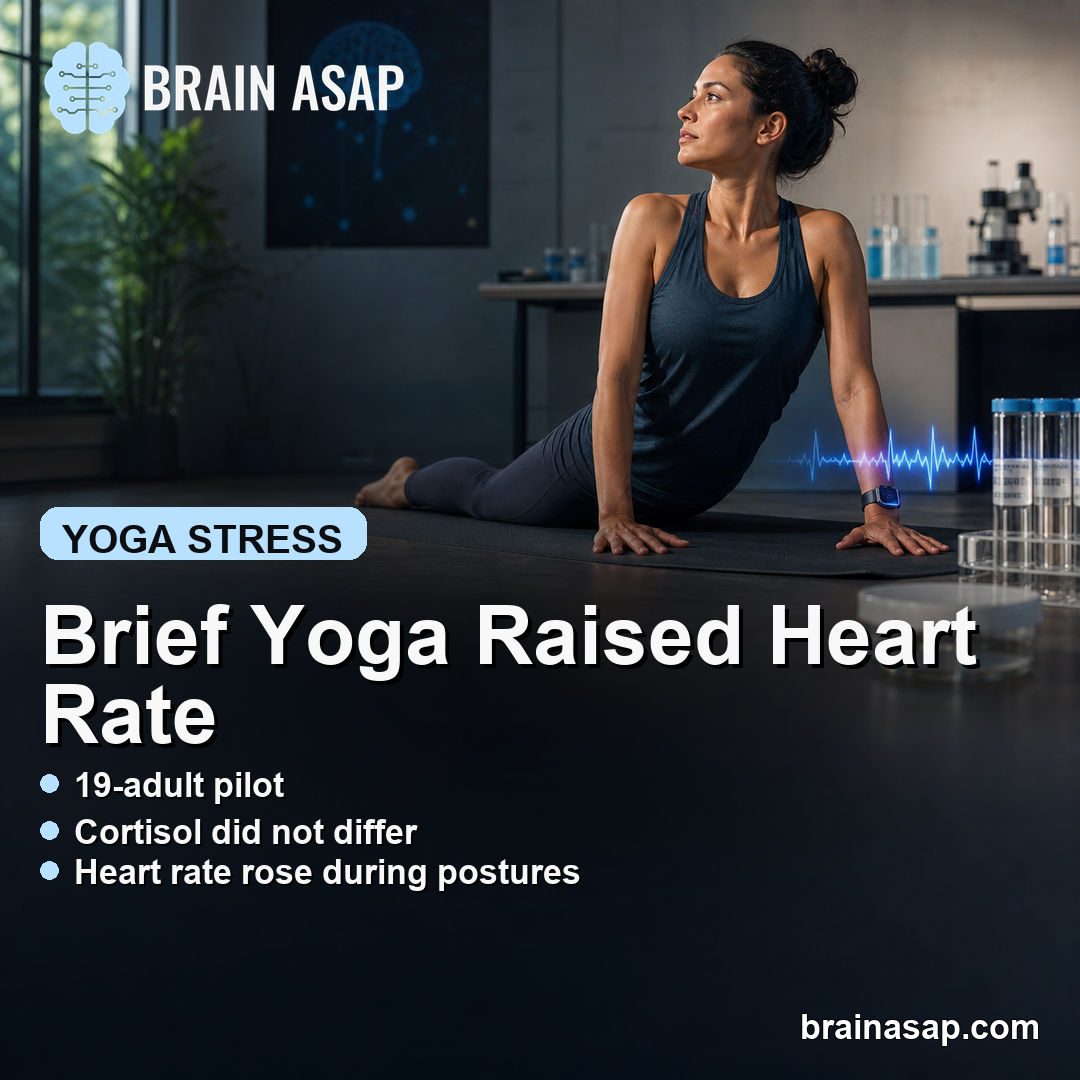
TL;DR: A 2026 randomized pilot study in JMIR Formative Research found that one brief yoga session did not significantly change salivary cortisol compared with quiet sitting, but it did raise heart rate during the active movement phase.
Key Findings
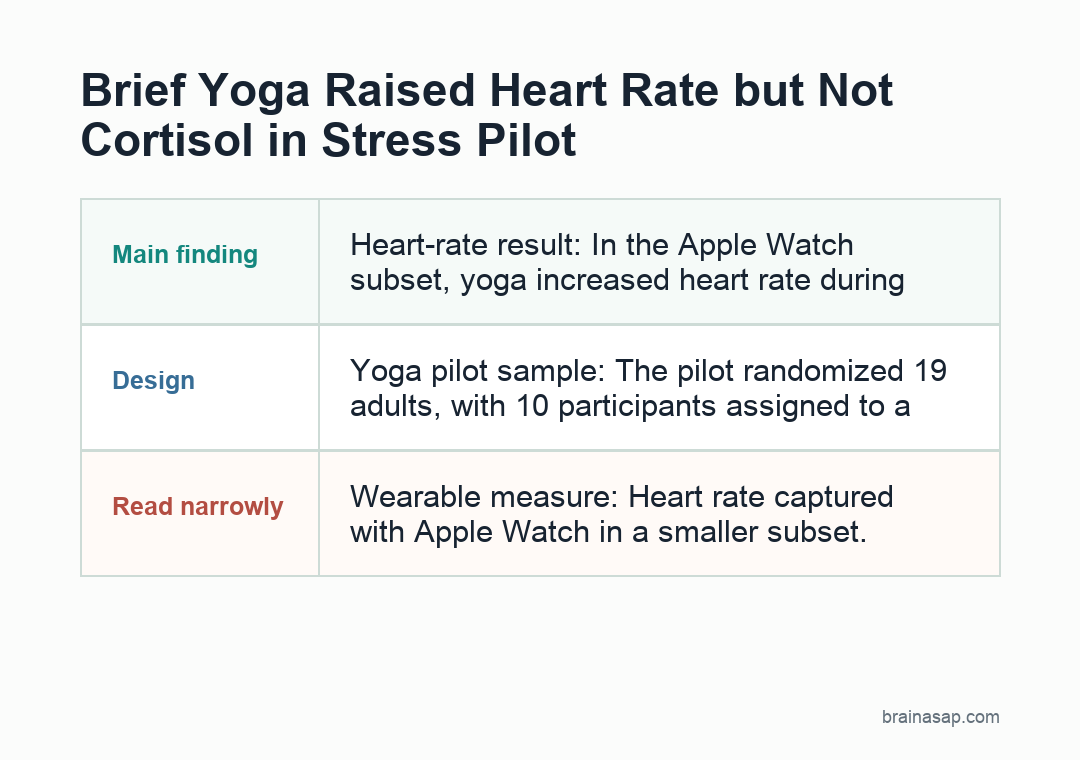
- Yoga pilot sample: The pilot randomized 19 adults, with 10 participants assigned to a 24-minute yoga session and 9 to a quiet sitting waitlist condition.
- Primary stress marker: Cortisol change did not significantly differ between groups, with a mean difference of 0.033 and P=.48.
- Second saliva marker: Alpha-amylase also showed no significant between-group difference, with P=.93.
- Heart-rate result: In the Apple Watch subset, yoga increased heart rate during postures by an adjusted 15.5 beats per minute versus control.
- Exploratory EEG: Emotional-state electroencephalography (EEG) indices were measured in only 8 participants, so those findings need cautious treatment.
Source: JMIR Formative Research (2026) | Zhou et al.
Brief yoga is often described as a quick stress-management tool, but acute stress biology is harder to measure than mood after a wellness class.
This pilot tested whether a single 24-minute guided session changed saliva, wearable heart-rate, and EEG emotional-state markers.
The clearest result was not a cortisol drop.
The session functioned as a short bout of controlled physiological activation, especially while participants moved through the posture portion.
One 24-Minute Yoga Session Was Compared With Quiet Sitting
The randomized exploratory pilot enrolled 19 university-affiliated adults who reported daily stress and no prior guided-yoga experience. Ten were assigned to immediate yoga, while 9 were assigned to a quiet sitting waitlist comparison.
The yoga sequence lasted 24 minutes. It combined about 5 minutes of breathing practice, 15 minutes of postures, and 4 minutes of meditation.
The control group sat quietly for the same period before later receiving the yoga session.
- Primary outcome: Salivary cortisol change from baseline to postintervention.
- Secondary saliva marker: Salivary alpha-amylase, a sympathetic nervous-system related enzyme.
- Wearable measure: Heart rate captured with Apple Watch in a smaller subset.
- EEG measure: Emotional-state indices from a consumer-facing EEG analysis system in an even smaller subset.
Baseline perceived-stress scores were similar between groups. Mean age was lower in the yoga arm, however, and the sample was too small for that imbalance to be ignored.
Cortisol and Alpha-Amylase Did Not Show a Clear Stress Reduction
The primary endpoint was cortisol. The between-group mean difference in cortisol change was 0.033, with a 95% confidence interval from -0.057 to 0.12 and P=.48.
That result does not support a clear acute cortisol-lowering effect from one brief session. It also does not prove yoga has no stress effect, because cortisol timing can miss delayed responses and the trial was very small.
- Cortisol: No statistically significant separation between yoga and quiet sitting.
- Alpha-amylase: Mean difference was 2.9, with a 95% confidence interval from -63 to 69 and P=.93.
- Measurement window: Immediate saliva sampling may not capture slower endocrine changes after a short intervention.
The saliva biomarkers were not the positive finding in this experiment.
Heart Rate Rose During the Active Yoga Posture Phase
The wearable subset pointed in a different direction. Compared with quiet sitting, the yoga group showed an adjusted heart-rate increase of 15.5 beats per minute during the posture phase, with a 95% confidence interval from 10.7 to 20.2 and P<.001.
Heart rate was also higher during the meditation comparison window. The adjusted between-group increase from baseline to meditation was 5.1 beats per minute, with P=.02.
- Movement effect: Postures produced the largest acute physiological shift.
- Not just relaxation: A short yoga session can raise arousal while still being experienced as structured stress practice.
- Subset boundary: Heart-rate data came from 12 participants, not the full randomized sample.
Many yoga studies mix breathing, movement, and meditation into one label. In this pilot, the active movement component appears central to the measurable physiological response.
EEG Emotional-State Signals Were Too Small for Strong Claims
The EEG emotional-state analysis was exploratory and very small. Only 8 participants contributed between-group EEG data, and the group comparisons did not show significant differences for stress, concentration, or calmness indices.
Within the combined yoga exposure data, concentration increased from baseline to meditation by 10.8 points, with P=.02. Some individual participants also showed lower stress or higher concentration patterns, but the variability was large.
- Useful hypothesis: EEG may help study immediate cognitive-emotional shifts during yoga.
- Not definitive: An 8-person analysis cannot establish a reliable stress-reduction effect.
- Validation issue: The emotional-index system has limits for absolute clinical interpretation.
The EEG findings are best treated as feasibility data. They show what might be measured in a larger trial, not what clinicians should conclude from a single session.
The Pilot Points to Better Acute Yoga Trial Design
Acute yoga physiology needs tighter trial designs. A short session may combine relaxation, attention, expectation, and physical activation, and those pieces may move different biomarkers in different directions.
Future studies would be stronger with larger randomized samples, prespecified heart-rate and mood endpoints, delayed saliva sampling, validated EEG scoring, and separate tests of breathing, postures, and meditation.
- Sample size: The trial had 19 total participants, with smaller wearable and EEG subsets.
- Control condition: Quiet sitting does not fully match expectation, instructor contact, or movement.
- Outcome timing: Cortisol may need multiple post-session samples to catch delayed change.
- Registration: No prospective trial registration was listed because this was a pilot study.
For now, this study supports a narrower conclusion: one brief yoga session produced a measurable heart-rate response, while immediate cortisol and alpha-amylase changes did not separate from quiet sitting.
Citation: DOI: 10.2196/87077. Zhou et al. Acute physiological and emotional responses to a brief 24-minute yoga session: randomized exploratory pilot study with waitlist comparison. JMIR Formative Research. 2026;10:e87077.
Study Design: Randomized exploratory pilot study with immediate yoga versus quiet sitting/waitlist comparison.
Sample Size: 19 adults in the randomized sample, with smaller wearable heart-rate and EEG subsets.
Key Statistic: Cortisol change did not significantly differ between groups, while heart rate rose by an adjusted 15.5 beats per minute during yoga postures.
Caveat: The study was small, exploratory, partly subset-based, and not designed to prove a durable stress-reduction effect.