TL;DR: A 2026 study in Psychopharmacology found that after 14 days of unpredictable chronic stress, a single 1-hour ayahuasca exposure restored sociability, reduced anxiety-like behavior, normalized cortisol, and rescued whole-brain BDNF in adult zebrafish wit…
Read article ↗
TL;DR: A 2026 MRI study in Brain Imaging and Behavior of 136 healthy young adults found no robust whole-brain gray matter, white matter, cortical thickness, or brain-age differences between early and late chronotypes. Key Findings 136 young adults: The study c…
Read article ↗
TL;DR: A 2026 preprint UK Biobank neuroimaging study in medRxiv found that the comorbidity group showed widespread lower cortical volume, subcortical differences, and white matter microstructure alterations, while several alterations appeared unique to the chr…
Read article ↗
TL;DR: A 2026 preprint birth-cohort study in medRxiv found that 91.1% of children had experienced violence by age 8, while age-8 violence exposure was associated with higher internalizing, externalizing, total problem scores, and disorder odds. Key Findings Ev…
Read article ↗
TL;DR: A 2026 BMC Medicine study of UK Biobank adults linked adversity in both childhood and adulthood to higher frailty, older metabolomic age profiles, lower grip strength, and some telomere differences, with the clearest associations in people reporting mul…
Read article ↗
TL;DR: A 2026 cohort study in BJPsych Open found that childhood attention-deficit/hyperactivity disorder (ADHD) and autism spectrum disorder (ASD) difficulties predicted poorer young-adult outcomes, but rare copy number variants (CNVs), which are deleted or du…
Read article ↗
TL;DR: A 2026 review in Reviews in the Neurosciences argues that chemotherapy-induced peripheral neurotoxicity (CIPN), nerve injury from cancer treatment, can involve central nervous system changes that help explain chronic neuropathic pain and chemotherapy-re…
Read article ↗
TL;DR: A 2026 methods paper in Nature Neuroscience introduced Cheese3D, a six-camera system that tracked whole-mouse-face movement in 3D at sub-millimeter precision and used facial dynamics to infer anesthesia depth and neural-state-linked expression. Key Find…
Read article ↗
TL;DR: A 2026 systematic review in European Archives of Psychiatry and Clinical Neuroscience argues that catatonia, a syndrome of freezing, mutism, and abnormal movement, may involve underweighted limbic-system circuitry linking emotional regulation with motor…
Read article ↗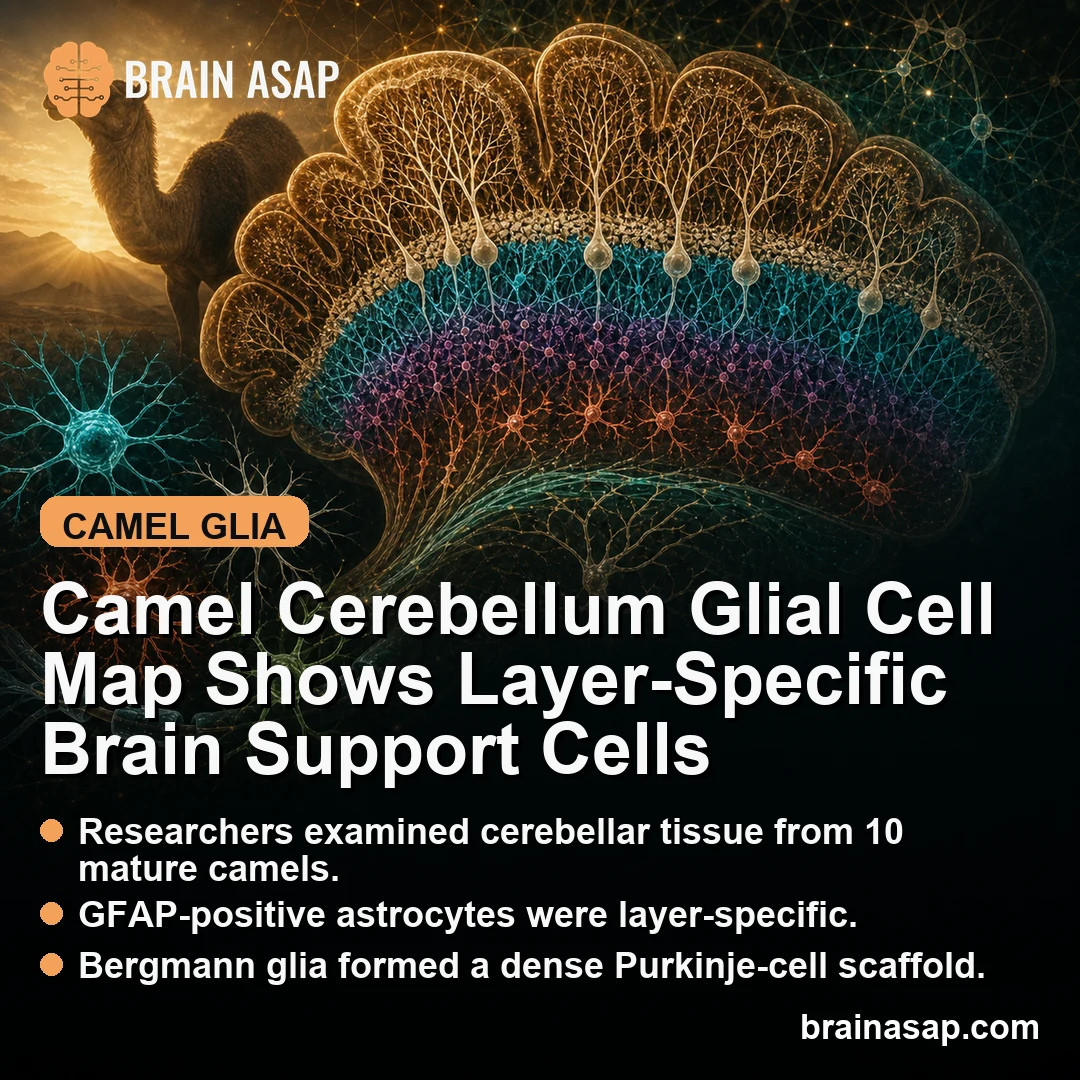
TL;DR: A 2026 Scientific Reports study mapped astrocytes, oligodendrocytes, Bergmann glia, and microglia in the camel cerebellum, showing that glial support cells are distributed very differently across cerebellar layers. Key Findings 10 mature camels: Researc…
Read article ↗