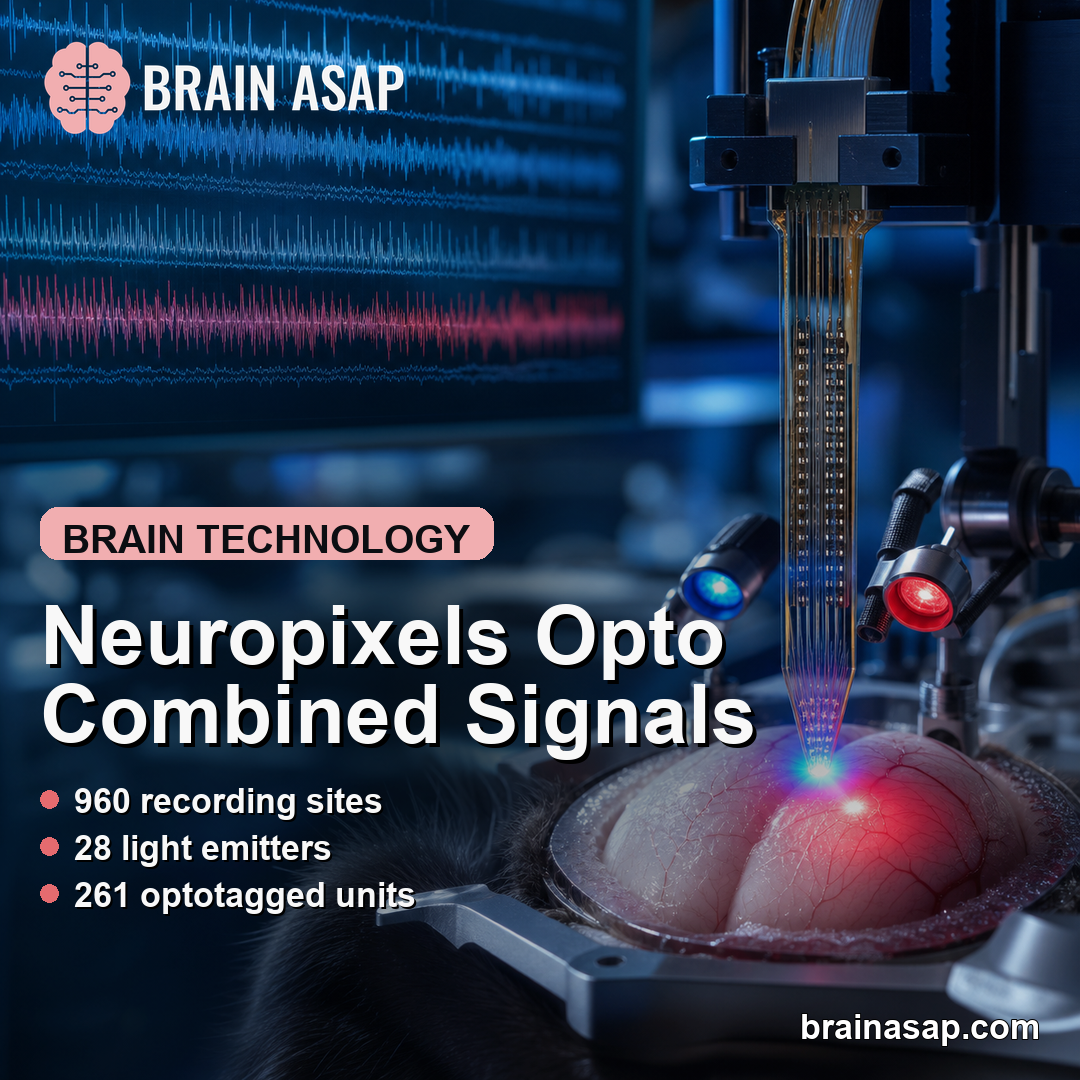
TL;DR: A 2026 methods paper in Nature Methods describes Neuropixels Opto probes that combine high-density neural recording with spatially addressable blue and red optogenetic stimulation in 1 mouse-brain device.
Key Findings
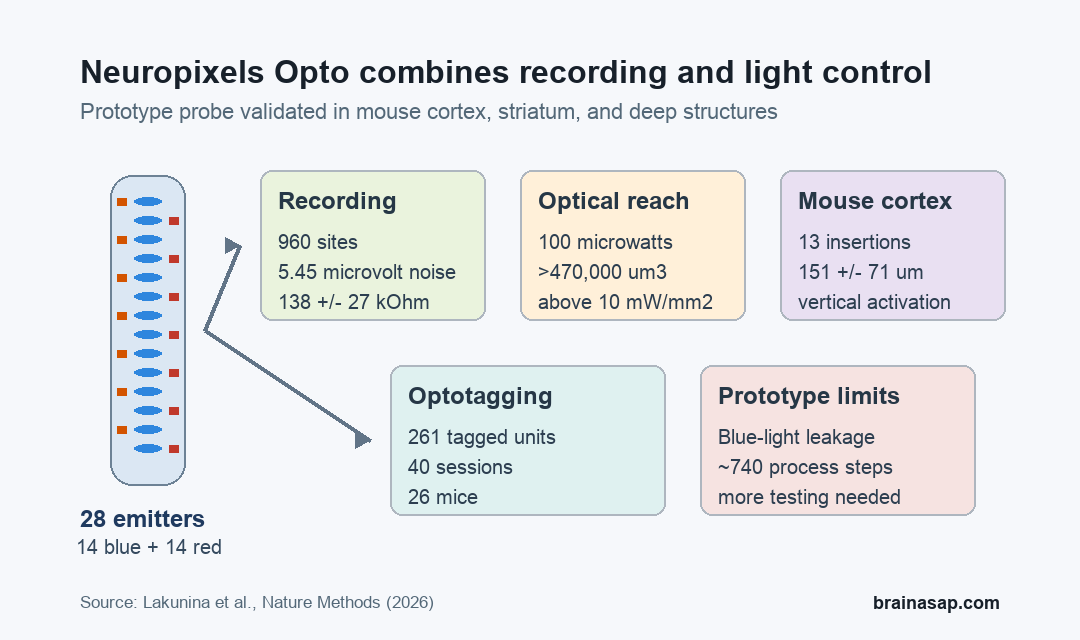
- 960 recording sites: Each prototype probe packed 960 electrical sites on a 70-micrometer-wide, 1-centimeter-long shank.
- 28 light emitters: Two sets of 14 emitters delivered spatially addressable 450-nm blue and 638-nm red light across about 1.5 millimeters near the probe tip.
- 21-probe bench test: Average electrode impedance was 138 +/- 27 kilohms, with action-potential-band noise near 5.45 microvolts.
- 13 cortical insertions: In mouse visual cortex, single-emitter red-light stimulation activated local neuronal populations with about 151 +/- 71 micrometers vertical spread.
- 261 tagged units: Across 40 sessions in 26 mice, the probes optotagged 261 units using multiple blue- and red-sensitive opsins.
Source: Nature Methods (2026) | Lakunina et al.
Neuropixels Opto is a prototype neural probe built to solve a practical neuroscience problem: researchers often want to record from many neurons and control genetically defined cells with light at the same time.
Standard Neuropixels probes are strong recording tools, but optogenetic stimulation usually requires a separate light-delivery device. This prototype integrated photonic light routing into the probe itself, aiming to reduce that mismatch.
Neuropixels Opto Combined 960 Recording Sites With 28 Emitters
The probe keeps the high-density electrical recording architecture of Neuropixels while adding on-chip photonic waveguides. Each shank is 10 millimeters long, 70 micrometers wide, and 33 micrometers thick.
The recording array includes 960 titanium-nitride sites, arranged in two vertical columns with 20-micrometer vertical spacing. Signals are split into action-potential and local-field-potential bands, matching the logic of earlier Neuropixels systems.
- Blue light: A 450-nm laser targets Channelrhodopsin-2 and related blue-sensitive opsins.
- Red light: A 638-nm laser targets red-sensitive opsins such as Chrimson and ChRmine.
- Emitter layout: Fourteen emitters per color are spaced 100 micrometers apart near the probe tip.
- Optical routing: Programmable photonic switching trees route each color to selected emitters.
The current prototype can turn on 1 emitter per color at a time. The paper notes that more complex combinations should be possible in principle with future designs.
Bench Testing Preserved Low-Noise Electrophysiology
Adding light delivery to a dense recording probe creates engineering risks. Photonic layers can bend a thin shank, and scattered light can hit CMOS recording circuits, raising noise or creating artifacts.
The team addressed those problems with silicon-nitride compensation layers and a titanium-nitride/aluminum light-blocking layer. In bench tests, electrical performance stayed close to established Neuropixels values.
- Impedance: Across 20,097 sites from 21 probes, average electrode impedance was 138 +/- 27 kilohms.
- Noise: Action-potential-band root-mean-square noise was 5.45 +/- 0.02 microvolts; local-field-potential-band noise was 5.33 +/- 0.03 microvolts.
- Light artifact: Red-light sharp onsets produced a small artifact of about 30 microvolts, far below the millivolt-scale artifact caused by directly illuminating recording sites.
Optical output was also tested. At 100 microwatts, the region above 10 milliwatts per square millimeter exceeded 470,000 cubic micrometers and extended more than 100 micrometers from the shank.
Mouse Cortex Tests Showed Spatially Addressable Activation
The first in vivo validation tested whether the probes could activate local neuronal populations in mouse visual cortex while recording spikes. Researchers expressed the red-sensitive depolarizing opsin ChRmine in CaMK2-positive cortical neurons.
Single-emitter red-light stimulation produced activity near the stimulating emitter, and spike sorting remained usable. The unit yield was similar to comparison Neuropixels 1.0 recordings in the same area using the same quality metrics.
- 13 insertions: Visual-cortex activation experiments included 13 probe insertions in 3 mice.
- Local spread: The activated population extended vertically by 151 +/- 71 micrometers full-width at half-maximum.
- Control checks: Light did not evoke activity in hippocampus without opsin expression, and a no-virus control mouse showed no light effect.
- Circuit test: In a separate inhibitory-neuron experiment, light activated some units and inactivated others, consistent with local synaptic inhibition.
These results matter because optogenetics can be misleading if light broadly activates tissue or creates recording artifacts. The cortical tests suggest the prototype can stimulate local populations while preserving electrophysiology.
Dual-Color Optotagging Identified Striatal Cell Types
Optotagging uses light-driven spiking to identify recorded neurons that express a specific opsin. Neuropixels Opto adds a useful twist: the same shank can deliver blue and red light at multiple depths.
In striatum, researchers used blue-sensitive and red-sensitive opsins to tag different medium spiny neuron populations. In 1 example recording, 25 of 39 recorded units were tagged, allowing parallel comparison of 2 cell types in the same structure.
- D1/D2 example: One experiment expressed CoChR in D1 medium spiny neurons and ChRmine in D2 medium spiny neurons.
- Multiple strategies: Other sessions tagged D2 neurons, cholinergic interneurons, glutamatergic neurons, or GABAergic neurons.
- 40 sessions: Across 40 sessions in 26 mice, the system optotagged 261 units.
- Coverage test: Tagged-unit distributions suggested the 100-micrometer emitter spacing left no vertical gaps in optotagging coverage.
The method is still a prototype. Blue-light routing showed some instability and leakage at higher intensity, so high-power spatially precise experiments relied mainly on red light.
The Probe Is a Neuroscience Tool, Not a Clinical Device
Neuropixels Opto is aimed at systems neuroscience labs, not diagnosis or treatment. Its value is technical: it can record, identify, and manipulate neuronal populations with fewer inserted devices than a separate electrode-plus-fiber setup.
The paper also makes clear that manufacturing remains difficult. The prototype required about 740 processing steps, almost twice the roughly 400 steps needed for Neuropixels 1.0 and 2.0 probes.
Future versions are expected to improve blue-light robustness, add photodetectors for emitter-power monitoring, simplify laser coupling, reduce probe form factor, and increase the number of emitters. The current prototype puts high-density recording and spatially targeted optogenetics onto the same neural probe.
Citation: DOI: 10.1038/s41592-026-03076-z. Lakunina et al. Neuropixels Opto: combining high-resolution electrophysiology and optogenetics. Nature Methods. 2026.
Study Design: Neural-probe engineering and validation study with bench characterization plus mouse cortex, striatum, and deep-structure experiments.
Sample/Model: Bench characterization of 21 probes; cortical activation experiments across 13 insertions in 3 mice; optotagging across 40 sessions in 26 mice.
Key Statistic: The prototype combined 960 recording sites with 28 light emitters and optotagged 261 units across the mouse validation experiments.
Caveat: The work describes prototype research hardware; blue-light robustness, emitter monitoring, coupling, and mass production still need further development.