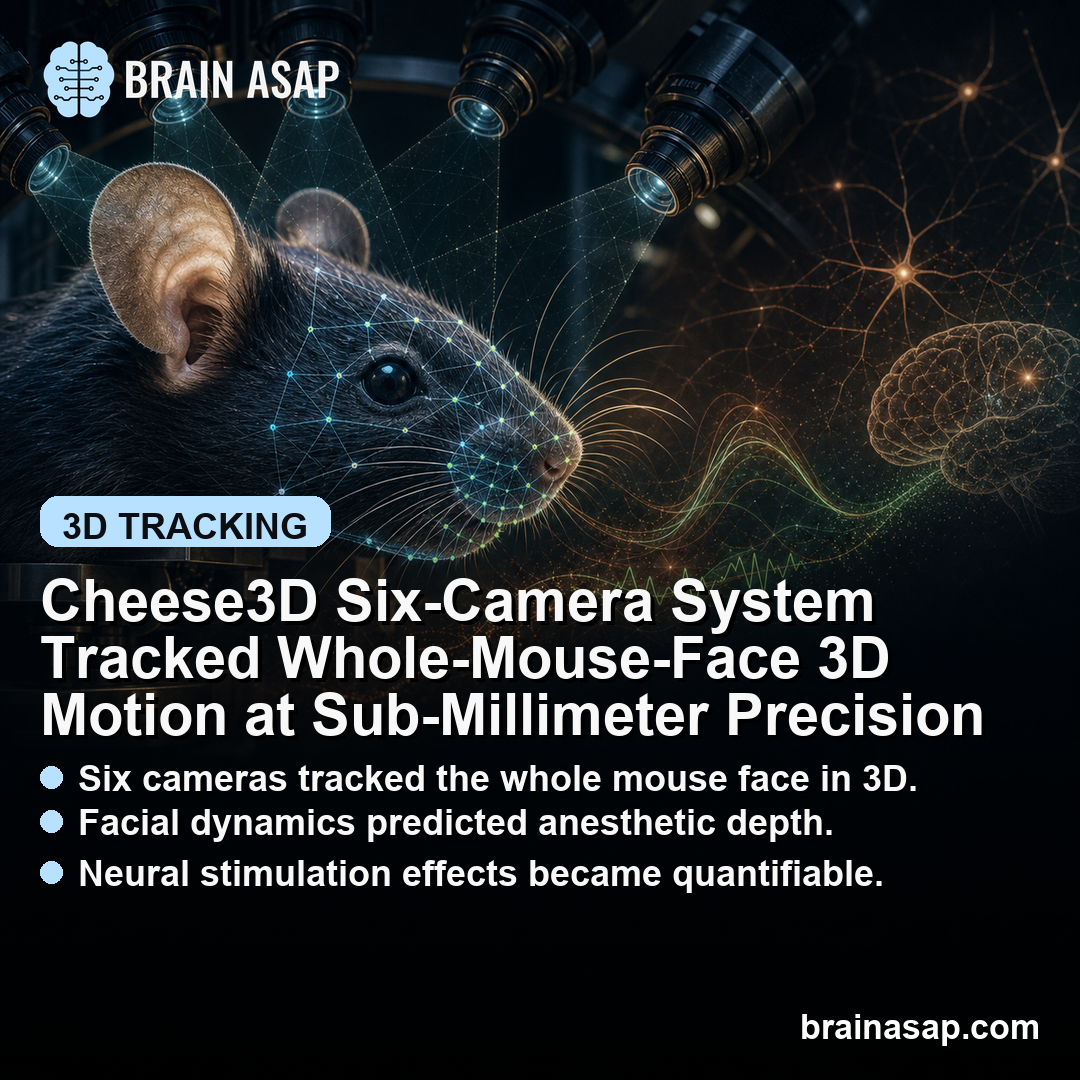
TL;DR: A 2026 methods paper in Nature Neuroscience introduced Cheese3D, a six-camera system that tracked whole-mouse-face movement in 3D at sub-millimeter precision and used facial dynamics to infer anesthesia depth and neural-state-linked expression.
Key Findings
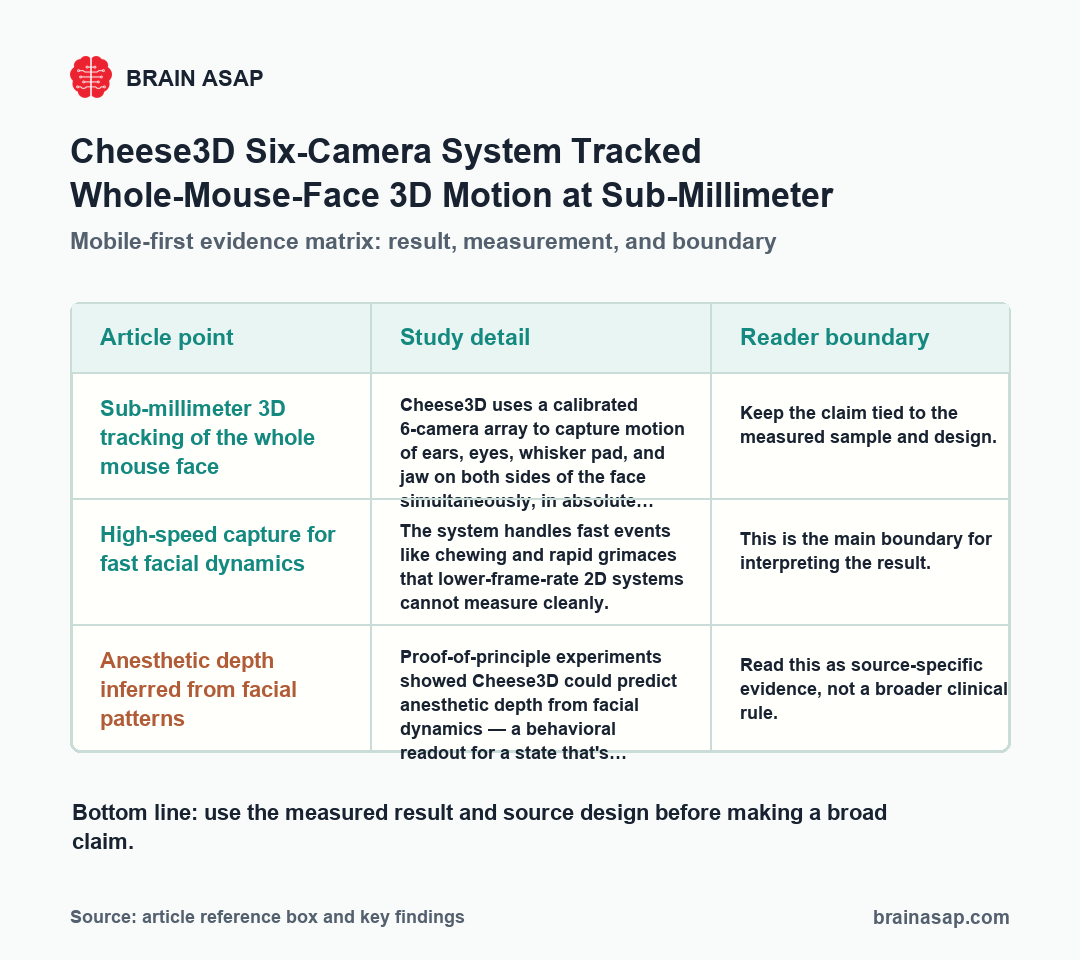
- Sub-millimeter 3D tracking of the whole mouse face: Cheese3D uses a calibrated 6-camera array to capture motion of ears, eyes, whisker pad, and jaw on both sides of the face simultaneously, in absolute world units.
- High-speed capture for fast facial dynamics: The system handles fast events like chewing and rapid grimaces that lower-frame-rate 2D systems cannot measure cleanly.
- Anesthetic depth inferred from facial patterns: Proof-of-principle experiments showed Cheese3D could predict anesthetic depth from facial dynamics — a behavioral readout for a state that’s normally measured electrophysiologically.
- Tooth and muscle anatomy inferred from ingestion movement: Fast face-wide motion during eating let the system infer underlying anatomical structure from movement alone.
- Brainstem stimulation produced minute, measurable facial differences: Subtle motor effects of targeted neural stimulation became quantifiable rather than qualitative.
- 3D-only features include ear-rotation angles: Some expressive features are only visible in 3D — angles of ear motion that 2D systems miss entirely.
Source: Nature Neuroscience (2026) | Daruwalla et al.
Mouse facial expressions are one of neuroscience’s most underused signals. Mice grimace, twitch their whiskers, move their ears, and shift their jaws in ways that track pain, anesthesia, fear, eating, and a long list of internal states.
The trouble is that mouse faces are tiny, three-dimensionally complex, and hard to track with the kind of precision that turns subtle expression change into a quantitative neural readout. Researchers built a system for that tracking problem.
Why Mouse Faces Are Harder to Track Than Human Faces
Human facial tracking is a solved problem — flat, large surface, well-spaced features, lots of training data. Mouse faces have none of those advantages:
- Small and conical: Most facial features sit on a curved surface rather than a flat plane, distorting 2D projections.
- Bilaterally distributed expression: Both sides of the face move, often differently — single-camera setups miss the asymmetry.
- Fast dynamics: Whisker movements, chewing, blinks happen on millisecond timescales that require high frame rates.
- Subtle morphology: Many states produce expression changes that are barely visible without millimeter-scale precision.
Existing tools for mouse facial tracking handle pieces of the problem but rarely deliver the combination — whole-face coverage, both sides, sub-millimeter precision, high frame rate, 3D geometry — needed to use facial expression as a serious neural readout.
Six-Camera Geometry Enabled Whole-Face 3D Tracking
Cheese3D’s hardware is the structural innovation.
Six calibrated cameras surround the mouse, capturing simultaneous views from multiple angles.
The geometry is computed once during calibration and then used to triangulate facial features into 3D world coordinates in real time:
- Anatomically meaningful landmarks: Software locates points on ears, eyes, whisker pad, and jaw on both sides.
- Triangulation from multiple views: Sub-millimeter 3D position of each landmark from the calibrated camera geometry.
- Absolute world units: Distances in millimeters, not relative pixel space — making cross-experiment comparison possible.
- Interpretable feature extraction: The framework produces measurements that map onto known anatomy rather than abstract latent variables.
Anesthetic Depth Prediction From Facial Dynamics Tested the System
The team’s first proof-of-principle was anesthetic depth prediction from facial movement alone. The method is useful because:
- Anesthetic depth is normally measured electrophysiologically — electroencephalography (EEG) signatures, response to noxious stimuli, autonomic changes.
- Facial behavior can substitute for invasive measurement if it carries enough information.
- Cheese3D extracted that information at sufficient precision to predict anesthetic state from face dynamics alone.
That’s a behavioral-to-physiological inference that’s hard to do without extremely precise facial tracking.
It also points toward applications where chronic neural measurement is not feasible: using whole-face 3D tracking as a non-invasive proxy for internal state.
How Eating Reveals Underlying Anatomy
Chewing produces fast, stereotyped face-wide movements.
Those movements depend on tooth geometry, jaw structure, and muscle architecture.
With sub-millimeter tracking of jaw and whisker-pad dynamics, Cheese3D can infer aspects of underlying anatomy from movement signatures alone — without dissection or imaging of the actual structures.
The biological point is straightforward. Behavioral signatures encode hidden structural information when the tracking is precise enough to read it out.
The same principle plausibly applies to disease models where anatomical changes precede or accompany behavioral changes. Cheese3D-style tracking could catch the structural signal earlier than standard imaging.
What Brainstem Stimulation and Spontaneous Expression Add
Two additional proof-of-principle experiments demonstrated breadth:
- Brainstem stimulation produced minute facial movement differences: Effects too subtle for visual scoring became quantifiable. The system can serve as a fine-grained readout for circuit-level neural manipulations.
- Neural activity correlated with spontaneous facial movements: Including expressive features only measurable in 3D, like ear-rotation angles. Some neural-behavioral correlations exist that 2D tracking literally cannot detect.
The combination — neural recording plus precision facial tracking — opens questions like: which brain regions control specific expressive features? How do facial expressions evolve during learning, anesthesia recovery, or disease progression?
What This Means for Mouse Neuroscience and Beyond
Cheese3D is a tool, not a result, but it’s the kind of tool that enables a new class of experiments:
- Fine-grained neural-behavioral correlation: Linking brain activity to facial expression at sub-millimeter resolution.
- Pain and discomfort assessment: Quantitative grimace scoring at much higher precision than current rodent pain scales.
- Disease model phenotyping: Detecting subtle facial signs of neurological or muscular disease earlier in disease progression.
- Drug effect monitoring: Pharmacological effects on motor systems become measurable as facial signatures.
- Anesthesia and analgesia research: Non-invasive depth and recovery monitoring from facial dynamics.
What this method establishes:
The honest framing is methodological.
Cheese3D demonstrates feasibility — sub-millimeter 3D tracking of the whole mouse face with neural-correlation and state-inference applications.
The proof-of-principle experiments are convincing demonstrations, not full validations.
Whether facial tracking will displace electrophysiology for any specific application depends on follow-up work that compares the two head-to-head in real experimental contexts.
What it establishes: mouse facial expression is now a quantitative experimental variable rather than a qualitative observation. The hardware is replicable, the framework is interpretable, and the demonstrations span the range from anatomy to anesthesia to circuit stimulation.
That’s a discovery tool whose value will grow as labs integrate it into existing experimental setups.
Citation: DOI: 10.1038/s41593-026-02262-8. Daruwalla et al. Cheese3D enables sensitive detection and analysis of whole-face movement in mice. Nature Neuroscience. 2026.
Study Design: Computer vision and computational framework using a calibrated 6-camera array for high-speed 3D capture of whole-face movement in mice; proof-of-principle experiments testing anesthesia inference, anatomy reconstruction from ingestion movement, brainstem stimulation effects, and neural-spontaneous-movement correlation.
Sample/Model: Head-fixed mice across multiple proof-of-principle experimental contexts.
Key Statistic: Sub-millimeter 3D tracking of ears, eyes, whisker pad, and jaw on both sides of the face; anesthetic depth predicted from facial dynamics; tooth and muscle anatomy inferred from ingestion movement; brainstem stimulation effects quantified at fine resolution; some neural-behavioral correlations only detectable in 3D (for example, ear-rotation angles).
Caveat: Methodological framework with proof-of-principle demonstrations; head-to-head comparison against established neural recording for specific applications is the next research step.