Loneliness Lowered Memory Without Speeding Decline
TL;DR: In 10,217 older Europeans, loneliness was linked to lower immediate and delayed recall at baseline, but it did not make memory decline faster over 6 years.
Key Findings
- 10,217 SHARE participants: The analysis included adults aged 65 to 94 from 12 European countries who participated in waves 5, 6, and 8.
- Six-year memory follow-up: Researchers modeled immediate and delayed recall trajectories using multilevel growth models.
- High loneliness started lower: Participants with high loneliness had lower immediate recall (-0.24) and delayed recall (-0.21) scores at baseline.
- Decline slope did not accelerate: Loneliness did not significantly influence the rate of memory decline over follow-up.
- Assessment value remains: The authors suggest loneliness checks could still belong in cognitive health assessments because baseline performance differed.
Source: Aging & Mental Health (2026) | Venegas-Sanabria et al.
Loneliness is usually framed as a dementia risk factor, and often for good reason. But this SHARE analysis separated baseline memory from later decline. Lonely adults began the study with worse memory scores, yet their memory trajectories did not fall more steeply than everyone else’s.
The Surprise Was in the Slope
If loneliness directly sped up memory aging, the high-loneliness group should fall faster over time. That was not what the study found.
Instead, lonely participants started lower on immediate and delayed recall, while the rate of change over 6 years looked similar. The difference was in the intercept more than the slope.
That distinction changes the interpretation. Loneliness looked more like a marker of lower memory status at study entry than a force that kept accelerating memory loss across the next 6 years.
- Immediate recall: participants repeated words right after hearing them, testing short-term learning and attention.
- Delayed recall: participants recalled words later, testing retention after a short interval.
- Growth model: the analysis separated the starting score from the rate of later change.
- Main pattern: loneliness was linked to lower starting scores, not a steeper six-year decline.
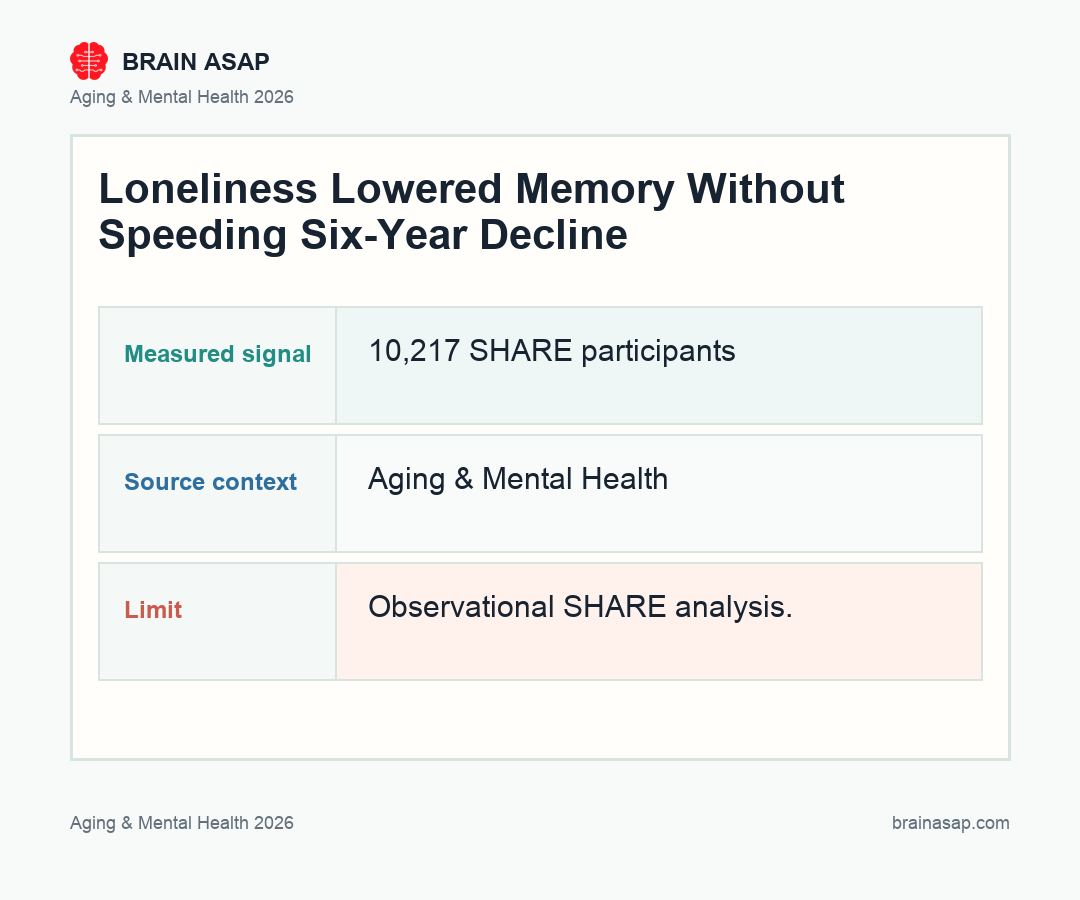
Lower Baseline Recall Still Matters
The absence of faster decline should not be misread as loneliness being harmless. Starting lower on memory tests can affect daily function, clinical concern, and resilience if other risks accumulate.
The immediate recall difference was -0.24 and delayed recall was -0.21 for high loneliness compared with low or average loneliness. Those are modest effects, but in a population sample of more than ten thousand older adults, modest shifts can matter.
Lower baseline recall can also change the clinical threshold problem. A person who begins closer to impairment has less reserve before medication side effects, sleep disruption, depression, sensory loss, or vascular disease pushes cognition into a range that affects daily life.
The result therefore still supports attention to loneliness in cognitive care. It simply argues against treating loneliness as a confirmed driver of faster memory decline in this dataset.
Loneliness May Be a Marker and a Mechanism
Loneliness can affect sleep, depression, stress physiology, inflammation, activity, and social stimulation. It can also reflect underlying health problems that make social connection harder.
That is why this study’s narrower result is useful. It suggests loneliness can identify older adults who already show lower memory performance, even if it did not independently steepen decline in this model.
Both directions can be true at once. Poor hearing, mobility limits, grief, depression, pain, and early cognitive change can increase loneliness; loneliness can then reduce activity, sleep quality, and stimulation in ways that further strain cognition.
The study did not resolve that loop, but it helped locate where the signal appeared most clearly. In this model, the strongest association sat at baseline memory level rather than in the subsequent slope.
SHARE Gives Breadth, Not Perfect Causality
The sample was large and multinational, but the design was observational. Loneliness was measured at baseline, and memory was modeled across three waves. Cultural context, health status, depression, sensory loss, sleep, inflammation, and social isolation can all complicate interpretation.
Still, the pattern argues against a simplistic headline. Loneliness was not a visible accelerator of memory loss here. It was more like a flag planted at a lower starting point.
The multinational design is useful because loneliness and aging are shaped by housing, family structure, retirement, widowhood, health care, and social norms. A 12-country sample gives the model more breadth than a single clinic or neighborhood study.
The tradeoff is measurement. A large survey can follow many people, but it cannot capture every social relationship, every medical change, or every reason someone feels lonely at a particular point in late life.
Screening Should Ask More Than Dementia Risk
The practical takeaway is compassionate and specific. Asking older adults about loneliness is not just a mood question and not just a dementia-prevention slogan.
It can help identify people with lower memory performance who may benefit from broader support: hearing care, depression treatment, sleep care, social programs, cognitive evaluation, or practical help staying connected.
That support should not be framed as telling people to socialize harder. Meaningful connection often depends on transportation, hearing aids, accessible public spaces, caregiver support, grief care, disability accommodation, and safe community programs.
The study also suggests a better research question for interventions. Instead of asking only whether loneliness programs slow memory decline, trials should ask whether they improve baseline function, mood, sleep, activity, and cognitive engagement in people already showing lower recall.
Those trials should also separate loneliness from social isolation. A person can have many contacts and still feel lonely, or have a small network that feels emotionally sufficient. The biology and intervention targets may differ.
For cognitive aging, the distinction changes the likely mechanism. Social isolation may reduce stimulation and practical support, while loneliness may amplify stress, sleep disturbance, depression risk, and threat vigilance.
The SHARE result therefore narrows the public message. Loneliness deserves clinical attention, but this dataset does not support a simple claim that loneliness steadily accelerates memory decline once baseline memory is taken into account.
The finding also gives clinicians a kinder way to interpret a low memory score. It can prompt questions about social pain, hearing, sleep, depression, and daily support instead of treating memory performance as an isolated cognitive number.
A stronger follow-up would measure loneliness repeatedly. If loneliness rises or falls over time, researchers could test whether memory changes follow those shifts rather than relying on one baseline report.
Repeated loneliness measures would also help distinguish temporary distress from chronic loneliness. A short period after bereavement, illness, or relocation may carry different cognitive implications than years of persistent social pain.
The study’s strongest contribution is therefore not a sweeping loneliness theory. It gives clinicians and researchers a more exact pattern to test: lower memory at entry, similar decline afterward, and a need to measure the social and biological pathways that could explain that starting gap.
Before any dementia diagnosis is on the table, the pattern supports earlier, broader care for older adults whose memory scores and social experience are already signaling vulnerability.
A practical assessment could combine recall testing with questions about hearing, bereavement, sleep, depression, mobility, transportation, and whether the person has regular contact that feels emotionally safe.
That clinical conversation should happen before impairment becomes obvious.
Paper: Memory trajectories in lonely individuals in Europe: an analysis of the Survey of Health, Aging, and Retirement in Europe (SHARE). Aging & Mental Health. 2026. DOI: 10.1080/13607863.2026.2624569
Authors: Venegas-Sanabria et al.
Study Design: Longitudinal observational analysis of SHARE waves 5, 6, and 8 using multilevel growth modeling.
Sample Size: 10,217 adults aged 65 to 94 from 12 European countries.
Key Statistic: High loneliness was associated with lower immediate recall (-0.24) and delayed recall (-0.21) at baseline, but not with a faster memory-decline slope.