TL;DR: A 2026 methylome-wide study in Clinical Epigenetics found that genetically inferred CYP2C19 metaboliser status, a pharmacogenomic marker relevant to antidepressant handling, was associated with DNA methylation patterns in a large Scottish cohort.
Key Findings
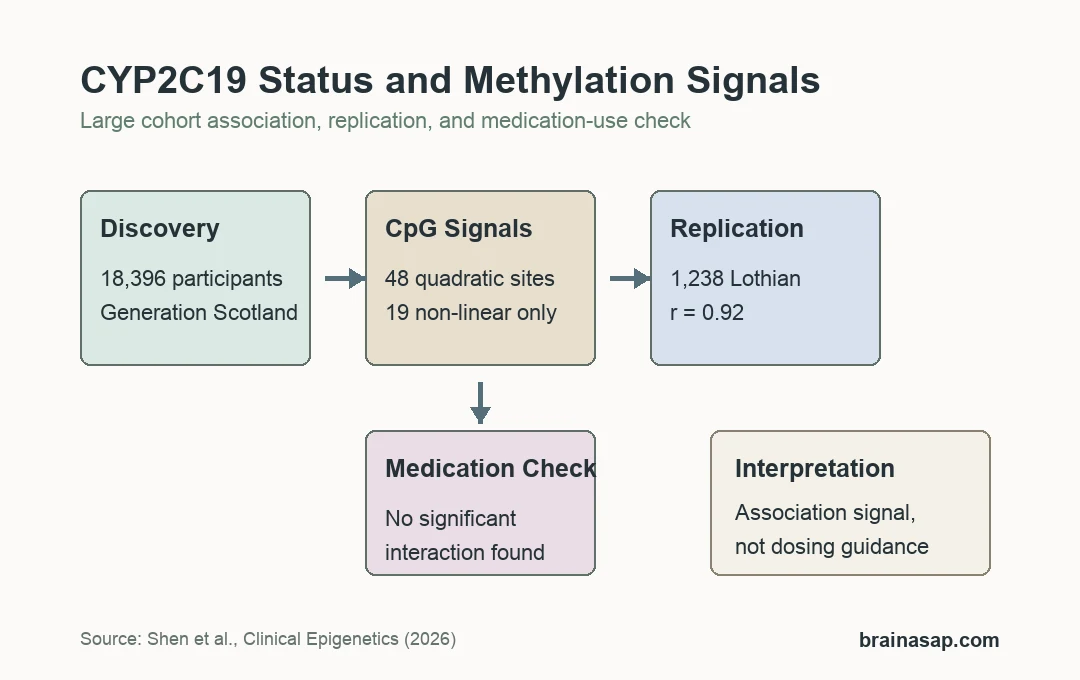
- 18,396-person discovery cohort: Generation Scotland supplied the main genetic and DNA methylation analysis for CYP2C19 metaboliser status.
- 48 quadratic CpG sites: Forty-eight CpG sites met the Bonferroni threshold for non-linear CYP2C19 metaboliser associations.
- 19 non-linear-only CpG sites: Nineteen CpG sites were associated with the quadratic term but not the linear term, suggesting U-shaped or inverted U-shaped patterns.
- 1,238-person replication cohort: Lothian Birth Cohorts replication showed high agreement in standardized effect sizes, with r = 0.92 for quadratic CpG effects.
- No medication interaction: CYP2C19-related medication use did not significantly interact with metaboliser status for the non-linear methylation sites.
Source: Clinical Epigenetics (2026) | Shen et al.
CYP2C19 Pharmacogenomics Was Tested Beyond Drug Levels
CYP2C19 is a drug-metabolizing enzyme involved in the handling of several medicines, including some antidepressants, proton pump inhibitors, and antiplatelet drugs. Genetic variants can classify people as poor, intermediate, normal, rapid, or ultrarapid metabolisers.
That classification is already clinically relevant because drug clearance can affect response and side effects. The question in this study was different: whether the inherited metaboliser category also tracked broader DNA methylation, an epigenetic mark that can influence or reflect gene regulation.
The paper is not a treatment trial and does not test whether changing antidepressant doses improves outcomes. It asks whether the biology around a drug-metabolism gene leaves a detectable methylation pattern in population data.
- Gene focus: CYP2C19, located on chromosome 10 and involved in metabolism of clinically used drugs.
- Status levels: poor, intermediate, normal, rapid, and ultrarapid metaboliser categories inferred from genetic variants.
- Epigenetic readout: cytosine-guanine dinucleotide (CpG) methylation sites measured across the methylome.
Generation Scotland Provided the 18,396-Person Discovery Sample
The discovery methylome-wide association study used 18,396 Generation Scotland participants. Blood samples supplied both genotype data for CYP2C19 metaboliser status and DNA methylation data for the methylome-wide analysis.
Researchers modeled metaboliser status in two ways. A linear model looked for a steady shift from poor through ultrarapid status, while a quadratic model looked for non-linear patterns where poor and ultrarapid groups could differ from normal metabolisers in a similar or opposite way.
That modeling choice fits pharmacogenomics. Some clinical drug-response patterns are not simple straight lines, because both slow and very fast metabolism can create problems for the same medication.
- Linear pattern: methylation changes steadily across the metaboliser scale.
- U-shaped pattern: poor and ultrarapid metabolisers differ from normal metabolisers in a related direction.
- Inverted pattern: normal metabolisers show a higher or lower methylation level than both ends of the metaboliser range.
Forty-Eight CpG Sites Met the Non-Linear Threshold
The main quadratic analysis found 48 CpG sites significantly associated with CYP2C19 metaboliser status at the Bonferroni threshold of P < 6.64 x 10⁻⁸. Of those, 19 CpG sites were linked to the quadratic term but not to the linear term.
Several of these non-linear CpG sites were annotated to genes near CYP2C19 on chromosome 10, including TBC1D12, PDLIM1, ACSM6, and CYP2C18. The study also found 48 CpG sites associated with the linear term, with overlap between the two models.
Pathway enrichment pointed toward metabolic activity and the Cytochrome P450 pathway. That is consistent with the central gene’s known role, but it also suggests the methylation pattern was not limited to a single local CpG site.
- Quadratic result: 48 CpG sites passed the non-linear association threshold.
- Non-linear-only subset: 19 CpG sites were not also significant in the linear model.
- Linear result: 48 CpG sites also met significance for the linear metaboliser-status term.
- Pathway context: enrichment included metabolic activity and Cytochrome P450 biology.
Lothian Birth Cohorts Replicated the Direction of Effect
The targeted replication analysis used 1,238 participants from the Lothian Birth Cohorts of 1921 and 1936. Replication did not simply repeat the discovery design at the same size, but it gave an important check on whether the effect directions were stable.
For significant CpG sites covered in the replication analysis, standardized regression coefficients were strongly correlated with the discovery results.
- Quadratic effects: discovery and replication coefficients correlated at r = 0.92.
- Linear effects: the same cross-cohort comparison correlated at r = 0.89.
- Nominal replication: seven CpG sites from the quadratic analysis were nominally significant in the Lothian Birth Cohorts.
The stronger message is the high cross-cohort agreement in effect direction, not that every site independently cleared a large-study threshold in the smaller replication sample.
CYP2C19-Related Medication Use Did Not Explain the Signal
The analysis also tested whether current use of CYP2C19-related medicines changed the methylation relationship. Participants were grouped as non-users or users of drugs for which CYP2C19 acts as an inducer, inhibitor, or substrate.
No significant interaction was detected between CYP2C19-related medication use and metaboliser status for the non-linear CpG sites. In plain terms, the methylation associations were not only visible in people currently taking medicines handled by CYP2C19.
Medication history still needs better measurement. Future work needs richer prescribing data, including dose, side effects, switching, and longer exposure history.
- Current-use limit: medication use was based on available records rather than detailed lifetime exposure.
- Blood-tissue limit: methylation was measured in blood, not liver or brain tissue where CYP2C19 biology may differ.
- Clinical-outcome limit: the study did not test antidepressant response, symptom change, or dosing decisions directly.
CYP2C19 metaboliser status may be connected to broader epigenetic and metabolic biology, but this population association is not a stand-alone clinical test for psychiatric medication choice.
Citation: DOI: 10.1186/s13148-026-02125-w. Shen et al. The non-linear and linear effects of CYP2C19 metaboliser status on DNA methylation: a methylome-wide association study. Clinical Epigenetics. 2026.
Study Design: Methylome-wide association study with targeted replication and medication-use interaction analysis.
Sample Size: 18,396 Generation Scotland participants for discovery and 1,238 Lothian Birth Cohorts participants for replication.
Key Statistic: Forty-eight CpG sites were associated with the quadratic CYP2C19 metaboliser-status term, and discovery-replication standardized effects correlated at r = 0.92.
Caveat: Blood methylation associations do not prove drug-response effects, brain effects, or dosing guidance for antidepressant treatment.